Filmlexikon.
Support
Parade
Camera · Technique

Parade

Murnau AI illustration
flow para roll

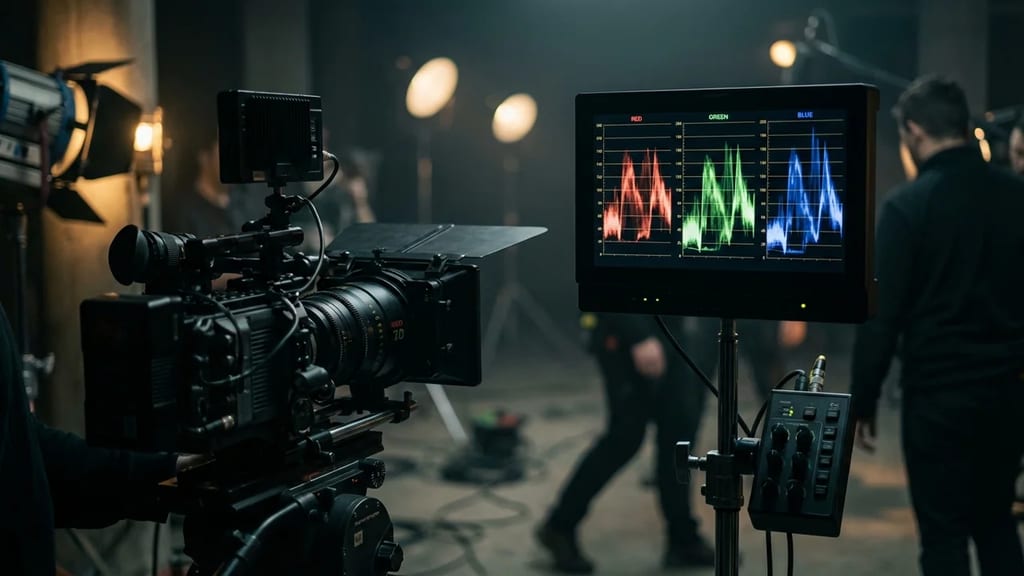
Parade: waveform display variant showing color channels (Red, Green, Blue) of a video signal side-by-side rather than overlaid.

Overview

The Parade (English: parade scope, often referred to as RGB Parade) is a measurement tool in image technology. It belongs to the family of waveform monitors and displays the individual channels of a video signal not superimposed, but side-by-side – in the classic variant, the three channels Red, Green, and Blue. This allows for a direct comparison of how strongly each color channel is distributed across the image.

In contrast to a pure luminance waveform, which only displays brightness, the Parade makes color deviations visible. It is a component of practically all color grading and editing programs (e.g., DaVinci Resolve, Adobe Premiere Pro, Vegas Pro) as well as professional monitoring hardware.

Display and Axes

The Parade is divided into several side-by-side areas, one for each channel:

  • Horizontal Axis: Within each channel, this represents the horizontal position in the image (from left to right).
  • Vertical Axis: This shows the level or brightness of the respective channel – from black (bottom) to white (top).

In addition to the common RGB Parade, many programs can display other signal forms, such as a Parade in the YCbCr/YUV color space, where Luma and the color difference channels appear separately side-by-side.

Use on Set and in Post

The Parade is one of the most important tools for white balance, color cast control, and color matching:

  • Detecting Color Cast: Unequal levels of the three channels in neutral image areas indicate a color cast.
  • White Balance: When measuring a neutral gray surface (e.g., a gray card), Red, Green, and Blue should be at the same level; deviations show in which direction correction is needed.
  • Shot Matching: When matching multiple shots, the direct comparison of channel levels helps maintain a consistent look across scenes.
From the crafts

Perspectives

Cinematographer

Ich plane Paradefahrten immer mit 1,5-fachem Puffer bei der Schienenlänge, da Schauspieler selten exakt ihre Markierungen treffen. Die kritische Phase liegt im ersten und letzten Bewegungsdrittel – hier bestimmt die Beschleunigungskurve des Dollys, ob die Parade organisch oder mechanisch wirkt. Bei Brennweiten über 100mm wird jede Micro-Erschütterung sichtbar, deshalb verwende ich pneumatische Dämpfungssysteme.

Director

Ich setze Paraden gezielt ein, um Hierarchien sichtbar zu machen – die Kamera folgt entweder dem dominanten Charakter oder offenbart durch die gleichmäßige Bewegung die Machtverhältnisse zwischen den Figuren. In "The West Wing" wurden Paradefahrten zum narrativen Markenzeichen für politische Macht und Dynamik. Eine gelungene Parade erzählt die Beziehungen der Charaktere allein durch ihre räumliche Anordnung zur Kamera.

Producer

Eine 100-Meter-Schienenanlage kostet 8.000-12.000 Euro Tagesmiete plus 15.000 Euro Setup-Kosten und bindet vier Techniker für zwei Tage. Steadicam-Paraden sind mit 2.500 Euro Tagesmiete günstiger, limitieren aber die Wiederholbarkeit bei Continuity-Problemen. Ich kalkuliere grundsätzlich 40% mehr Drehzeit für Paradesequenzen, da die Koordination zwischen Kamerabewegung, Schauspiel und Licht komplexe Proben erfordert.

More in the lexikon

Related terms

Test your knowledge

Quiz

1. Zu welchem Department gehört „Parade"?

2. Wie viele verschiedene Fachperspektiven bietet dieser Eintrag?

Report an error
From the Filmfarm ecosystem

Understand visual language, budget productions, connect crew.

The Lexikon is part of the Filmfarm ecosystem — alongside budgeting (FilmBalance), an industry magazine (FilmCircus) and crew networking (FilmCall, CrewMesh). One shared vocabulary for the whole production.

FilmFarm FilmRadarComing soonFilmPulseComing soonFilmNumbersComing soonFilmCapitalComing soonFilmLabComing soonFilmBalanceComing soonFilmCircusComing soon