Filmlexikon.
Support
Overcrank
Camera · Terms

Overcrank

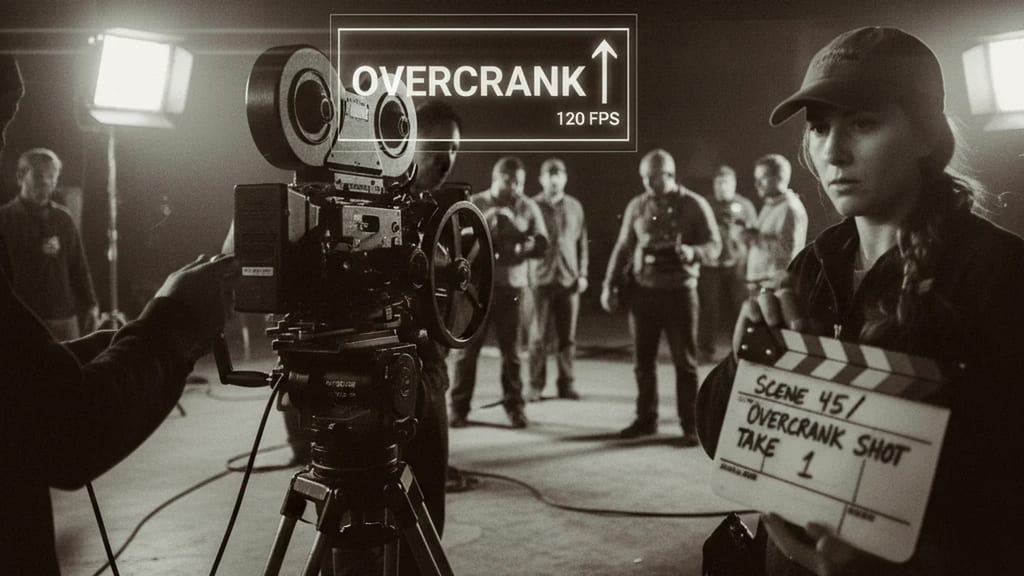
Murnau AI illustration
flow para roll take

High-speed cinematography technique capturing at elevated frame rates (48–120 fps instead of 24 fps) to create slow-motion effects during normal playback.

Technical Details

Standard feature film cameras operate at 24 fps, while overcranking typically occurs between 48-120 fps. Modern digital cinema cameras like the ARRI ALEXA 35 achieve up to 120 fps at full 4K resolution, and the RED V-RAPTOR manages 600 fps at 2K. High-speed specialty cameras like the Phantom TMX 7510 can reach up to 1.75 million fps at reduced resolution. The increased frame rate requires correspondingly more light, as the exposure time per frame is shortened – at 120 fps, five times more light is needed than at 24 fps.

History & Development

The technique originated in the silent film era around 1900, when cinematographers experimentally tried different cranking speeds. Georges Méliès consciously used slow-motion effects for the first time in "Le Voyage dans la Lune" in 1902. The first precise high-speed camera was developed by Bell Laboratories in 1936 for scientific purposes at 100,000 fps. Kodak's Ektachrome HR became the standard high-speed film from 1962 onwards. The transition to digital sensors from 2005 eliminated the cost limitations of film material and enabled longer high-speed recordings.

Practical Use in Film

Sam Peckinpah established slow motion as a dramatic stylistic device for depicting violence with "The Wild Bunch" in 1969. Zack Snyder systematically used 120 fps footage for fight scenes in "300" (2006). "The Matrix" (1999) combined overcranking with Bullet Time for iconic action sequences. Wes Anderson uses subtle overcranking (32 fps) for his characteristic aesthetic slowdown. Documentaries employ high-speed cameras for nature footage – BBC's "Planet Earth II" filmed big cats at 1000 fps.

Comparison & Alternatives

Overcranking differs from digital post-production slow motion through its actually higher temporal resolution without interpolation. While frame-blending software like Twixtor can create slow motion from 24 fps material, it produces artifacts with fast movements. Undercranking achieves the opposite – time-lapse by using a lower recording frame rate. Variable Frame Rate (VFR) allows for speed changes within a shot. Motion blur control through shutter angle adjustment further influences motion blur in high-speed recordings.

From the crafts

Perspectives

Cinematographer

Überkurbeln verändert meine Lichtplanung fundamental - bei 120 fps benötige ich fünfmal stärkere Beleuchtung und muss den Shutter-Angle entsprechend anpassen. Bewegungsunschärfe verschwindet fast komplett, weshalb ich bewusst mit Motion-Blur-Techniken arbeiten muss, um das Bild nicht zu steril wirken zu lassen.

Director

Zeitlupen intensivieren emotionale Momente und schaffen eine fast meditative Betrachtung von Bewegungen, die dem Publikum normalerweise entgehen würden. Ich setze Überkurbeln gezielt für Höhepunkte ein, da die Technik den subjektiven Zeitfluss der Charaktere visualisiert - Schock, Euphorie oder das berühmte "Leben zieht vor dem geistigen Auge vorbei".

Producer

High-Speed-Aufnahmen verdreifachen die Drehtage durch komplexere Beleuchtung und Kamera-Setup, während Spezialkameras 2.000-5.000 Euro Tagesmiete kosten. Der Datendurchsatz explodiert - eine Minute 4K-Material bei 120 fps erzeugt 500 GB, was Storage- und Postproduktionskosten erheblich steigert.

More in the lexikon

Related terms

Test your knowledge

Quiz

1. Zu welchem Department gehört „Überkurbeln"?

2. Wie viele verschiedene Fachperspektiven bietet dieser Eintrag?

Report an error
From the Filmfarm ecosystem

Understand visual language, budget productions, connect crew.

The Lexikon is part of the Filmfarm ecosystem — alongside budgeting (FilmBalance), an industry magazine (FilmCircus) and crew networking (FilmCall, CrewMesh). One shared vocabulary for the whole production.

FilmFarm FilmRadarComing soonFilmPulseComing soonFilmNumbersComing soonFilmCapitalComing soonFilmLabComing soonFilmBalanceComing soonFilmCircusComing soon