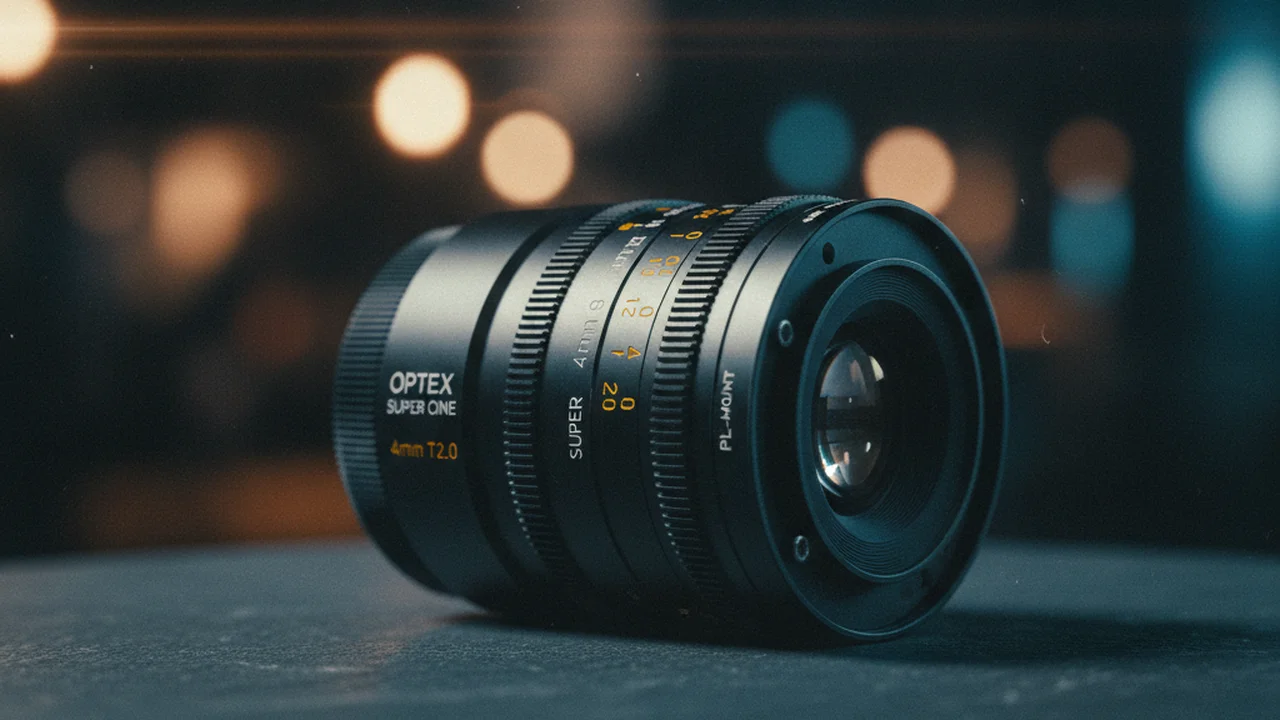
British ultra-wide range for Super 16 in 4, 5.5 and 8mm — a rectilinear design without fisheye distortion, in PL mount.
The Optex Super Cine is the answer to a question that only arises in Super 16: how to achieve an image width of less than eight millimeters without the picture becoming a hemisphere. In this format, an 8mm lens is approximately equivalent to a 20mm on 35mm film — what is considered wide-angle in Super 35 is already a normal focal length here. Anyone who wants truly wide quickly ends up with calculations that lead to a fisheye.
The Set
Three focal lengths: 4mm, 5.5mm, and 8mm, all with PL mount and Super 16 image circle, with a minimum focus distance of around 38 centimeters. Aperture specifications vary depending on the rental list: the 4mm and 5.5mm are predominantly listed as f/1.8, while the 5.5mm and 8mm are also listed as T2. This is not a contradiction, but the same value in two notations — f-stop is the geometric calculation, T-stop is the measured light transmission. Optex itself no longer maintains an active product page for the series; the most reliable information today comes from rental lists.
Rectilinear — That's the Whole Point
A fisheye achieves its angle of view by distorting straight lines. A rectilinear lens keeps straight lines straight and pays for this with stretching at the image edges. At 4mm on Super 16, both are extreme — but the difference remains crucial: architecture, a door frame, a horizon remain recognizable as what they are with the Optex. That's why the series is found in music video and commercial rentals, not in the effects department.
Where It's Used
Three applications appear repeatedly. First, handheld and gimbal shots, because at these focal lengths, almost nothing shakes in a way the viewer perceives as shake. Second, tight spaces — car interiors, bathrooms, elevators — where no other lens can provide an overview. Third, deliberately exaggerated close-ups, where a face in the foreground and an entire room behind it are simultaneously in the frame.
What You Need to Plan For
With these angles of view, half the crew will be in the shot if no one is careful. Light stands, dolly tracks, cables, the boom operator — everything that is comfortably just outside the frame at 25mm will be within it at 4mm. Lighting must be resolved from outside the room or as practical sources within the scene. And the depth of field is deceptive: at 4mm, at a medium aperture, practically everything more than a hand's breadth away is sharp — pulling focus ceases to be a creative tool.
Classification
Alongside the Super Cine, Optex also offers anamorphic adapters and the Excellence series. The Super Cine is the part of the program for which there is little competition to this day: the widest rectilinear glass for Super 16. Anyone needing a shot in this format today that goes wider than an Ultra 16 eight will hardly be able to bypass this series.
Related terms
Quiz
1. Was beschreibt „Optex Super Cine" am besten?
2. Zu welchem Department gehört „Optex Super Cine"?