Filmlexikon.
Support
Open Face
Lighting · Terms

Open Face

Murnau AI illustration
color temperature flow roll take

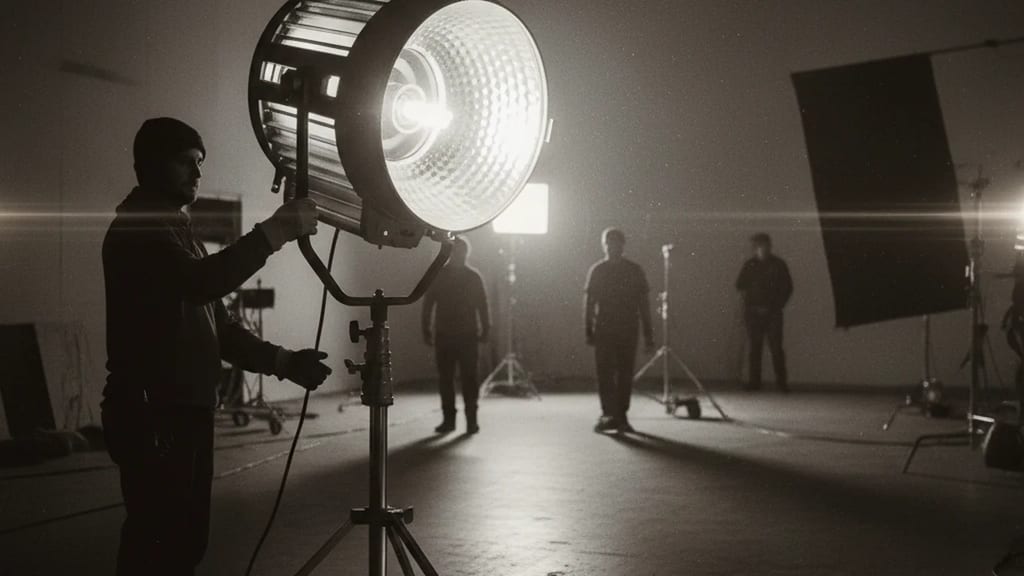
Spotlight without Fresnel lens using a parabolic reflector; lamp position adjustment varies beam angle from 15–65°.

Technical Details

Classic open-face fixtures utilize halogen incandescent bulbs from 650W to 10,000W, while modern LED variants achieve 100-1000W with comparable light output. The parabolic reflector, made of polished aluminum, focuses the light from the centrally positioned source. The flood-spot mechanism moves the lamp along the optical axis by 15-25mm, allowing the beam angle to be varied between 15 degrees (spot) and 65 degrees (flood). Typical examples include the Arri 650 Plus or Dedolight DLED4.

History & Development

Mole-Richardson developed the first professional open-face fixture, the "Mighty Mole," in 1963 for the emerging field of location filming. Ianiro followed in 1968 with the Redhead series, which became an industry standard. In the 1980s, Lowel and Arri introduced compact variants for the ENG segment. From 2010 onwards, LED open-face lights like the Aputure LS series revolutionized the market with lower heat generation and variable color temperature.

Practical Use in Film

Open-face fixtures are suitable as hard light sources for fill and effect lighting. Roger Deakins used Redheads for the characteristic backlight design in "No Country for Old Men" (2007). For exterior shots, they serve as fill light or to simulate artificial light in windows. The uneven beam creates natural-looking brightness gradients. Without diffusion, hard shadows with distinct edges are produced, which are used for dramatic lighting.

Comparison & Alternatives

In contrast to Fresnel fixtures, they lack uniform light distribution and stepless focusing. PAR lights offer harder, more directional light with less flexibility. Modern LED panels are increasingly replacing classic open-face lights due to better color rendering (CRI >95) and dimming without color temperature shift. For budget productions, halogen open-face fixtures remain relevant due to their low acquisition cost.
From the crafts

Perspectives

Cinematographer

Ich verwende Open-Face hauptsächlich als Gegenlicht oder hartes Seitenlicht, da die ungleichmäßige Charakteristik natürlicher wirkt als Fresnel-Licht. Die schnelle Spot-Flood-Verstellung ermöglicht mir spontane Anpassungen der Lichtführung, besonders bei engen Zeitplänen. Bei LED-Varianten schätze ich die konstante Farbtemperatur und das kühlere Arbeiten am Set.

Director

Open-Face-Licht hilft mir, psychologische Spannung zu erzeugen, da die harten Schatten und ungleichmäßige Ausleuchtung Unruhe vermitteln. Für Thriller oder Drama setze ich bewusst auf die raue Lichtqualität, während ich bei romantischen Szenen eher diffundierte Alternativen wähle. Die direkte, ungefilterte Lichtcharakteristik unterstützt authentische, documentary-style Atmosphären.

Producer

Open-Face-Scheinwerfer bedeuten niedrige Anschaffungskosten ab 200 Euro und geringen Stromverbrauch bei LED-Modellen, was die Generatorkosten reduziert. Die kompakte Bauweise spart Transportvolumen und Auf- bzw. Abbauzeit. Bei Halogen-Varianten kalkuliere ich höhere Stromkosten und Lampenwechsel ein, dafür entfallen teure Vorschaltgeräte.

More in the lexikon

Related terms

Test your knowledge

Quiz

1. Zu welchem Department gehört „Open Face"?

2. Wie viele verschiedene Fachperspektiven bietet dieser Eintrag?

Report an error
From the Filmfarm ecosystem

Understand visual language, budget productions, connect crew.

The Lexikon is part of the Filmfarm ecosystem — alongside budgeting (FilmBalance), an industry magazine (FilmCircus) and crew networking (FilmCall, CrewMesh). One shared vocabulary for the whole production.

FilmFarm FilmRadarComing soonFilmPulseComing soonFilmNumbersComing soonFilmCapitalComing soonFilmLabComing soonFilmBalanceComing soonFilmCircusComing soon