Filmlexikon.
Support
Off-Screen Sound
Sound · Terms

Off-Screen Sound

Murnau AI illustration
15lb sandbag 20 c stand 216 diffusion 250 diffusion 251 diffusion 25lb sandbag 35lb sandbag 40 c stand

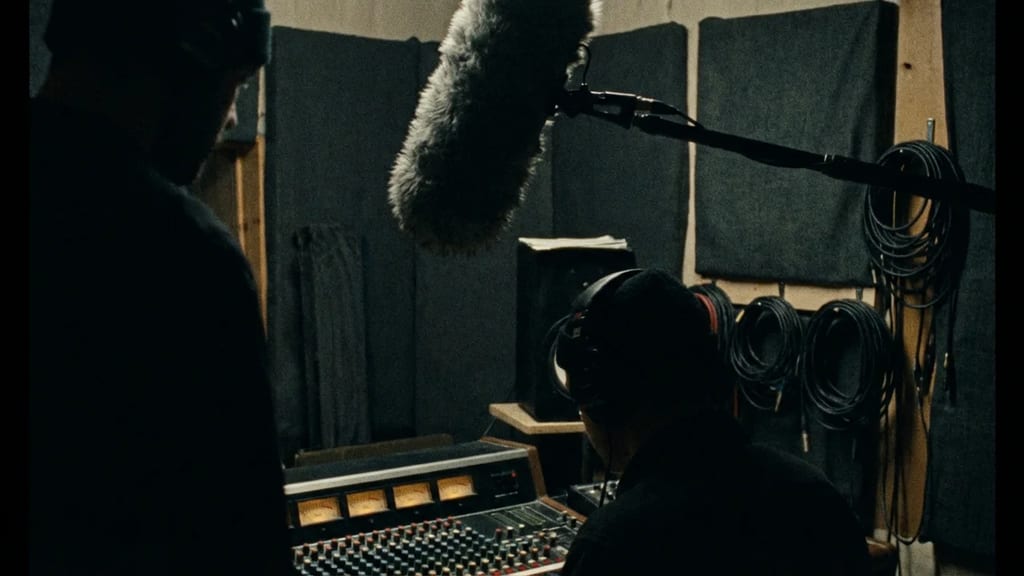
Sound from unseen sources within the scene, recorded with separate microphones outside camera view, typically mixed at reduced levels.

Technical Details

Recording is usually done with separate microphones outside the camera's field of view, often using directional microphones (Shure VP89, Sennheiser MKH416) at a distance of 1-3 meters from the sound source. In post-production, off-screen sounds are often placed on separate audio tracks (tracks 5-12 in standard 24-track systems) and processed with 10-15% reduced volume and slight attenuation of high frequencies (from 8 kHz) to suggest spatial distance. Since 2012, Dolby Atmos has enabled precise positioning of off-screen sources in three-dimensional space with up to 128 object positions.

History & Development

As early as 1927, Alan Crosland used off-screen singing as a narrative element in "The Jazz Singer." In 1931, Fritz Lang perfected the technique in "M" using Edvard Grieg's "In the Hall of the Mountain King" from unseen sources. Orson Welles systematically applied this in 1941 in "Citizen Kane" with innovative multi-track recording. The transition to multi-channel technology (from 1952 with CinemaScope) enabled precise directional assignment of off-screen sources via the surround channels.

Practical Application in Film

In "Jaws" (1975), Steven Spielberg uses off-screen sounds for 80% of the shark's presence without showing the animal. In "Arrival" (2016), Denis Villeneuve deliberately positions the alien communication outside the frame to amplify threat. Standard workflows involve recording during principal photography, with a separate sound recording team (2-3 people) operating in parallel to the camera. Synchronization is achieved via timecode with an accuracy of ±1 frame at 24fps.

Comparison & Alternatives

Off-screen sound fundamentally differs from voice-over (extra-diegetic) and soundtrack music through its spatial placement within the scene's reality. Acousmatic sound specifically describes noises of unknown origin, whereas off-screen sound refers to identifiable sources outside the frame. Modern alternatives include 360° audio for VR productions and object-based audio mixing, which allows for dynamic source positioning.
From the crafts

Perspectives

Cinematographer

Ich muss bei der Kaderwahl bewusst entscheiden, welche Schallquellen außerhalb des Bildes bleiben sollen, um dramatische Spannung zu erzeugen. Die Beleuchtung der Off-Screen-Bereiche reduziere ich oft auf 30-50% der Hauptausleuchtung, da dort nur die Tonaufnahme stattfindet. Meine Kamerabewegungen plane ich so, dass wichtige Off-Screen-Quellen nie zufällig ins Bild geraten.

Director

Off-Screen-Ton ist mein Werkzeug, um Räume größer wirken zu lassen und die Fantasie des Zuschauers zu aktivieren – das Ungesehene wirkt oft bedrohlicher als das Sichtbare. Ich setze ihn gezielt ein, um Erwartungshaltungen zu schaffen und später zu brechen, besonders in Thrillern. Die Timing-Abstimmung zwischen Bildschnitt und Off-Screen-Elementen bestimmt maßgeblich den Rhythmus meiner Szenen.

Producer

Off-Screen-Aufnahmen verlängern meinen Drehtag um durchschnittlich 45-60 Minuten, da separate Tonangeln und zusätzliche Mikrofonierung erforderlich sind. Die Postproduktionskosten steigen um 15-20%, weil präzise Soundmischung und räumliche Positionierung zeitaufwändiger sind. Gleichzeitig spare ich Kosten für aufwändige Set-Extensions oder teure Requisiten, die nur akustisch präsent sein müssen.

More in the lexikon

Related terms

Test your knowledge

Quiz

1. Was beschreibt „Off-Screen-Ton" am besten?

2. Zu welchem Department gehört „Off-Screen-Ton"?

3. Wie viele verschiedene Fachperspektiven bietet dieser Eintrag?

Report an error
From the Filmfarm ecosystem

Understand visual language, budget productions, connect crew.

The Lexikon is part of the Filmfarm ecosystem — alongside budgeting (FilmBalance), an industry magazine (FilmCircus) and crew networking (FilmCall, CrewMesh). One shared vocabulary for the whole production.

FilmFarm FilmRadarComing soonFilmPulseComing soonFilmNumbersComing soonFilmCapitalComing soonFilmLabComing soonFilmBalanceComing soonFilmCircusComing soon