Technical Details
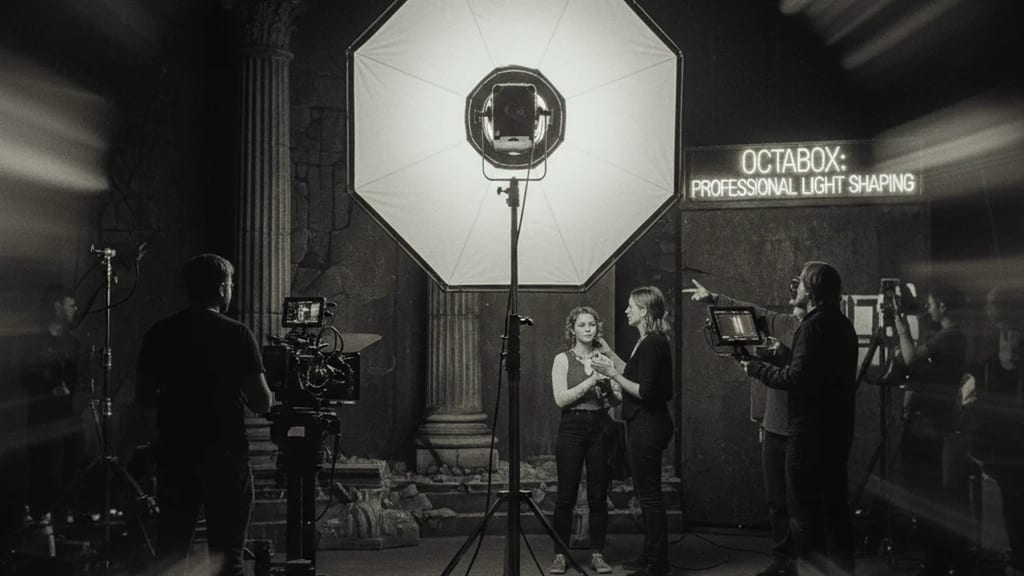
Octaboxes consist of a foldable metal frame with eight spokes, covered with reflective interior material (mostly silver or white) and a front diffusion made of heat-resistant ripstop nylon. The light distribution typically achieves a beam angle of 60° to 80° with a light loss of 1.5 to 2 stops compared to an open fixture. High-quality models feature double diffusion (inner baffle and front diffuser) and removable grids (Honeycomb Grid) for light concentration at 40° to 50°. Speed rings allow mounting on various lighting manufacturers such as Arri, Broncolor, or Profoto.
History & Development
The Octabox was developed in the late 1980s by the US manufacturer Photoflex, originally for portrait photography. In 1992, Chimera introduced the first professional film version with a reinforced frame for tungsten lights. With the advent of LED panels from 2008 onwards, lighter variants with reduced heat development emerged. Modern Octaboxes use quick-setup systems with fiberglass spokes, reducing setup time from 10 minutes to under 2 minutes.
Practical Use in Film
In "Her" (2013), cinematographer Hoyte van Hoytema used large Octaboxes as the main light for Joaquin Phoenix to illuminate his face softly and naturally. Typical workflow: positioning at a 45° angle to the camera as a key light, combined with a fill light from a smaller softbox or reflector. Advantage over rectangular softboxes: more natural catchlights and more even light distribution in close-ups. Disadvantage: bulky design makes positioning in tight sets difficult, longer setup time than with strip lights or Fresnels.
Comparison & Alternatives
Compared to rectangular softboxes, the Octabox creates rounder catchlights and softer transitions between light and shadow. Strip softboxes are better suited for full-body illumination, while Octaboxes excel in portraits and medium shots. Parabolic softboxes offer even more uniform light distribution but are more expensive and heavier. LED panels with softbox attachments are increasingly replacing traditional Octaboxes in documentary shoots but do not achieve their light output in feature film productions.