Definition
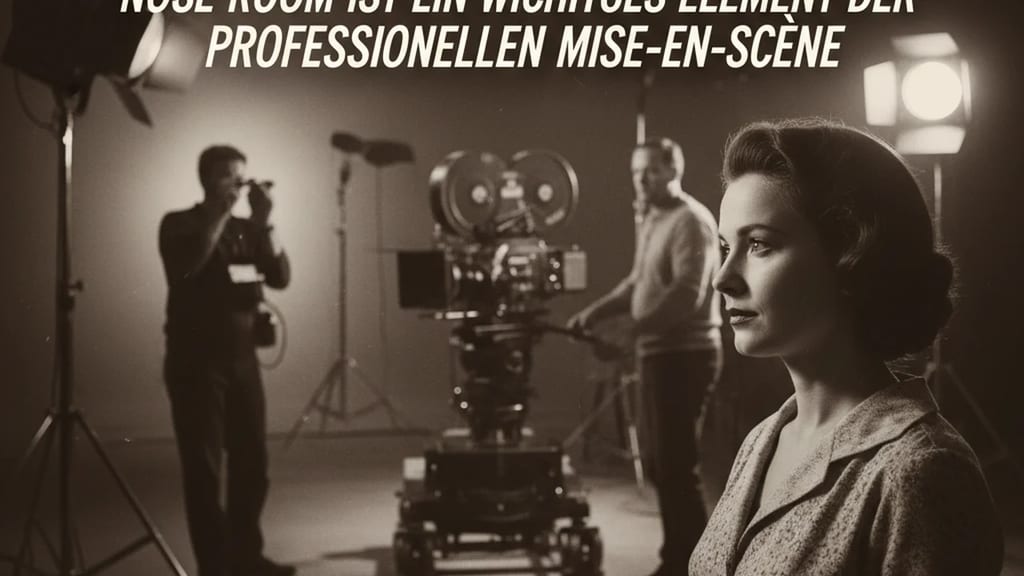
Nose room refers to the visual space in front of moving objects or persons within the frame, which anticipates the direction of movement. For a person in profile looking to the right, nose room encompasses the image area to the right of the face up to the edge of the frame. The standard measurement is in thirds of the total image width, with optimal nose room occupying between 1/3 and 1/2 of the horizontal image area.
Technical Details
Professional camera monitors display guide lines for nose room control at 33%, 40%, and 50% of the image width. In a 16:9 aspect ratio, minimal nose room corresponds to 0.59 aspect ratio units, and maximal to 0.89 units. Modern focus pulling systems like Preston FIZ consider nose room parameters for automatic focus tracking of moving subjects. Steadicam operators use mechanical markers on the monitor frame that define nose room limits for focal lengths between 25mm and 85mm with 35mm lenses.
History & Development
The term originated in 1962 in Hal Ashby's editing rooms at MGM, when editor Dede Allen codified systematic rules for movement space. Ashby's "The Landlord" (1970) first established mathematically defined nose room standards in the Hollywood mainstream. The French New Wave deliberately ignored these conventions – Godard's "Breathless" (1960) eliminates nose room in 47% of all movement shots. Digital compositing software since Adobe After Effects 5.0 (2002) allows for post-production nose room correction through edge extension.
Practical Application in Film
Paul Thomas Anderson's "There Will Be Blood" (2007) uses extremely reduced nose room (15% image width) for Daniel Plainview's isolation. Kubrick's "Barry Lyndon" (1975) maximizes nose room to 60% in candlelight scenes for baroque visual aesthetics. DoP Roger Deakins completely eliminates nose room in "No Country for Old Men" (2007) chase scenes to visualize distress. Handheld shots reduce nose room control by 23% compared to tripod setups, which is why Dogme 95 films developed a characteristic sense of spatial confinement.
Comparison & Alternatives
Headroom regulates vertical, while nose room regulates horizontal image composition. Lead room additionally encompasses objects and vehicles, whereas nose room exclusively concerns persons. Modern gimbal systems like DJI Ronin 4D automate nose room adjustment through AI-powered facial recognition. Virtual production with LED walls eliminates nose room issues in 180° pans, as the background allows for infinite expansion.