Technical Details
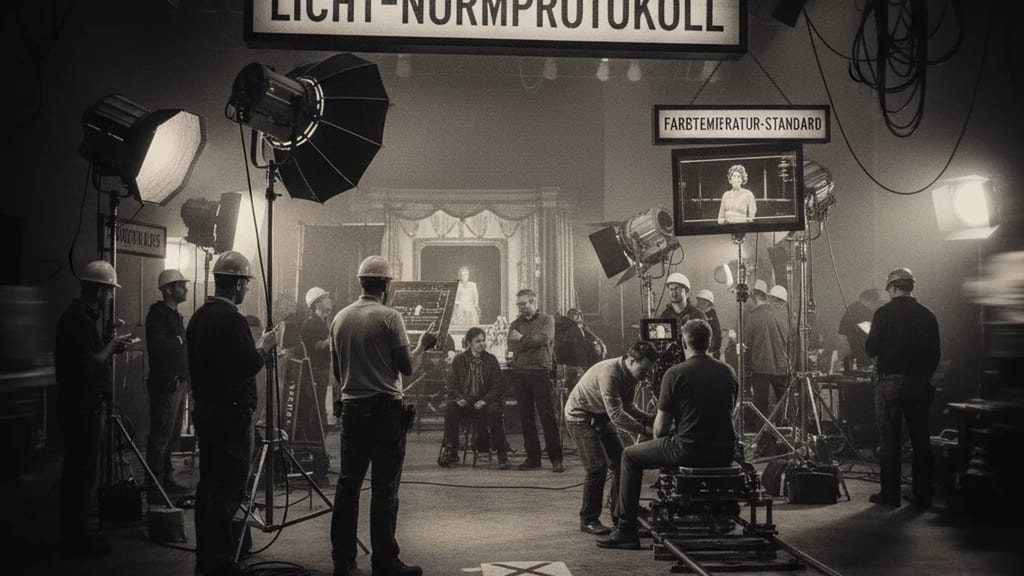
The most important norms include DIN 5033 for color measurement, ISO 7589 for illuminance measurement, and ANSI/IES RP-16 for studio lighting. Standard values define daylight at 5600K, artificial light at 3200K, and LED panels with CRI >95. Measuring instruments such as spectroradiometers capture values in 1nm steps between 380-780nm wavelength. Tolerances are typically ±100K for color temperature and ±5% for lux values. Modern Digital Imaging Technicians (DITs) use calibrated monitors according to Rec. 709 or Rec. 2020 standards to comply with norms.
History & Development
In 1928, the Academy of Motion Picture Arts and Sciences introduced the first lighting standards to ensure consistency between different studios. In 1953, the CIE (Commission Internationale de l'Éclairage) established international color standards. The introduction of tungsten-halogen lamps in 1959 first enabled precise 3200K reference values. With HD video in 2000, digital norms according to ITU-R BT.709 emerged, followed by HDR standards (ST 2084) from 2014 onwards. Current LED technology since 2018 requires extended norms for variable color temperatures between 2700K-6500K.
Practical Application in Film
Christopher Nolan used precise norm adherence in "Dunkirk" (2017) for seamless IMAX 65mm and 35mm integration with uniform 5600K exterior shots. Roger Deakins calibrated all LED panels to an exact 2800K for "Blade Runner 2049" (2017) to achieve a consistent neon atmosphere. Digital Intermediate (DI) Colorists use norms to match different camera systems – for example, Alexa Mini (3200K native) and RED Monstro (5600K native) in the same scene. Gaffers use norm-compliant light meters for reproducible setups during reshoots.
Comparison & Alternatives
Norms differ from subjective "film look" decisions through objective measurability. While creative color grading deliberately deviates from standards, norms ensure technical compatibility. Alternatives like ACES (Academy Color Encoding System) expand classic norms with cross-workflow color consistency. "False Color" modes on modern cameras visualize norm deviations in real-time. Traditional waveform monitors display IRE values (0-100), while modern scopes additionally show nits (cd/m²) for HDR norms.