Filmlexikon.
Support
Nikon Z Mount
Camera · Terms

Nikon Z Mount

Murnau AI illustration
flow para roll take

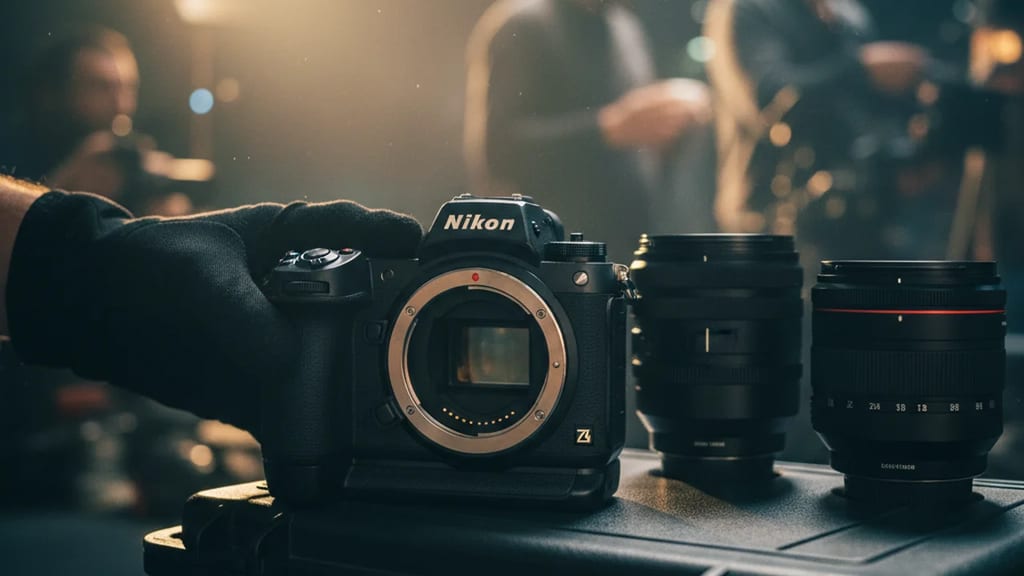
Nikon's mirrorless full-frame bayonet mount with 55mm diameter and 16mm flange distance, enabling lenses up to f/0.95 and 5-axis image stabilization.

Technical Details

The Z Mount operates with a maximum data transfer rate of 1.875 Mbps between lens and camera body. The bayonet mount features a robust metal construction with precision-engineered locking elements. Lenses can achieve aperture values down to f/0.95, as demonstrated by the Noct 58mm f/0.95. The mount supports mechanical and electronic in-body image stabilization (IBIS) with up to 5-axis compensation.

History & Development

Nikon introduced the Z Mount in August 2018 along with its first two full-frame mirrorless cameras, the Z7 and Z6. Development began in 2013 as a response to Sony's E-Mount system and Canon's later introduced RF Mount. In 2019, Nikon expanded the system to include the APS-C format with the Z50, followed by the professional Z9 in 2021. The mount design has enabled the development of extreme lenses from the outset, such as the 400mm f/2.8 TC VR S.

Practical Use in Film

Cinematographers use Z Mount cameras for documentaries and low-budget productions where the low weight and excellent low-light performance of the Z6II or Z9 are crucial. The FTZ adapter allows the use of classic F-Mount lenses, giving productions access to proven cine lenses. The Z9 offers internal 8K RAW recording and ProRes codecs, simplifying post-production workflows. Handheld shots particularly benefit from the 5-axis stabilization with longer focal lengths.

Comparison & Alternatives

Compared to Canon's RF Mount (54mm diameter, 20mm flange distance), the Z Mount offers marginal advantages in the optical design of extreme wide-angle lenses. Sony's E-Mount (46.1mm/18mm) remains more compact but limits the maximum lens aperture. The classic F-Mount (44mm/46.5mm) requires more complex optical designs for equivalent light gathering capabilities. For film productions, the Z system primarily competes with Sony's FX series and Panasonic's Lumix S cameras in the hybrid photo/video segment.

From the crafts

Perspectives

Cinematographer

Ich schätze die 16mm Auflagemaß des Z-Mounts, weil sie mir Zugang zu nativen f/0.95-Objektiven verschafft – das bedeutet echte Available-Light-Aufnahmen ohne Körnigkeit. Der große Mount-Durchmesser eliminiert Vignettierung selbst bei extremen Weitwinkeln, und die 5-Achsen-Stabilisierung der Z9 erspart mir in 80% der Handheld-Situationen das Gimbal.

Director

Für mich öffnet das Z-Mount neue narrative Möglichkeiten durch die exceptional Low-Light-Performance – ich kann Szenen in praktischer Dunkelheit drehen, die früher aufwendiges Lighting erfordert hätten. Die kompakte Bauform der Z-Kameras ermöglicht Einstellungen in beengten Räumen oder verdeckte Kamera-Positionen, die mit größeren Cinema-Kameras unmöglich wären.

Producer

Das Z-System reduziert meine Equipment-Kosten erheblich, da eine Z9 sowohl Photo-Unit als auch B-Kamera ersetzen kann – bei 8K-RAW-Qualität für unter 6.000 Euro. Der FTZ-Adapter schützt Investitionen in bestehende F-Mount-Objektive, und das geringere Gewicht spart Transport- und Crew-Kosten bei Location-Shoots.

More in the lexikon

Related terms

Test your knowledge

Quiz

1. Zu welchem Department gehört „Nikon Z-Mount"?

2. Wie viele verschiedene Fachperspektiven bietet dieser Eintrag?

Report an error
From the Filmfarm ecosystem

Understand visual language, budget productions, connect crew.

The Lexikon is part of the Filmfarm ecosystem — alongside budgeting (FilmBalance), an industry magazine (FilmCircus) and crew networking (FilmCall, CrewMesh). One shared vocabulary for the whole production.

FilmFarm FilmRadarComing soonFilmPulseComing soonFilmNumbersComing soonFilmCapitalComing soonFilmLabComing soonFilmBalanceComing soonFilmCircusComing soon