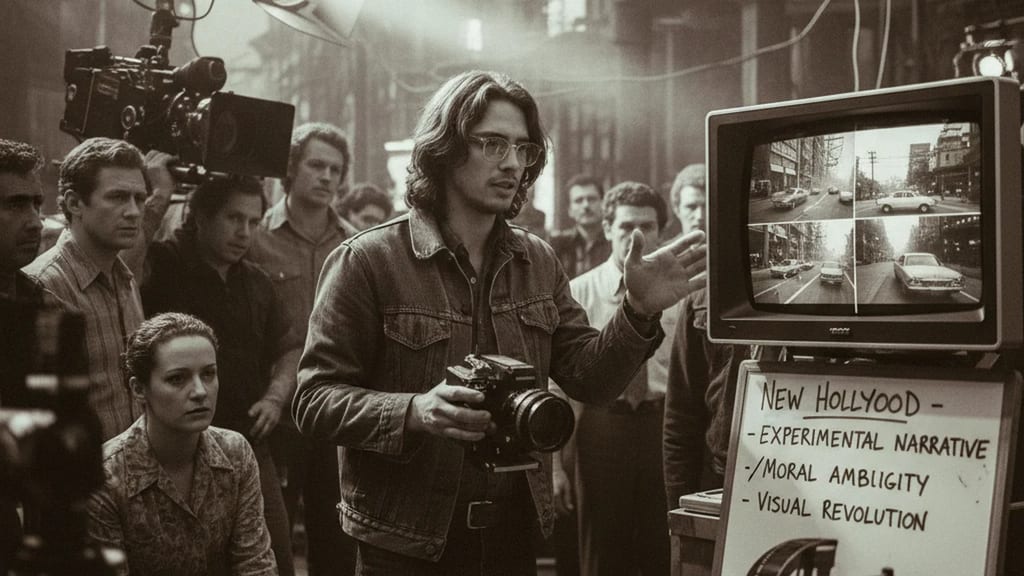
Definition & Origin
New Hollywood (approx. 1967-1980) was a cinematic revolution that transformed the classic studio system through artistically ambitious young filmmakers. After decades of commercially safe, morally conservative films, directors like Francis Ford Coppola, Martin Scorsese, and Steven Spielberg entered the industry with European avant-garde ideas, complex characters, and experimental techniques. They not only made artistic art films but also blockbuster successes that could earn millions. This was a revolution within commercialism – artistic ambition and financial profitability were no longer opposites.
Visual Characteristics & Stylistic Techniques
Moral Ambiguity: New Hollywood films do not depict simple good-vs-evil dualities but complex, morally ambiguous characters. The protagonist can be an anti-hero – a mafia boss (The Godfather), a paranoid obsessive marine (Taxi Driver), a selfish race car driver (Days of Thunder).
Experimental Narratives: The classic three-act structure is dissolved. Films can be fragmented, non-linear, or have open endings. "Mulholland Drive" and "Inland Empire" showcase non-linear narratives that force the audience to actively interpret.
Visual Innovation: New Hollywood utilized European cinema techniques – long takes (Bresson), zoom lenses (Godard), experimental lighting, extreme close-ups. The cinematography is not invisible but deliberately artistic.
Violence & Sexuality: New Hollywood depicted explicit violence and sexuality in a completely new way. The MPAA ratings system (from 1968) enabled this. The violence is not glorified but often tragic or absurd.
Music & Sound Design: The soundtrack became an artistic element. Elliot Goldenthal, John Williams, and others created innovative scores. Sound design became experimental – unconventional techniques, unusual instruments.
Aesthetic Self-Reflexivity: Films consciously refer to other films and art. Tarantino, the Coen Brothers, and others quote classics and experimental films.
Historical Context
New Hollywood emerged from several cultural factors:
- Economic Crises: Hollywood studios were in economic trouble in the 1960s. Spectacular productions like "Cleopatra" (1963) were financial disasters. The studios needed new talent and riskier projects.
- Cultural Revolution: The 1960s were decades of social and political upheaval – the Vietnam War, civil rights, the sexual revolution. Audiences wanted films that reflected this complexity, not classic escapism.
- European Influence: The French Nouvelle Vague and Italian Neorealism showed that artistic ambition and commerce could be combined. Young filmmakers studied Godard, Truffaut, Visconti and adapted European techniques for Hollywood.
- Cinephilia & Film Criticism: Film critics like Andrew Sarris promoted the "Auteur Theory" and popularized European art films. Young filmmakers were cinephiles who knew and loved European cinema.
- Technological Innovation: Improved cameras (Arriflex 16mm), portable sound recording, and refined lighting techniques enabled more mobile, innovative filmmaking.
Key Figures & Filmmakers
Francis Ford Coppola (1939-) – "The Godfather" (1972) and "The Godfather Part II" (1974) are paradigms of New Hollywood – commercial blockbuster successes with artistic sophistication and moral complexity.
Martin Scorsese (1942-) – "Taxi Driver" (1976), "Raging Bull" (1980), and "The Departed" (2006) showcase psychological depth, visual innovation, and complex male characters. His use of zoom lenses and fast-paced editing directly stems from European cinema.
Steven Spielberg (1946-) – "Jaws" (1975) and "E.T." (1982) defined the modern blockbuster. Spielberg combined Hollywood storytelling with European visual techniques and emotional authenticity.
Brian De Palma (1940-) – A master of visual thriller cinema, heavily influenced by Hitchcock and Italian Giallo films. His films feature experimental editing and visually spectacular sequences.
George Lucas (1944-) – "Star Wars" (1977) and "American Graffiti" (1973) demonstrated that science fiction and commercial blockbusters could be artistically complex.
Robert Altman (1925-2006) – An experimental filmmaker who utilized fragmented narratives, overlapping dialogue, and critical perspectives on American institutions ("M*A*S*H", "Nashville").
Key Films & Masterpieces
The Godfather (1972, Francis Ford Coppola) – A blockbuster about a mafia family. The film combines suspense and moral complexity – no simple good-vs-evil duality. Coppola employed long, contemplative takes, subtle lighting (Gordon Willis' "Prince of Darkness" cinematography), and European narrative techniques within a Hollywood blockbuster.
Taxi Driver (1976, Martin Scorsese) – A psychological portrait of an obsessive, deranged man. The film is visually innovative (zoom lenses, fast-paced editing), narratively deliberately limited (we see the world only through Travis's psychotic perception), and morally ambivalent (the protagonist is unsympathetic).
Raging Bull (1980, Martin Scorsese) – A film about a violent boxer. The film is visually experimental (black and white cinematography, innovative camera angles) and psychologically complex. The protagonist's sexual violence and jealousy are depicted without sentiment.
Jaws (1975, Steven Spielberg) – A thriller about a shark terrorizing a town. The film is formally innovative – long sequences without showing the shark, subtly building suspense, innovative sound design and editing.
American Graffiti (1973, George Lucas) – A film about teenagers in a California town at the end of a summer. The film uses innovative editing, diegetic music, and a fragmented narrative to create a bittersweet atmosphere.
Network (1976, Sidney Lumet) – A satirical thriller about television and commerce. The film is visually and narratively experimental, with fast-paced editing and desaturated color.
Chinatown (1974, Roman Polanski) – A neo-noir thriller with experimental editing and moral darkness. The film depicts the impossibility of ethical action in a corrupt society.
Technical Aspects & Cinematic Innovation
New Hollywood implemented techniques in blocks:
- Zoom Lenses (especially by Scorsese) for dynamic spatial composition
- Mobile Camera and handheld shots for documentary authenticity
- Experimental Editing with rapid cuts and visual effects
- Color Grading & Desaturation for emotional impact
- Innovative Sound Design with synthetic sounds and experimental music
- Practical Effects & Stunts for more realistic action sequences
Influence & Legacy
New Hollywood had profound effects on global cinema:
- Blockbuster Aesthetic: New Hollywood proved that commercial blockbusters could be artistically complex. This influenced generations of filmmakers worldwide.
- Auteur Cinema in the Mainstream: The studio system was replaced by the auteur system, where individual directors retained artistic control.
- Genre Innovation: New Hollywood showed that genre films (thrillers, crime, science fiction) could possess artistic depth.
- Global Influences: Filmmakers worldwide adopted New Hollywood techniques – Asian action filmmakers, Indian blockbuster directors, and European experimental filmmakers all showed New Hollywood influences.
Comparison & Contextualization
vs. Classic Hollywood: While classic Hollywood was morally prescriptive and validated the status quo, New Hollywood depicted moral ambiguity and critiqued societal institutions.
vs. French Nouvelle Vague: While the Nouvelle Vague radicalized European art film conventions, New Hollywood adapted these techniques for commercial blockbusters.
vs. Italian Neorealism: While Neorealism depicted working-class authenticity, New Hollywood often focused on complex, psychologically deep characters from various social strata.
End of the Era & Aftermath
The New Hollywood era ended in the early 1980s with the rise of blockbuster franchises (Star Wars, Indiana Jones) and the so-called "Jaws-E.T. era," where studios focused solely on massive blockbuster successes. The mid-1980s saw a return to genre filmmaking without the moral complexity and artistic ambition of the New Hollywood era.
But the legacy remains alive – contemporary filmmakers like the Coen Brothers, Paul Thomas Anderson, and David Fincher work directly in the New Hollywood tradition, combining artistic ambition with mainstream success.