Filmlexikon.
Support
ND Gel
Lighting · Equipment

ND Gel

Murnau AI illustration
15lb sandbag 20 c stand 216 diffusion 250 diffusion 251 diffusion 25lb sandbag 35lb sandbag 40 c stand

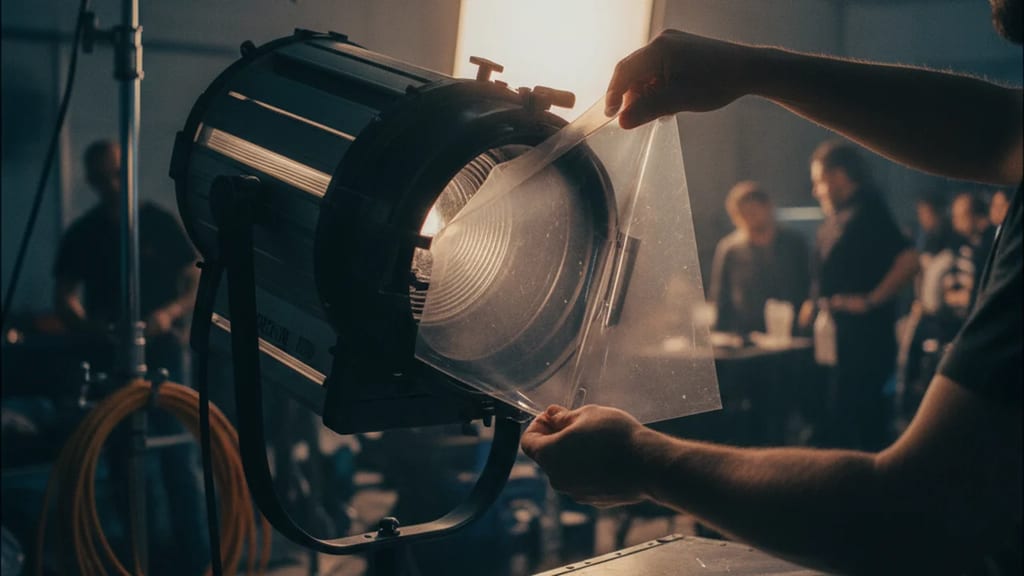
Neutral density gel for lighting instruments; reduces light output without altering color temperature. Available in stops from ND 0.3 to ND 1.8 (50% to 1.56% transmission).

Technical Details

Standard ND gels are 0.1mm to 0.3mm thick and consist of a polyester base material with carbon particles or metallic coatings. Common density levels include 0.3 ND (50% light reduction), 0.6 ND (25%), 0.9 ND (12.5%), 1.2 ND (6.25%), and 1.8 ND (1.56%). Spectral transmission varies between 400-700nm by a maximum of ±2%, keeping color shifts below critical thresholds. Lee Filters offers ND gels in rolls 762mm wide, while Rosco uses 610mm. Heat-resistant variants can withstand up to 120°C continuous load.

History & Development

Kodak developed the first photographic ND filters from optical glass for still cameras in 1952. Lee Filters launched flexible ND gels for film production in 1967, initially only in 0.9 ND strength. In 1974, Rosco expanded its range to include continuously variable ND gels. The introduction of Inconel-coated gels in 1989 significantly improved heat resistance. Since 2010, new sputtering coating processes have enabled extremely uniform density values with tolerances below 1%.

Practical Use in Film

In "Blade Runner 2049" (2017), Roger Deakins used ND 1.2 gels in front of tungsten sources to consistently work at T2.8 aperture during daylight shots. ND gels are standard when HMI lights need to be dimmed for night scenes, as electronic dimming causes color temperature shifts. The workflow requires precise light measurement after applying the gel, as manufacturer specifications can deviate by up to 0.2 stops. Reflections on the gel surface are a disadvantage, creating ghost images at unfavorable angles.

Comparison & Alternatives

Unlike CTO/CTB gels, ND material exclusively changes the amount of light, not the color temperature. Scrim fabric reduces light by fixed 0.5 or 1.0 stops, but offers no intermediate steps. Electronic dimmers operate steplessly but significantly shift Kelvin values with tungsten lamps. Variable ND filters on the lens allow continuous adjustment but exhibit color casts and vignetting at extreme settings. ND gels remain the first choice for critical color grading projects when spectral neutrality is crucial.
From the crafts

Perspectives

Cinematographer

Ich verwende ND-Folien hauptsächlich, um bei Außenaufnahmen mit konstanter T-Blende arbeiten zu können, ohne die Schärfentiefe zu verlieren. Besonders bei Available-Light-Szenen lassen sich so HMI-Spots exakt an die vorhandene Beleuchtung anpassen, ohne dass ich die Farbtemperatur korrigieren muss. Der Nachteil liegt in der zusätzlichen Reflexionsebene, weshalb ich bei kritischen Winkeln auf Scrim-Gewebe ausweiche.

Director

ND-Folien ermöglichen mir, die Lichtstimmung einer Szene präzise zu kontrollieren, ohne die Farbdramaturgie zu beeinträchtigen. Wenn ich beispielsweise in einer Innenszene subtile Helligkeitsabstufungen zwischen verschiedenen Bereichen schaffen will, kann ich gezielt einzelne Lichtquellen abdunkeln. Dadurch entstehen natürlich wirkende Kontraste, die der emotionalen Entwicklung der Charaktere folgen, ohne dass künstliche Farbverschiebungen die Atmosphäre stören.

Producer

ND-Folien kosten etwa 8-12 Euro pro Quadratmeter und amortisieren sich schnell gegenüber zusätzlichen Dimmern oder Lampenwechseln. Ein Standard-Set mit sechs verschiedenen Dichtestufen deckt 80% aller Drehanforderungen ab und passt in jeden Grip-Truck. Die kurzen Umbauzeiten von 2-3 Minuten pro Scheinwerfer halten Standzeiten gering, während die Wiederverwendbarkeit die laufenden Kosten minimiert.

More in the lexikon

Related terms

Test your knowledge

Quiz

1. Was beschreibt „ND-Folie" am besten?

2. Zu welchem Department gehört „ND-Folie"?

3. Wie viele verschiedene Fachperspektiven bietet dieser Eintrag?

Report an error
From the Filmfarm ecosystem

Understand visual language, budget productions, connect crew.

The Lexikon is part of the Filmfarm ecosystem — alongside budgeting (FilmBalance), an industry magazine (FilmCircus) and crew networking (FilmCall, CrewMesh). One shared vocabulary for the whole production.

FilmFarm FilmRadarComing soonFilmPulseComing soonFilmNumbersComing soonFilmCapitalComing soonFilmLabComing soonFilmBalanceComing soonFilmCircusComing soon