Technical Details
Daylight provides an average of 100,000 lux in direct sunlight, 20,000 lux in shade, and 1,000 lux on an overcast day. Moonlight reaches only 0.25 lux during a full moon. Exposure times vary between 1/125s at f/2.8 (sunlight) and several seconds at f/1.4 (moonlight) at ISO 800. Candlelight produces approximately 12.5 lux at a distance of one meter. The spectral composition of natural light sources shows continuous gradients without the peaks of artificial light sources, leading to more authentic color rendition.
History & Development
In 1895, the Lumière brothers shot their first films exclusively using natural light, as electric lighting was not yet available. In 1915, D.W. Griffith first deliberately used natural light for dramatic effects in "The Birth of a Nation." In 1978, Terrence Malick revolutionized the use of the "Magic Hour" – the 20-minute twilight phase with an optimal color temperature of 3,200K – with "Days of Heaven." In 1975, Stanley Kubrick filmed "Barry Lyndon" entirely by candlelight, using special NASA lenses with an aperture of f/0.7.
Practical Application in Film
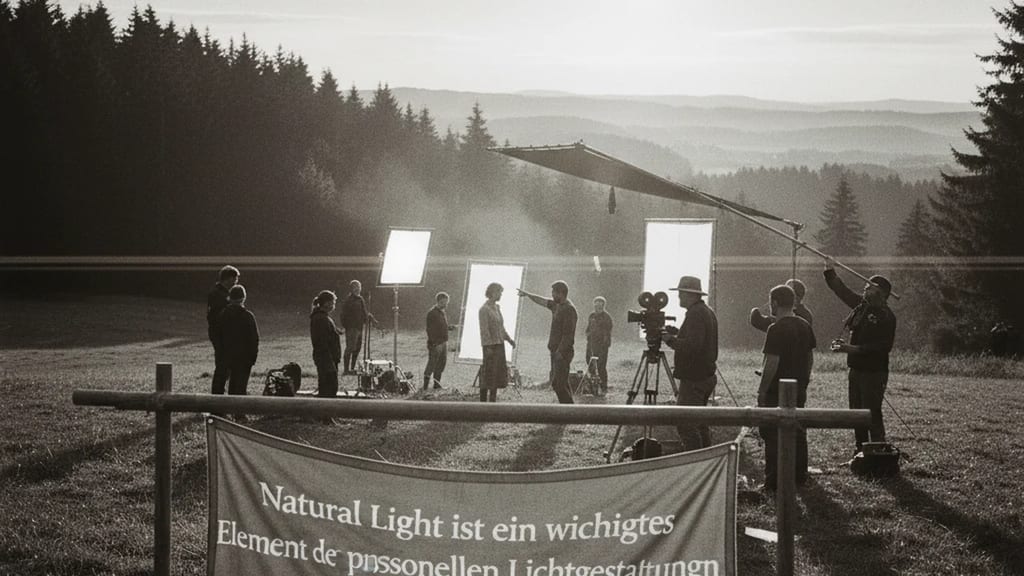
In "The Revenant" (2015), Emmanuel Lubezki completely eschewed artificial light, using only available daylight, which resulted in an average shooting day of only 90 minutes. Chloé Zhao consistently relied on natural lighting in real locations for "Nomadland" (2020). Dispensing with lighting equipment allows for more spontaneous camera work and more authentic acting performances, but requires precise weather forecasts and flexible shooting schedules. Post-production is usually limited to minimal color correction to preserve the natural look.
Comparison & Alternatives
Unlike LED panels (5,600K) or HMI lights (6,000K), natural light offers completely uniform illumination without hotspots or color shifts. Bounce boards and diffusers are already considered forms of artificial light shaping. Available Light differs by incorporating existing artificial light sources such as streetlights or neon signs. Modern alternatives like SkyPanels can simulate natural light but do not achieve its spectral authenticity and spatial softness.