Cinematographer
Aus DoP-Perspektive ist dieses Element essentiell für die visuelle Gestaltung. Es ermöglicht mir die gewünschte Farbstimmung und das ästhetische Bild konsistent umzusetzen.
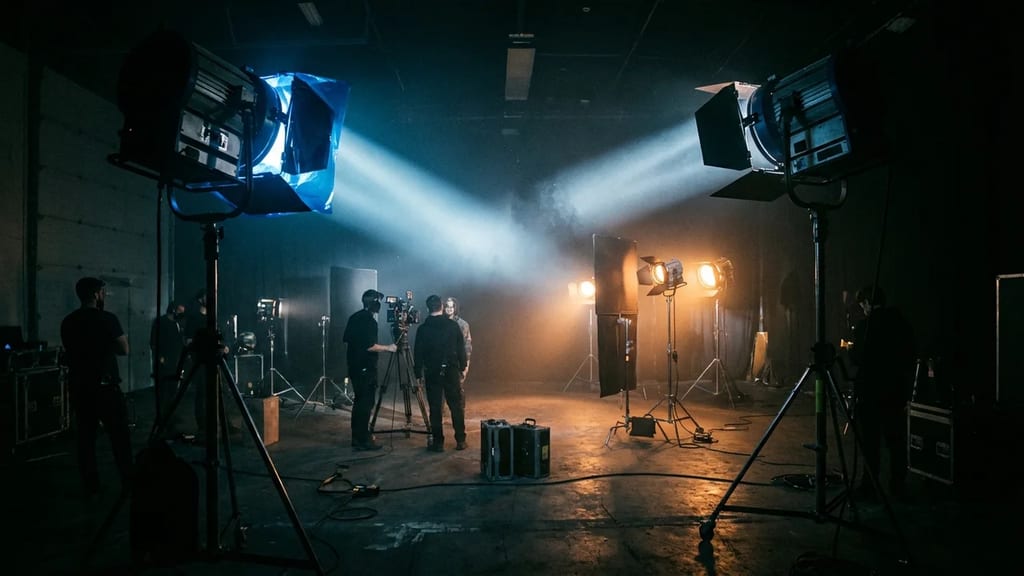
Light sources at 5600K color temperature matching natural daylight, enabling direct mixing with sunlight without filtration.
Daylight Balanced (German: tageslichtabgestimmt) describes not a single fixture or brand, but a characteristic of film lighting: the light source emits light whose color temperature corresponds to average daylight – conventionally set at around 5600 Kelvin. Thus, "Daylight Balanced," along with "Tungsten Balanced" (around 3200 Kelvin), forms one of the two standard lighting regimes to which practically everything in film and TV lighting is referenced.
The purpose of balancing is clean white balance: if the camera is set to 5600 K and illuminated exclusively with daylight-balanced sources, white tones appear neutral, without a color cast. Conversely, if daylight-balanced light is mixed with tungsten light without correction, color shifts occur (tungsten appears orange/warm in daylight white balance, daylight appears blue in tungsten white balance).
Tungsten fixtures (incandescent filament, around 3200 K) can be boosted to daylight using CTB gel (Color Temperature Blue); however, this involves a significant loss of light, which is why daylight-balanced sources like HMI are usually used from the outset for true daylight.
Daylight-balanced sources are used when the image is set to a daylight white balance – for example, during daytime exterior shoots, for fill light in sunlight, for window spill in interiors, or when the set is intended to appear deliberately cool/neutral. To match a daylight-balanced source to tungsten light, conversely, CTO gel (Color Temperature Orange) is applied, which lowers the color temperature towards 3200 K.
| Light Regime | Reference Color Temperature | Correction to Other Regime |
|---|---|---|
| Daylight Balanced | approx. 5600 K | CTO gel lowers towards 3200 K |
| Tungsten Balanced | approx. 3200 K | CTB gel raises towards 5600 K |
The Kelvin values indicated are industry conventions; actual sources may deviate, which is why a color meter is used on set for control.
Aus DoP-Perspektive ist dieses Element essentiell für die visuelle Gestaltung. Es ermöglicht mir die gewünschte Farbstimmung und das ästhetische Bild konsistent umzusetzen.
Diese professionelle Lösung erhöht die Produktionseffizienz und reduziert Post-Production-Anforderungen. Sie ermöglicht flexible, schnelle Anpassungen während des Drehs.
Als Gaffer ist dies ein unverzichtbares Werkzeug meines täglichen Handwerkszeugs. Es ermöglicht mir professionelle Lichtkontrolle und schnelle Anpassungen auf Set, was Zeit spart und Qualität sichert.
1. Zu welchem Department gehört „Tageslicht-abgestimmt"?
2. Wie viele verschiedene Fachperspektiven bietet dieser Eintrag?
The Lexikon is part of the Filmfarm ecosystem — alongside budgeting (FilmBalance), an industry magazine (FilmCircus) and crew networking (FilmCall, CrewMesh). One shared vocabulary for the whole production.