Filmlexikon.
Support
Music Editor
Editing · Roles

Music Editor

Murnau AI illustration
editor flow roll

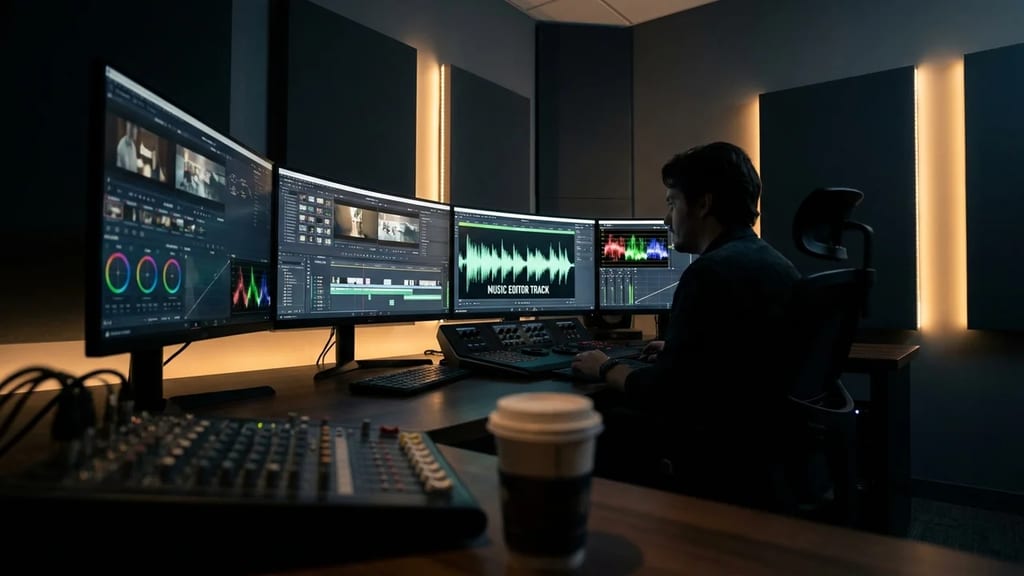
Edits and synchronizes film music frame-accurately to picture using Pro Tools and SMPTE timecode, managing up to 150 audio tracks per production.

Technical Details

Music Editors work with DAW software (Digital Audio Workstations) like Pro Tools, Logic Pro, or Cubase, with Pro Tools dominating the industry standard at 96 kHz/24-bit. They use SMPTE timecode for frame-accurate synchronization (24, 25, or 29.97 fps depending on production standard) and create cue sheets with hit points to 1/100th of a second accuracy. Typical workflows include creating temp tracks, spotting new music, and conforming to picture edits. Specialized plugins like SynchroArts VocAlign or Celemony Melodyne are used for complex timing adjustments.

History & Development

The role emerged in 1927 with "The Jazz Singer" as the first successful sound film, initially relying on mechanical synchronization via records. In 1935, RKO Studios introduced the first official Music Editor position. The transition to magnetic 35mm fullcoat sound in the 1950s revolutionized workflows, followed by the digital shift starting in 1990 with systems like Fairlight and later Pro Tools. Since 2010, cloud-based collaboration tools have enabled remote teamwork between composers, editors, and sound studios.

Practical Application in Film

John Williams' scores for "Star Wars" (1977) required 47 separate music cues totaling 74 minutes, which Music Editor Kenneth Wannberg had to adapt to precise picture edits. For "Mad Max: Fury Road" (2015), Tom Ozanich synchronized over 300 music segments with practical stunts. Modern productions like "Dune" (2021) combine orchestral recordings with electronic elements, with the Music Editor managing up to 150 separate audio tracks. The average editing time is 8-12 weeks for a feature-length film.

Comparison & Alternatives

The Music Editor differs from the Sound Editor by focusing exclusively on musical elements, whereas the Re-Recording Mixer combines all sound layers. Unlike the Composer, the Music Editor is not involved in creative conception but rather technical implementation. Small productions often forgo a dedicated Music Editor, assigning the tasks to the Sound Designer or Composer themselves. AI-based tools like LANDR or Amper Music are increasingly automating simple synchronization tasks.
From the crafts

Perspectives

Cinematographer

Als DoP muss ich bereits beim Dreh an die spätere Musiksynchronisation denken, besonders bei Tanzszenen oder Musikvideos, wo ich exakte BPM-Zahlen für Kamerabewegungen brauche. Der Music Editor hilft mir später dabei, rhythmische Schnitte mit meinen geplanten Einstellungswechseln abzugleichen. Bei Actionsequenzen koordiniere ich Slow-Motion-Aufnahmen (120fps) direkt mit ihm, damit die Musikdramatik optimal zur verlangsamten Bildwirkung passt.

Director

Ich arbeite intensiv mit dem Music Editor am Temp Track, um Schauspielern und Schnittteam meine emotionale Vision zu vermitteln, bevor der finale Score existiert. Er übersetzt meine narrativen Ideen in präzise Timing-Vorgaben für den Komponisten – wenn ich eine Spannungskurve über 3 Minuten 47 Sekunden brauche, erstellt er dafür das exakte musikalische Timing-Gerüst. Seine Arbeit entscheidet darüber, ob ein emotionaler Höhepunkt beim Publikum funktioniert oder um entscheidende Frames verfehlt wird.

Producer

Ein erfahrener Music Editor spart mir durchschnittlich 15-20% der Postproduktionszeit, da er Änderungswünsche ohne kostspielige Orchester-Nachaufnahmen umsetzt – reine Studiomiete kostet 800-1200€ pro Tag. Er verhindert teure Verzögerungen durch rechtzeitige Spotting-Sessions und reduziert die benötigten Mixing-Tage von 8 auf 5-6 Tage. Bei Budgets ab 500.000€ ist seine Position obligatorisch, darunter oft als Freelancer für 3000-5000€ pro Woche buchbar.

More in the lexikon

Related terms

Test your knowledge

Quiz

1. Zu welchem Department gehört „Music Editor"?

2. Wie viele verschiedene Fachperspektiven bietet dieser Eintrag?

Report an error
From the Filmfarm ecosystem

Understand visual language, budget productions, connect crew.

The Lexikon is part of the Filmfarm ecosystem — alongside budgeting (FilmBalance), an industry magazine (FilmCircus) and crew networking (FilmCall, CrewMesh). One shared vocabulary for the whole production.

FilmFarm FilmRadarComing soonFilmPulseComing soonFilmNumbersComing soonFilmCapitalComing soonFilmLabComing soonFilmBalanceComing soonFilmCircusComing soon