Technical Details
Montage sequences operate with cutting rates of 20-120 cuts per minute, significantly higher than the standard cutting cadence of 4-8 cuts per minute in narrative scenes. Image composition often does not follow the 180-degree rule, as spatial continuity is sacrificed for emotional or thematic connections. Three main variants exist: Metric Montage (fixed cutting intervals), Rhythmic Montage (oriented by image content), and Intellectual Montage (conceptual connections). Audio-wise, 32-48 kHz sampling rates are typically used for synchronous musical accompaniment.
History & Development
Sergei Eisenstein developed the systematic montage theory in 1925 in "Battleship Potemkin," demonstrated in the famous Odessa Steps sequence with 155 shots in 7 minutes. Hollywood adapted the technique from 1930 onwards for training sequences and time jumps. In 1976, "Rocky" set new standards for 80 American sports films of the following decade with its training montage. The digital revolution from 1995 onwards enabled more complex compositing montages with up to 200 layers per shot, as systematically employed for the first time in "The Matrix" (1999).
Practical Application in Film
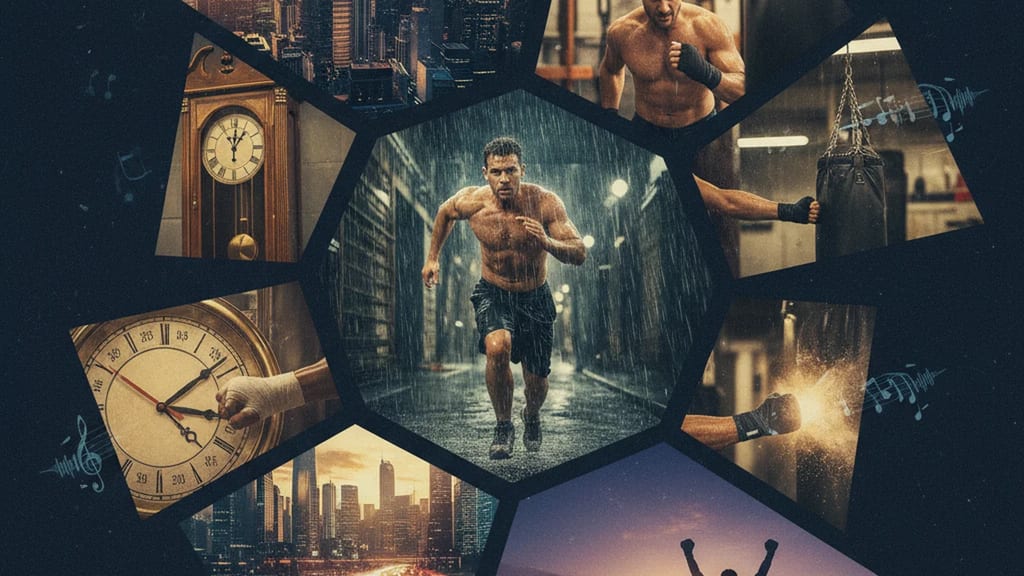
"Goodfellas" (1990) uses a 3-minute cocaine paranoia montage with 47 cuts of varying focal lengths (14mm to 200mm). Training montages typically follow the 4-act structure: Preparation (20%), Effort (40%), Crisis (20%), Triumph (20%). Action montages, as seen in "Mad Max: Fury Road" (2015), use geographical landmarks every 8-12 cuts to avoid spatial confusion. Emotional montages work with color temperature shifts of up to 2000K between shots for psychological impact.
Comparison & Alternatives
Montage sequences differ from jump cuts through their deliberate discontinuity and from cross-cutting through temporal rather than spatial parallelism. Modern alternatives include the single-take sequence (as in "1917") or split-screen montage ("24," "Kill Bill Vol. 1"). While classical montage relies on cutting rhythm, contemporary montage utilizes digital transitions and motion graphics. The choice depends on budget constraints: montage sequences require 40-60% less shooting time than narrated scenes of equal narrative density.