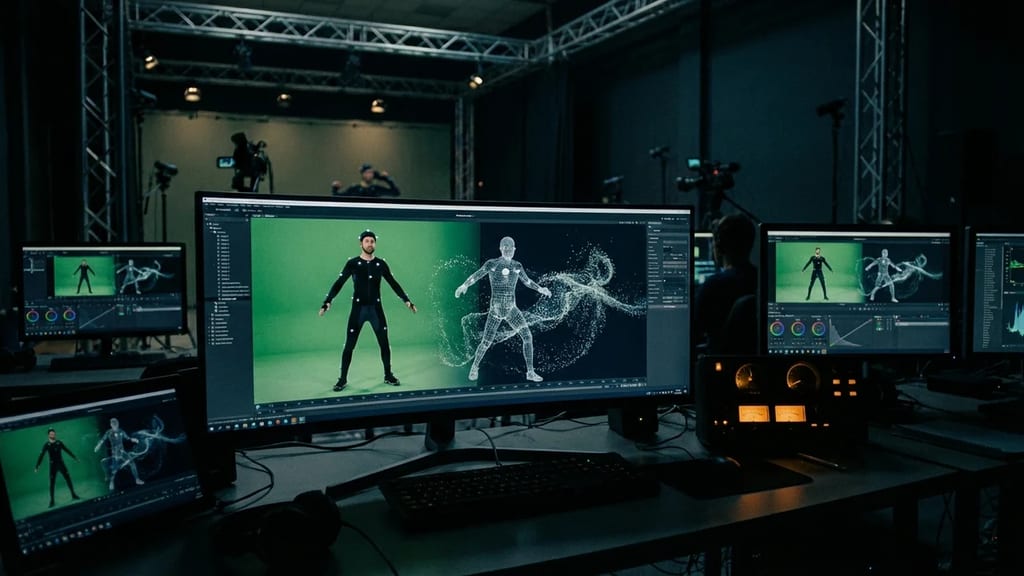
Overview
MoCap is the common abbreviation for Motion Capture, also called Performance Capture in film production when facial expressions and fingers are also captured. The movements of a real performer are captured and translated into a digital skeleton or rig animation, which is then applied to a computer-generated character. MoCap is therefore a process at the interface between shooting and the VFX pipeline, not a single device or a lighting tool in the classic sense.
The recording area where the performer acts and is captured by cameras is called the Volume (Capture Volume). It is surrounded by multiple synchronized cameras that cover the space from different angles, ensuring that every point is seen by multiple cameras as continuously as possible (reduction of occlusion).
Methods and Systems
In film and game production, three main approaches are primarily used:
- Optical, passive (marker-based): The most common approach in large productions. The performer wears a suit with retro-reflective spherical markers. Infrared cameras emit IR light, which is reflected back by the markers; the 3D position of each marker is calculated via triangulation from the 2D views of multiple cameras. Well-known manufacturers include Vicon, OptiTrack, Qualisys, and Motion Analysis.
- Inertial (sensor-based): The suit contains IMU sensors (accelerometers, gyroscopes) that stream rotation and acceleration. These systems are portable, quicker to set up, and independent of sightlines to cameras, but tend to drift.
- Markerless: Based on multi-camera video, computer vision, and machine learning, motion is estimated without attached markers.
Usage and Conditions on Set
For optical systems, a sufficiently large volume is necessary, as small areas promote occlusion and inaccurate triangulation. The floor should be matte and non-reflective to avoid optical interference.
From a lighting and set perspective, the most important requirement is the control of infrared and light sources, as optical MoCap systems operate in the IR spectrum:
- Avoid direct sunlight and flickering fluorescent light as much as possible, as they can overload IR sensors and lead to marker dropouts.
- Prefer even, diffuse ambient light without strong IR components to minimize reflections and shadows.
- Reflective surfaces, bare metal parts, and shiny props can be mistakenly recognized as markers by the cameras.
Optical systems operate with high frame rates (often in the range of approximately 120 to 240 fps) to accurately capture fast movements. In practice, MoCap is often combined with a separate reference/witness camera for the image, while the actual lighting for the final CG character is done in VFX post-production.