Cinematographer
Aus DoP-Perspektive ist dieses Element essentiell für die visuelle Gestaltung. Es ermöglicht mir die gewünschte Farbstimmung und das ästhetische Bild konsistent umzusetzen.
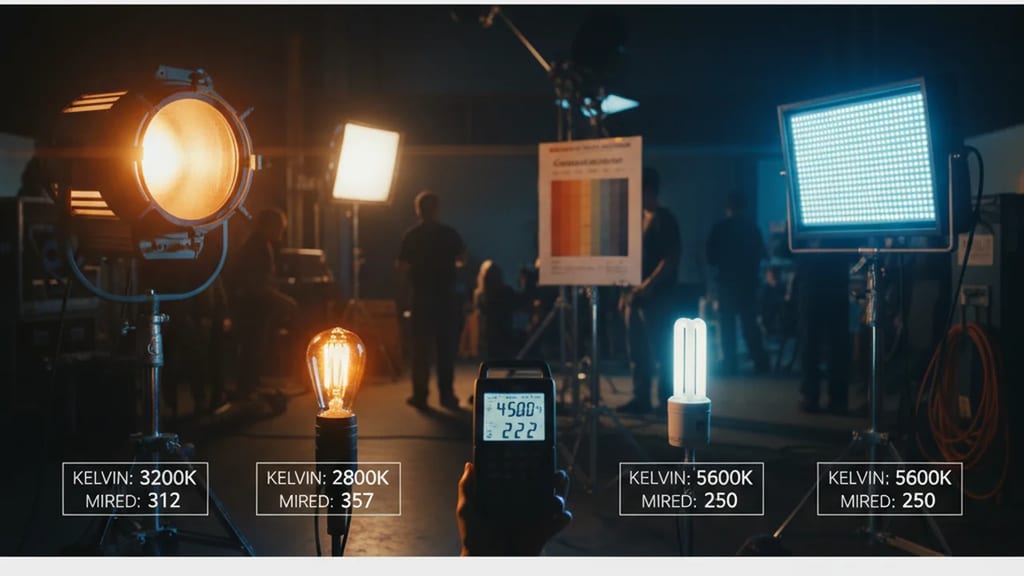
Mired value: reciprocal color temperature unit (1,000,000 divided by Kelvin) for comparing correction filters and light sources on set.
The Mired value (from English micro reciprocal degrees) is a unit of measurement for describing color temperature. Instead of stating the color temperature in Kelvin (K), the reciprocal is calculated and multiplied by one million. The unit is used in lighting because equal Mired differences over the entire relevant range (approximately 1,000 K to 10,000 K) correspond to approximately equal perceived color differences — unlike the Kelvin scale, where a 200 K difference in the tungsten range (3,200 K) appears optically much stronger than 200 K in the daylight range (5,600 K).
In practice, the Mired value is primarily relevant for gaffers and lighting technicians as the Mired shift value of conversion filters (CTO, CTB). Since Mired shifts are additive, the values of multiple gels can be easily added or subtracted to determine the total correction needed.
The conversion is done using a simple formula:
The Mired shift of a filter is the difference between the Mired values of the source and target color temperatures. Since the reciprocal is used, warming (lower Kelvin number) results in a positive shift, and cooling (higher Kelvin number) results in a negative shift.
The Mired shift is used to select the appropriate correction filter to match one light source to another — for example, to "pull" a tungsten spotlight (artificial light) towards daylight or vice versa, to correct daylight through a window to artificial light.
The following table shows typical conversions of common Rosco Cinegel filters. The specific Mired shift numbers may vary slightly depending on the manufacturer (Rosco vs. Lee) and data sheet generation, which is why manufacturer data sheets should always be consulted for exact values.
| Filter | Effect | Example Conversion |
|---|---|---|
| Full CTO | Warming (+) | approx. 6,500 K to 3,200 K |
| Full CTB | Cooling (−) | approx. 3,200 K to 5,500 K |
| 1/2 CTO | Warming (+) | Half shift of a Full CTO |
| 1/4 CTO | Warming (+) | Quarter shift of a Full CTO |
Note: Strictly speaking, the term "Mired" is considered outdated; Kodak and others alternatively use "reciprocal megakelvin" (MK⁻¹ or 1/MK), with numerically identical values.
Aus DoP-Perspektive ist dieses Element essentiell für die visuelle Gestaltung. Es ermöglicht mir die gewünschte Farbstimmung und das ästhetische Bild konsistent umzusetzen.
Diese professionelle Lösung erhöht die Produktionseffizienz und reduziert Post-Production-Anforderungen. Sie ermöglicht flexible, schnelle Anpassungen während des Drehs.
Als Gaffer ist dies ein unverzichtbares Werkzeug meines täglichen Handwerkszeugs. Es ermöglicht mir professionelle Lichtkontrolle und schnelle Anpassungen auf Set, was Zeit spart und Qualität sichert.
1. Zu welchem Department gehört „Mired-Wert"?
2. Wie viele verschiedene Fachperspektiven bietet dieser Eintrag?
The Lexikon is part of the Filmfarm ecosystem — alongside budgeting (FilmBalance), an industry magazine (FilmCircus) and crew networking (FilmCall, CrewMesh). One shared vocabulary for the whole production.