Filmlexikon.
Support
Mickey Mousing
Sound · Terms

Mickey Mousing

Murnau AI illustration
flow mickey roll

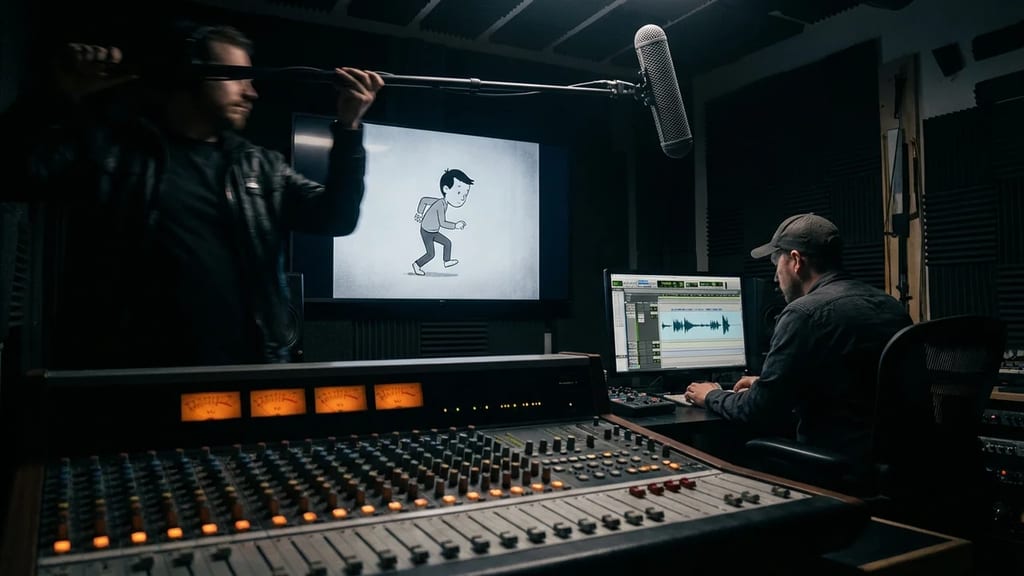
Frame-accurate synchronization of musical accents with visual action, pioneered in 1928's Steamboat Willie. Enhances comedic effect in animation and action sequences.

Technical Details

The implementation is achieved through frame-accurate synchronization, where musical accents are placed on precisely defined image points. At 24 fps, one frame corresponds to a tolerance of 41.67 milliseconds for synchronicity. Composers work with click tracks at specific tempos, mathematically aligned with the frame rate – for example, 120 BPM for uniform quarter-note accents every 12 frames. Modern Digital Audio Workstations (DAWs) enable SMPTE timecode-based synchronization with an accuracy of ±1 frame.

History & Development

The technique originated in 1928 with Walt Disney's "Steamboat Willie," the first fully synchronized Mickey Mouse cartoon. Carl Stalling perfected the process starting in 1930 at Warner Bros. for the "Looney Tunes" series. In the 1940s, film composers like Max Steiner and Erich Wolfgang Korngold adapted the method for feature films. With the introduction of digital editing systems from the 1990s onwards, frame-accurate synchronization became technically simpler and more cost-effective.

Practical Application in Film

Classic applications can be found in slapstick comedies, animated films, and action sequences. In "Tom & Jerry" cartoons, glissandi on the piano underscore falls, while xylophone runs accompany movements. Steven Spielberg's "Indiana Jones" films use Mickey Mousing specifically in chase scenes. John Williams synchronizes orchestral accents with whip cracks or leaps. The technique enhances comedic effect and action dynamics, but overuse can lead to the unintended trivialization of dramatic scenes.

Comparison & Alternatives

In contrast to Underscoring, which creates emotional moods without direct visual synchronization, Mickey Mousing exclusively reacts to visual events. Contrapuntal scoring deliberately uses music that is contrary to the on-screen narrative. Modern film music favors more subtle Hit Points – targeted synchronization points without continuous picture-sound coupling. Diegetic Scoring integrates music as part of the film's reality. Mickey Mousing is primarily suitable for comedy, animation, and stylized action scenes, while dramatic genres generally require more restrained scoring approaches.
From the crafts

Perspectives

Cinematographer

Ich muss bei Mickey-Mousing-Szenen bereits während der Aufnahme die musikalischen Sync-Points mitdenken und entsprechend präzise Bewegungsabläufe choreographieren. Die Kameraführung wird rhythmischer und folgt oft einem unsichtbaren Metronom, was besonders bei Steadicam-Fahrten oder Kranaufnahmen eine mathematische Präzision in der Ausführung verlangt. Spontane Takes funktionieren hier selten, da die Post-Production auf exakte Timing-Vorgaben angewiesen ist.

Director

Mickey-Mousing ist für mich ein zweischneidiges Schwert – es kann brillante komödiantische Momente schaffen, aber auch die emotionale Glaubwürdigkeit einer Szene zerstören. Ich setze es gezielt in stilisierten Sequenzen ein, wo die Übertreibung gewollt ist, vermeide es aber in intimen Charaktermomenten. Die Schauspielerführung wird dadurch mechanischer, da ich oft Bewegungen im Takt vorgeben muss statt natürlicher Reaktionen.

Producer

Mickey-Mousing erhöht die Postproduktionskosten erheblich, da Komponist und Sound-Editor frame-genau arbeiten müssen – das bedeutet 20-30% mehr Studiozeit für die Musikaufnahme. Nachträgliche Schnittänderungen werden extrem teuer, da die gesamte Vertonung neu synchronisiert werden muss. Ich kalkuliere bei Mickey-Mousing-lastigen Produktionen grundsätzlich einen Puffer von 15% der Gesamtbudgets für die Tonpostproduktion ein.

More in the lexikon

Related terms

Test your knowledge

Quiz

1. Zu welchem Department gehört „Mickey-Mousing"?

2. Wie viele verschiedene Fachperspektiven bietet dieser Eintrag?

Report an error
From the Filmfarm ecosystem

Understand visual language, budget productions, connect crew.

The Lexikon is part of the Filmfarm ecosystem — alongside budgeting (FilmBalance), an industry magazine (FilmCircus) and crew networking (FilmCall, CrewMesh). One shared vocabulary for the whole production.

FilmFarm FilmRadarComing soonFilmPulseComing soonFilmNumbersComing soonFilmCapitalComing soonFilmLabComing soonFilmBalanceComing soonFilmCircusComing soon