Filmlexikon.
Support
Low Combo
Lighting · Terms

Low Combo

Murnau AI illustration
color temperature flow roll take

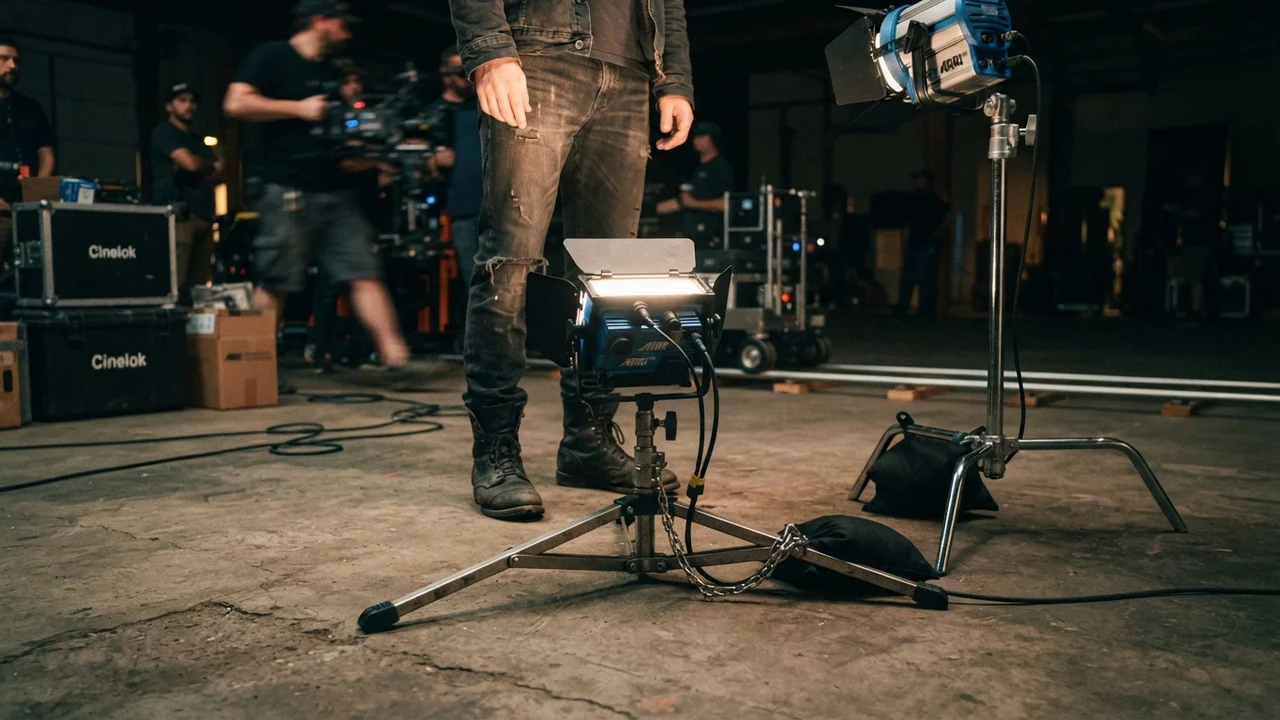
Mobile light stand with wheels for 5–15 kg fixtures; developed 1967 by Matthews for low-ceiling spaces. Features three spring-loaded legs, pneumatic damping, extends to 2.1 m.

Technical Details

Standard low combos carry loads between 5-15 kg and feature a 5/8" (16mm) spud with a 1/4" thread. The three or four-legged construction uses spring-loaded legs with quick-release locks, while three wheels per leg (typically 75mm diameter) ensure mobility. The air-cushioned cylinder prevents uncontrolled descent of the telescopic section. High-quality models from Matthews, Avenger, or Manfrotto offer additional braking wheels and reinforced mounts for heavier tungsten or LED panels up to 20 kg.

History & Development

Matthews Studio Equipment developed the first low combo in 1967 in response to the increasing number of low-ceiling television studios. The original "Low Boy Combo Stand" combined the proven Century Stand principle with reduced dimensions for 16mm film productions. In the 1980s, the industry standardized height measurements, while the 1990s saw the introduction of lighter aluminum alloys. Since 2010, specialized variants for LED technology with adapted weight specifications have emerged.

Practical Use in Film

Cinematographer Roger Deakins extensively used low combos for the basement scenes in "No Country for Old Men" (2007) to precisely shape shadows under the 2.1m ceiling height. A typical workflow involves placing them as fill light below an already mounted key light setup, with the wheels allowing for quick repositioning between takes. The advantage lies in space-saving storage and rapid mobility, while the disadvantage is the limited height range for classic portrait lighting above eye level.

Comparison & Alternatives

In contrast to the standard combo (up to 3.7m) or high combo (up to 4.9m), the low combo is limited to ground level up to medium height. Mini combos only reach 1.5m but offer greater mobility. Modern C-stand alternatives with wheel sets are increasingly replacing low combos, as they allow for more versatile arm configurations. For LED panel setups under 5 kg, lightweight carbon stands with wheel adapters are now preferred.
From the crafts

Perspectives

Cinematographer

Ich setze Low Combos primär für Fill-Light in engen Locations ein, wo Standard-Stative die Deckenhöhe sprengen würden. Die schnelle Mobilität zwischen Setups spart mir wertvolle Zeit, besonders bei Multi-Kamera-Produktionen wo ich Lichter permanent nachjustieren muss. Allerdings limitiert die geringe Höhe meine Möglichkeiten für klassische Rembrandt-Beleuchtung.

Director

Für mich sind Low Combos das ideale Werkzeug für intime Szenen in niedrigen Räumen, wo ich warmes Fill-Light aus Bodenperspektive brauche. Sie helfen mir, düstere Kelleratmosphäre zu schaffen, ohne dass Stative ins Bild ragen oder Schatten werfen. Die leise Mobilität ermöglicht spontane Lichtanpassungen während der Szenenentwicklung.

Producer

Low Combos reduzieren meine Equipmentkosten, da sie mehrere Stativtypen ersetzen und durch kompakte Maße Transportvolumen sparen. Ein 10er-Set kostet etwa 1.200€ weniger als separate Standard-Combos plus Rollensätze. Die schnelle Auf- und Abbauzeit verkürzt meine Drehtage um durchschnittlich 15 Minuten pro Setup-Wechsel.

More in the lexikon

Related terms

Test your knowledge

Quiz

1. Zu welchem Department gehört „Low Combo"?

2. Wie viele verschiedene Fachperspektiven bietet dieser Eintrag?

Report an error
From the Filmfarm ecosystem

Understand visual language, budget productions, connect crew.

The Lexikon is part of the Filmfarm ecosystem — alongside budgeting (FilmBalance), an industry magazine (FilmCircus) and crew networking (FilmCall, CrewMesh). One shared vocabulary for the whole production.

FilmFarm FilmRadarComing soonFilmPulseComing soonFilmNumbersComing soonFilmCapitalComing soonFilmLabComing soonFilmBalanceComing soonFilmCircusComing soon