Technical Details
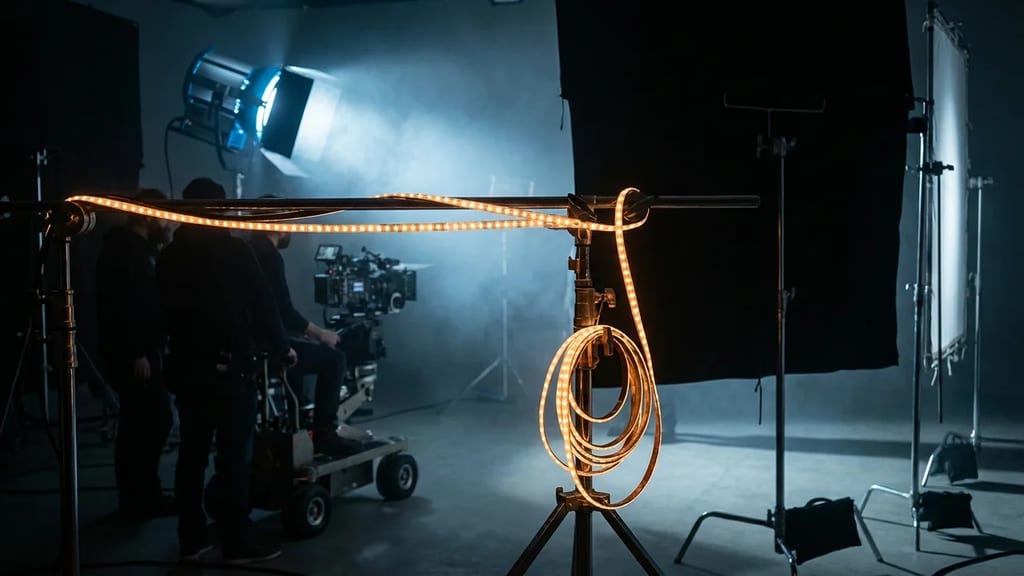
LiteRibbon systems operate with 12V or 24V DC voltage and achieve color temperatures between 2700K and 6500K. The LED density is 60-180 LEDs per meter, creating homogeneous light without visible hotspots. Modern variants offer CRI values above 95 and are available in RGB or RGBW versions. The flexible copper PCB substrate allows for bends down to a 2 cm radius. Standard lengths range from 1-10 meters, with industrial versions up to 50 meters. The lifespan is 30,000-50,000 hours at constant brightness.
History & Development
Litepanels developed the first film-ready LiteRibbon in 2014 in response to the demand for concealable light sources for tight shooting spaces. The technology is based on advancements in SMD LED manufacturing and flexible printed circuit boards from the automotive industry. In 2016, Aladdin introduced the BI-FLEX series, which offered the first daylight-balanced LiteRibbons for exterior shoots. Quasar Science revolutionized the market in 2018 with the Q-LED Linear, integrating DMX control and color mixing. Current developments focus on wireless control and battery packs for off-grid operation.
Practical Use in Film
LiteRibbon systems are suitable for accent lighting in vehicle interiors, as seen in the night drives in "Baby Driver" (2017), where they were mounted invisibly behind dashboards. In tight-space scenes in "Dunkirk" (2017), hidden LiteRibbons illuminated the cockpits of the Spitfire aircraft. The ribbons can be integrated into props or used as practical light sources – for example, as LED strips behind translucent wall panels. The workflow requires external dimmers and power supplies that must be positioned out of frame.
Comparison & Alternatives
Unlike conventional LED panels, LiteRibbons offer linear light distribution with minimal depth, but achieve only 30% of the light output per unit area. Tube lights like Astera Titans produce a similar light characteristic but require a diameter of 3-5 cm. Modern alternatives include OLED panels (still more expensive, but full-surface) and COB LED strips (higher output, but thicker construction). LiteRibbons remain unbeatable for concealed mounting and uniform edge lighting, while tube lights are preferable for visible use and higher light requirements.