Filmlexikon.
Support
LiteGear LiteMat
Lighting · Terms

LiteGear LiteMat

Murnau AI illustration
color temperature flow litegear roll take

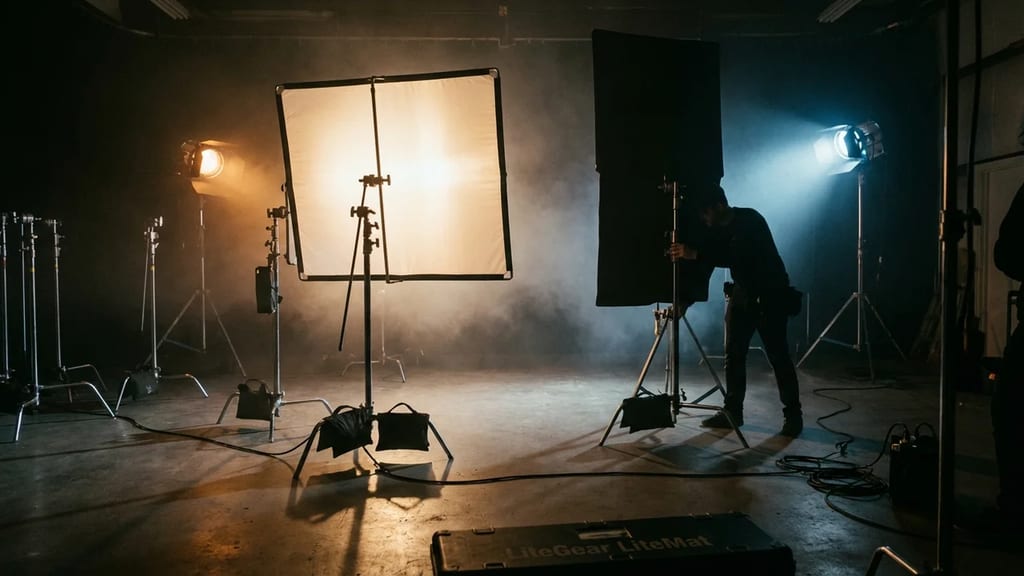
LiteGear LiteMat: flexible LED panel with 576–1152 chips, CRI >95, 2700–6500K. Bends to 15cm radius; delivers soft, even light without diffusion.

Technical Details

The LiteMat series utilizes OLED-like technology with 576 or 1152 individual LED chips per panel. The color temperature ranges from 2700K to 6500K with a CRI value of over 95. The light output is 1800 or 3600 lumens with 95% uniformity across the entire luminous surface. The flexible substrate allows for bends up to a radius of 15cm. Variants include the LiteMat Plus (higher output), LiteMat Spectrum (RGB+W), and the LiteMat 8 (244x244cm) for large-area illumination.

History & Development

LiteGear introduced the first LiteMat in 2012 at NAB, developed by company founder Pat Grosswendt. The technology was based on advancements in flexible printed circuits from the automotive industry. In 2015, the LiteMat Plus followed with 40% higher light output, and in 2017, the color-variable Spectrum series. In 2019, the LiteMat 4 expanded the product range with RGBWW capabilities and app control.

Practical Use in Film

Cinematographer Roger Deakins used LiteMats on "Blade Runner 2049" (2017) for concealed lighting in tight vehicle interiors. The flexible design allows for hiding behind props or conforming to curved surfaces. Typical applications include fill light through windows, concealed background lighting, and uniform illumination of large areas without hot spots. The low power consumption of 72-144 watts enables battery-powered use for 2-4 hours.

Comparison & Alternatives

Unlike traditional softboxes, the LiteMat directly produces soft light without additional diffusion. Competing products like the Arri SkyPanel or Kino Flo Celeb offer higher light output but are more rigid and heavier. The Creamsource Vortex4 offers similar flexibility with higher output but costs 60% more. For budget productions, Aladdin Bi-Flex or Falcon Eyes RX-24TDX represent more affordable alternatives but do not achieve the color accuracy of the LiteMat.

From the crafts

Perspectives

Cinematographer

Ich schätze die LiteMat für ihre gleichmäßige Lichtverteilung ohne Hotspots – perfekt für Close-ups ohne aufwändige Diffusion. Die Flexibilität ermöglicht mir kreative Lichtführung in engen Räumen, wo ich sie um Ecken biegen oder hinter Objekten verstecken kann. Der hohe CRI-Wert gibt mir Sicherheit bei der Farbwiedergabe, besonders bei Hauttönen.

Director

Die LiteMat hilft mir, natürlich wirkendes Licht zu schaffen, das die Illusion echter Lichtquellen unterstützt. Durch ihre dünne Bauform kann ich sie unauffällig in die Szenerie integrieren, ohne dass sie die Schauspielführung stört oder im Bild sichtbar wird. Die gleichmäßige Ausleuchtung schafft eine beruhigende, professionelle Atmosphäre am Set.

Producer

Die LiteMat reduziert meine Transportkosten durch geringes Gewicht und kompakte Maße – drei Panels passen in eine Standardtasche. Der niedrige Stromverbrauch spart Generator- und Stromkosten, besonders bei Location-Drehs. Die robuste Bauweise minimiert Reparaturkosten, auch wenn der Anschaffungspreis von 1.200-3.500€ pro Panel initial hoch ist.

More in the lexikon

Related terms

Test your knowledge

Quiz

1. Was beschreibt „LiteGear LiteMat" am besten?

2. Zu welchem Department gehört „LiteGear LiteMat"?

3. Wie viele verschiedene Fachperspektiven bietet dieser Eintrag?

Report an error
From the Filmfarm ecosystem

Understand visual language, budget productions, connect crew.

The Lexikon is part of the Filmfarm ecosystem — alongside budgeting (FilmBalance), an industry magazine (FilmCircus) and crew networking (FilmCall, CrewMesh). One shared vocabulary for the whole production.

FilmFarm FilmRadarComing soonFilmPulseComing soonFilmNumbersComing soonFilmCapitalComing soonFilmLabComing soonFilmBalanceComing soonFilmCircusComing soon