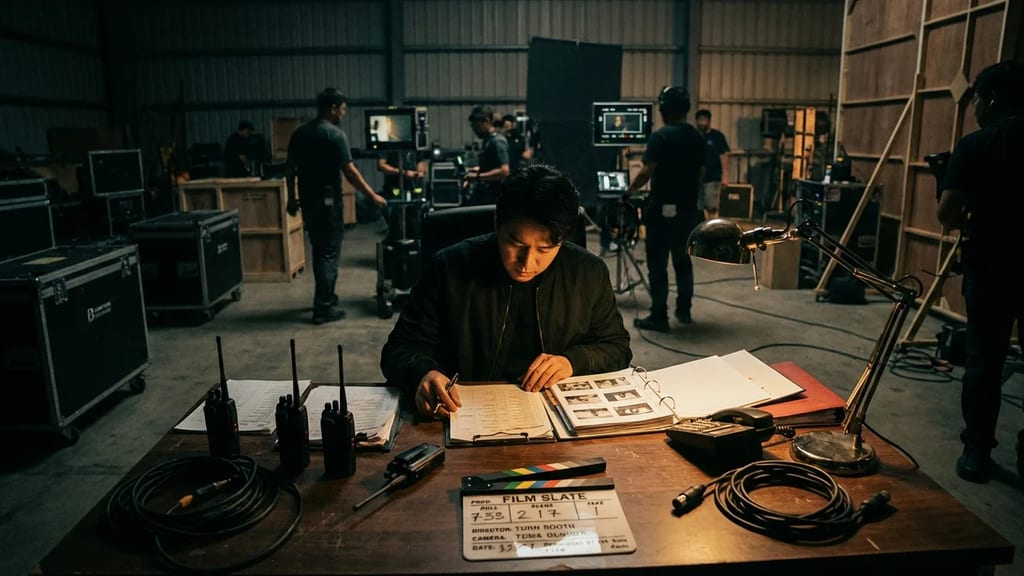
Definition
The Line Producer (also Production Manager) is an executive position responsible for the financial and logistical management of a film production. The Line Producer:
- Creates and manages the budget
- Develops schedule options
- Negotiates with vendors and locations
- Monitors costs daily
- Reports to producers/financiers
- Manages the Unit Production Manager
Roles and Responsibilities
Pre-Production Phase (Weeks 1-12)
Tasks:
- Budget Development
- Script breakdown for cost requirements
- Obtain department head quotes (DP, Production Designer, etc.)
- Vendor quotes for equipment, locations, special services
- Create multiple budget scenarios (Best Case, Realistic, Lean)
- Schedule Development
- Works with UPM on shooting schedule options
- Analyzes costs per schedule variant
- Optimizes for efficiency (location blocks, cast availability)
- Creates 2-3 schedule options for presentation
- Crew & Vendor Hiring
- Negotiates with department heads over rates
- Solicits bids from equipment rental houses
- Evaluates cost options without quality loss
- Works with UPM on crew selection
- Risk Assessment
- Identifies potential cost risks (VFX-heavy, weather-dependent, etc.)
- Calculates contingency budgets
- Plans mitigation strategies
- Documents assumptions and risks
Principal Photography Phase (Weeks 13-20)
Tasks:
- Daily Budget Monitoring
- Receives daily cost reports from UPM
- Compares actual vs. budgeted
- Identifies overruns or underspends
- Reports to producer daily/weekly
- Change Order Management
- Approves or rejects change orders
- Analyzes financial impact
- Documents all budget changes
- Negotiates with vendors on changes
- Budget-Impact Analysis
- Weather day impacts (how much does a weather day cost?)
- Schedule overages (does an additional day cost 120K or 80K?)
- Contingency deployment (can we use reserve budget?)
- End-of-production forecast (will we go over budget?)
- Problem-Solving
- Equipment failures: find quick solutions
- Location issues: negotiate alternate locations
- Crew issues: coordinate replacements
- Cast issues: manage overages or schedule changes
Post-Production Phase (Weeks 21-36)
Tasks:
- VFX/Post-Budget Monitoring
- Monitors VFX studio bills
- Approves color grading and sound mixing invoices
- Ensures post-production stays within budget
- Final Cost Reconciliation
- Collects all final bills
- Creates final cost report
- Calculates final cost outcome
- Documents budget variances
Line Producer vs. Unit Production Manager (UPM)
| Aspect | Line Producer | Unit Production Manager |
|---|
| Focus | Financial/Strategic | Operational/Daily |
| Office | Office (often remote) | On-set or local office |
| Reporting | Producer/Financiers | Line Producer |
| Decisions | Budget/major changes | Daily operations, small changes |
| Meetings | Weekly producer calls | Daily set meetings |
| Hours | 40-50/week during production | 60-70/week during production |
| Department Size | Works with 1-2 assistants | Manages 20-30 person team |
Analogy: Line Producer = CEO, UPM = COO
Budget Development Workflow
Step 1: Initial Script Breakdown (Week 1)
Line Producer analyzes screenplay for:
- Location requirements (how many different locations?)
- Day/night ratio (how much night shooting needs 2-3x more lighting?)
- Special effects (explosions, water, stunts?)
- Cast requirements (how many principal roles?)
- Equipment requirements (crane? helicopter? green screen?)
Step 2: Department Quotes (Week 2-3)
Sends detailed shooting script to:
- DP: "How much budget do you need for lighting & camera?"
- Typical response: "You have 15 EXT scenes at golden hour, I need $200K for equipment"
- Production Designer: "How much for set design & construction?"
- Typical response: "5 locations with interiors, I need $400K"
- Special Effects: "How much for the explosion in scene 45?"
- Typical response: "$150K for pyrotechnics & permit"
- Vendors: Equipment rental quotes
- Camera rental: "$50K for 50-day rental"
- Lighting rental: "$40K for 50-day rental"
Step 3: Budget Compilation (Week 4-5)
Template:
ABOVE-THE-LINE:
 Producer: $300K
 Director: $350K
 Writer: $100K
 Cast: $1M
 DP (ATL rate): $150K
SUBTOTAL ATL: $1.9M

BELOW-THE-LINE:
 Production Management: $150K
 Camera Crew: $250K
 Lighting: $300K
 Grip: $150K
 Sound: $100K
 Locations: $200K
 Art Department: $400K
 Costumes: $100K
 Special Effects: $150K
 Transportation: $150K
 Catering: $200K
 Insurance: $250K
 Other: $100K
SUBTOTAL BTL: $2.4M

POST-PRODUCTION: $1M

CONTINGENCY (10%): $530K

TOTAL: $5.83M → Rounds to $5.8M
Step 4: Multiple Scenarios (Week 6)
Line Producer creates multiple budgets:
Version A: "Top-Gun" (Best Case)
- $6.5M (all ATL wishes, premium crew, full VFX)
- But: Only if all financing is secured
Version B: "Realistic" (Recommended)
- $5.8M (good quality, balanced crew, reasonable VFX)
- This is what line producer recommends
Version C: "Bare Bones"
- $4.2M (reduced crew, deferred salaries, minimal VFX)
- Only if financing doesn't work out
Producer typically chooses Version B.
Key Skills of a Good Line Producer
1. Financial Acumen
- Budget creation
- Cost tracking & analysis
- Negotiation skills
- Understanding of tax incentives
2. Production Knowledge
- Knows film workflow from pre-production to post
- Understands department requirements
- Realistic about time and financial consequences
3. Negotiation Skills
- With department heads (cost negotiations)
- With vendors (equipment, locations)
- With talent agents (deferral agreements)
- With financiers (budget adjustments)
4. Problem-Solving
- Creative with budget constraints
- Quick decisions under pressure
- Evaluate multiple solution options
- Finding win-win solutions
5. Relationship Management
- Familiar with key department heads
- Good rapport with producers
- Respect from director (even when saying "no")
- Good communication with financiers
Line Producer Rates & Salary
Rates by Film Size
| Budget | Typical LP Rate | Notes |
|---|
| $250K-500K (Micro) | $20K-40K | Often deferred |
| $500K-2M (Low) | $40K-80K | Part shared with UPM |
| $2M-10M (Mid) | $80K-200K | Dedicated LP role |
| $10M-50M (Large) | $200K-400K | Full-time, experienced |
| $50M+ (Blockbuster) | $400K-750K+ | Top-tier LP only |
Structure
Typical compensation:
- Advance salary: Weekly/monthly during pre-production & production
- Contingency bonus: 10-20% if final cost under budget
- Deferral: Possible in very low-budget productions
Common Line Producer Decisions
Decision 1: Location Efficiency
Scenario: Screenplay has 3 apartment scenes at different locations
Option A: Rent 3 different real apartments
- Budget: $5K/day × 2 days × 3 locations = $30K
- Advantage: Authentic
Option B: 1 studio build with different dressings
- Budget: $50K studio build + $1K/day × 2 days = $52K
- Advantage: Controlled, faster transitions
- Line Producer: "Studio is more expensive, but saves movement days. I recommend the studio."
Decision 2: Cast Efficiency
Scenario: A-list star only available 5 weeks, but has scenes over 8 weeks
Option A: Book A-list for 8 weeks
- Cost: $50K/day × 40 days = $2M
Option B: A-list 5 weeks, double/CGI for other scenes
- Cost: $50K/day × 25 days + $200K VFX = $1.45M
- Saving: $550K
- Line Producer: "Can propose a double solution, saves significantly"
Decision 3: Crew Size
Scenario: Gaffer proposes 12 electricians
Option A: 12 electricians
- Cost: $500/day × 12 × 50 = $300K
Option B: 8 electricians, longer days
- Cost: $500/day × 8 × 55 days = $220K
- Saving: $80K
- Trade-off: Crew fatigue, longer days
- Line Producer: "Can reduce to 8, but should check crew wellness"
Line Producer and Financiers
The line producer is the primary contact point to financiers:
Weekly Calls with Financiers:
- Current budget status
- Risks & issues
- Forecast to completion
- Changes or adjustments needed?
A bad budget report could jeopardize financing → Line producer communication is CRITICAL
Example horror scenario:
- Week 2 of production
- Actual costs 20% over budget
- Line producer reports late or not at all
- Financier learns from producer → breach of trust
- Financing could be at risk
Line Producer Success Metrics
A successful line producer is measured by:
- Budget Achievement
- Final project within 5% of budget
- Typically: under-budget is better than over
- Schedule Adherence
- Maintains planned shooting schedule
- No surprise delays
- Quality Maintenance
- Cuts costs without quality loss
- Crew satisfied (not overworked)
- Stakeholder Satisfaction
- Producer happy with budget
- Financiers confident
- Crew respects budget decisions
- Problem-Solving
- Finds solutions quickly
- No surprises at the end
Line Producer and Creativity
Good line producers understand:
- Creativity costs money – but sometimes money saves creativity
- Constraints foster innovation – A $2M budget can be more creative than $20M because limits force creativity
- Partnership with director – Not "saying no" but "here are your options with cost consequences"
Quote from an experienced line producer:
"My job is not to save money – my job is to enable good cinema within a financial framework. Sometimes that means saying 'yes' even though it's expensive, if it makes the film better."
The line producer is the financial conscience of a film production – balancing creative ambition with financial reality.