Technical Details
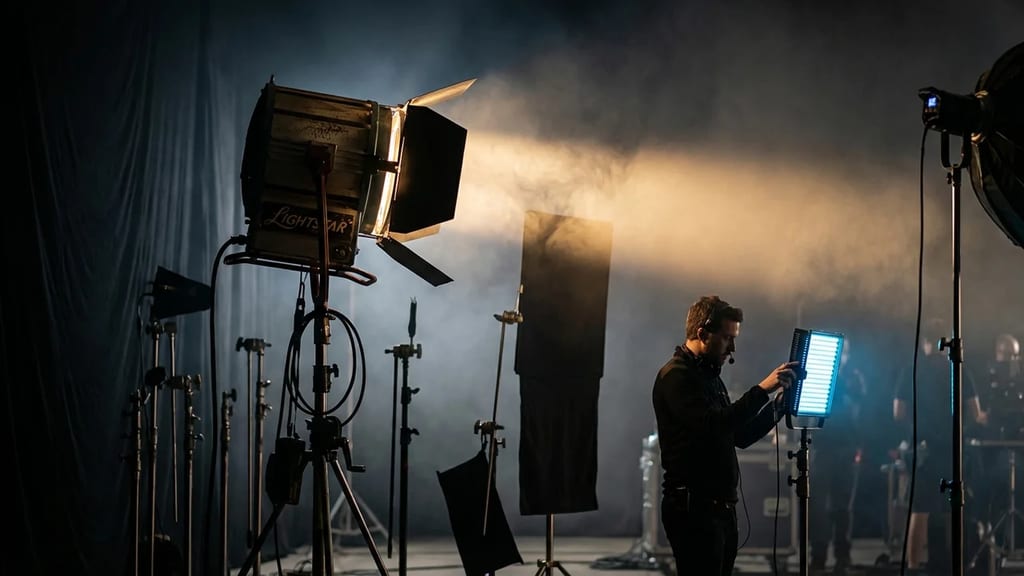
The Lightstar series was based on the Fresnel principle with stepless focusing from 12° spot to 60° flood. The Lightstar 575W model achieved a luminous intensity of 18,000 candela in spot mode at a color temperature of 3200K. The housings were made of die-cast aluminum with forced ventilation by axial fans in models from 1kW upwards. Characteristic features were the patented Quick-Change system for barndoors and filters, as well as the asymmetrical housing shape for better heat dissipation. The larger models (5kW, 10kW, 20kW) featured separate ballasts and DMX-512 control for dimmer functions.
History & Development
LTM introduced the first Lightstar in 1985 in response to the growing demand for more compact studio lights. In 1988, HMI variants were integrated, and in 1994, the remote-controlled Lightstar Remote series was introduced. A milestone was the Lightstar Crystal in 1997 with improved optics and 15% higher light output. Production ended in 2010 when LED technology began to dominate the market. In total, LTM sold over 200,000 Lightstar units worldwide.
Practical Use in Film
Lightstar luminaires shaped film production in the 1990s and 2000s. "Titanic" (1997) used over 150 Lightstar units for the interior shots of the ship. The compact design allowed for use in confined sets, while the even light distribution produced natural-looking portraits. Typical workflow: Lightstar as key light in 575W or 1kW, combined with softboxes or diffusion material. Disadvantages included limited flicker-free dimming below 20% and heat generation during long shooting times.
Comparison & Alternatives
Main competitors were Arri's Arrilite series and Mole-Richardson's Mighty Mole, with Lightstar scoring points for better color consistency. Modern LED panels like Arri SkyPanel or Litepanels Gemini today offer similar light quality with lower power consumption and heat generation. While Lightstar exclusively delivered tungsten light, LED alternatives offer variable color temperature from 2700K to 6500K. In vintage-oriented productions, original Lightstar luminaires are still used because their light characteristics create an authentic film look from the late analog era.