Technical Details
Lee Filters are made of heat-resistant polyester with a material thickness of 0.12 mm and transmission values between 5% and 95%. The color system is based on CIE colorimetry and offers color temperature corrections from 2700K to 6500K. The most important categories include CTB (Color Temperature Blue) and CTO (Color Temperature Orange) filters with gradations such as 1/8, 1/4, 1/2, and Full. ND filters (Neutral Density) are available in 0.3 to 3.0 stops, corresponding to 1 to 10 stops of light reduction. Special filters such as diffusion (216 White Diffusion, 250 Half White Diffusion) and effect filters (200 Double CT Blue, 181 Congo Blue) expand the spectrum.
History & Development
Edwin F. Lee founded the company in 1967 after working at Strand Electric. In 1982, Lee Filters introduced the world's first computer-controlled color mixing system for stage lighting. The breakthrough in film came in the 1980s through the standardization of filter sizes and the international distribution of the numbering system. In 1994, the product range was expanded to include the HT series (High Temperature) for high-power tungsten and HMI luminaires. In 2008, Lee launched the LED series specifically for modern LED lighting.
Practical Use in Film
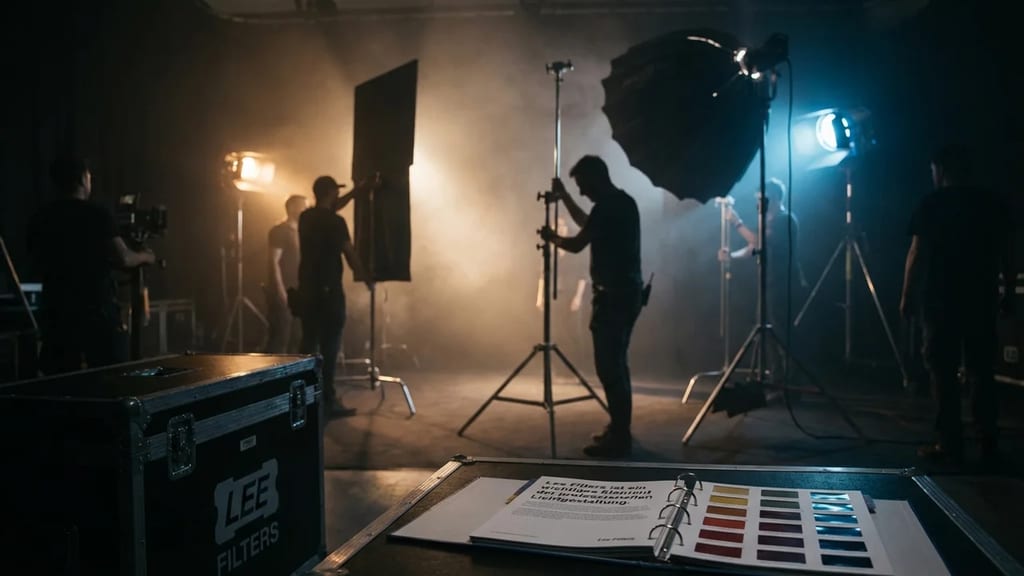
Cinematographers use Lee 85 filters for correcting daylight to tungsten lighting, while Lee 201 (CT Blue) adjusts artificial light to daylight. Roger Deakins extensively used Lee 200 (Double CT Blue) in "Blade Runner 2049" for the characteristic orange-blue color palette. Lee CTO filters were used in "Mad Max: Fury Road" to enhance the desert atmosphere. Standard workflow: Filters are clamped into barndoors or attached directly to the luminaire with clips. Advantage: precise color control and international availability. Disadvantage: light absorption reduces intensity by 10-60%.
Comparison & Alternatives
Main competitors are Rosco filters from the USA with different numbering and slightly different color values. While Lee 201 produces a color temperature of 5600K, Rosco 3202 reaches only 5500K. GAM filters from France offer similar quality but less international availability. Modern LED panels with built-in color correction are increasingly replacing filters in smaller productions, but do not achieve the color accuracy of physical filters. For high-end productions, Lee filters remain the standard, as they guarantee reproducible results with different light sources.