Filmlexikon.
Support
Lavender Net
Lighting · Terms

Lavender Net

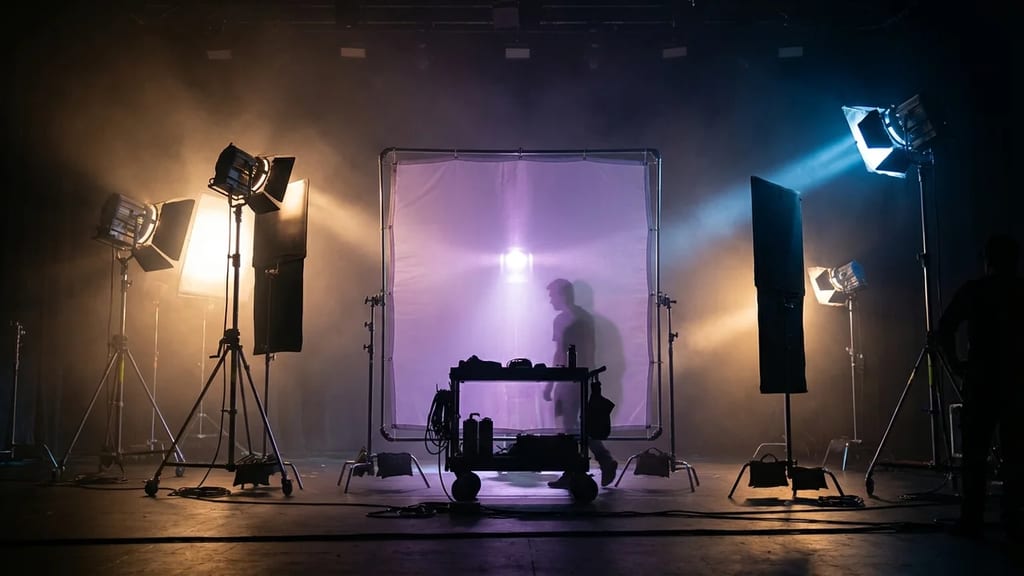
Murnau AI illustration
15lb sandbag 20 c stand 216 diffusion 250 diffusion 251 diffusion 25lb sandbag 35lb sandbag 40 c stand

Synthetic mesh fabric (0.8–1.2 mm aperture) with lavender tint for simultaneous light diffusion and color temperature correction of tungsten to daylight balance.

Technical Details

Lavender Nets are made of synthetic mesh fabric with a mesh size of 0.8 to 1.2 mm and a material thickness of 0.1 mm. The violet coloration is achieved through woven-in fibers or subsequent coating with lightfast pigments. Standard sizes range from 12"x12" to 20"x20" for flag mounting, and 6"x6" to 8"x8" for smaller luminaires. The material is heat-resistant up to 120°C and transmits approximately 60-70% of incident light. Variants differ in net thickness: Single Net (finer diffusion), Double Net (stronger scattering), and Half Net (gradual transitions).

History & Development

Lavender Nets evolved in the 1980s from classic white diffusion nets, as cinematographers sought ways to color-balance daylight and artificial light without separate color gels. The first documented use was in 1984 on "The Natural" under DoP Caleb Deschanel. Matthews Studio Equipment standardized production in 1987 and established the currently common sizes. With the advent of digital cameras from 2000 onwards, the Lavender Net gained new significance, as digital sensors react more strongly to color temperature deviations than film.

Practical Use in Film

Roger Deakins extensively used Lavender Nets in "Blade Runner 2049" (2017) for night exterior scenes to color-correct sodium vapor lamps. Typical workflow: Mounted on a C-stand with a flag arm 60-80 cm in front of the light source, combined with barndoors for light shaping. The net creates softer shadows than diffusion gels and retains more directional light than softboxes. Disadvantage: The net structure can become visible when directly illuminating reflective surfaces. Particularly effective with LED panels with a high red component.

Comparison & Alternatives

Unlike CTB (Color Temperature Blue) gels, the Lavender Net offers simultaneous diffusion and color correction. Silk diffusion creates softer transitions but without color shift. In modern productions, digital color correction in post-production often replaces physical filtering, but mechanical light scattering remains irreplaceable. Lee Filters 3/4 CTB + Opal Frost achieves similar results but requires two filters. For LED lights with variable color temperature, the coloration can be done digitally, while the diffusion effect must be physically created.
From the crafts

Perspectives

Cinematographer

Ich nutze Lavender Nets hauptsächlich bei Mixed-Light-Situationen, wo ich warme Practicals mit kühlerem Key Light ausbalancieren muss. Das Netz gibt mir eine natürlichere Lichtqualität als reine CTB-Folien und ich spare mir das Doppel-Flagging mit separater Diffusion. Bei digitalen Kameras sehe ich sofort im Monitor, ob die Farbkorrektur ausreicht oder ob ich zusätzlich mit Gels arbeiten muss.

Director

Für mich ist das Lavender Net ein Werkzeug, um emotionale Übergänge zwischen warmen und kühlen Szenen fließender zu gestalten. Statt harter Schnitte zwischen verschiedenen Farbtemperaturen kann ich Zwischentöne schaffen, die das Publikum subtil auf Stimmungsänderungen vorbereiten. Besonders bei Thriller-Szenen nutze ich die kühlere Tönung, um unterschwellige Bedrohung zu suggerieren.

Producer

Lavender Nets reduzieren meine Ausrüstungskosten, da sie zwei Filter in einem vereinen – weniger Equipment bedeutet weniger Transport und schnellere Setup-Zeiten. Ein Set kostet etwa 150-200 Euro und ist deutlich günstiger als separate CTB- plus Diffusionsfilter. Die Zeitersparnis bei komplexen Beleuchtungssetups kann bei knappen Drehtagen den Unterschied zwischen Überstunden und planmäßigem Drehschluss bedeuten.

More in the lexikon

Related terms

Test your knowledge

Quiz

1. Was beschreibt „Lavender Net" am besten?

2. Zu welchem Department gehört „Lavender Net"?

3. Wie viele verschiedene Fachperspektiven bietet dieser Eintrag?

Report an error
From the Filmfarm ecosystem

Understand visual language, budget productions, connect crew.

The Lexikon is part of the Filmfarm ecosystem — alongside budgeting (FilmBalance), an industry magazine (FilmCircus) and crew networking (FilmCall, CrewMesh). One shared vocabulary for the whole production.

FilmFarm FilmRadarComing soonFilmPulseComing soonFilmNumbersComing soonFilmCapitalComing soonFilmLabComing soonFilmBalanceComing soonFilmCircusComing soon