Filmlexikon.
Support
L5-C
Lighting · Terms

L5-C

Murnau AI illustration
color temperature flow roll take

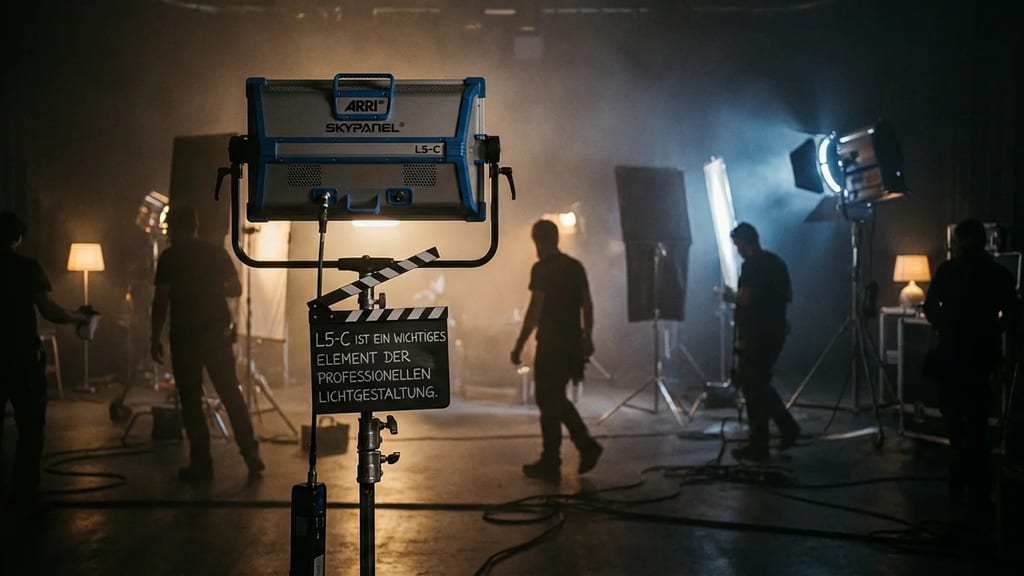
L5-C LED standard delivering 140–160 lm/W at 5600K daylight with TLCI >97. Industry benchmark for premium film lighting since 2019, flicker-free to 25kHz.

Technical Details

L5-C LEDs achieve an luminous efficacy of 140-160 lumens per watt at an operating voltage of 24-48V DC. The spectral distribution exhibits characteristic peaks at 450nm (Blue) and 550nm (Green), while the critical red range between 620-700nm is enhanced through phosphor conversion. Modern L5-C arrays utilize COB (Chip-on-Board) chips with power ratings between 50W and 400W per unit. Color consistency is within a ±150K tolerance, and the TLCI (Television Lighting Consistency Index) reaches values above 97. Dimming is PWM-controlled from 0.1% to 100% without color shift.

History & Development

The L5-C standard was developed in response to the lack of color quality in early LED systems in the film industry around 2015-2017. Arri introduced the first L5-C certified fixtures in 2019 with the SkyPanel series, followed by Aputure (2020) and Astera (2021). The breakthrough came in 2020 when Netflix accepted L5-C LEDs as a technical standard for original productions. By 2023, over 40 manufacturers had received L5-C certifications.

Practical Use in Film

Christopher Nolan used L5-C panels in "Tenet" (2020) for uniform illumination of the time-inversion sequences, as the flicker-free 25,000Hz frequency guarantees constant light even during slow-motion shots. In "The Mandalorian," L5-C arrays replace traditional HMI lights for volume stages, as they emit no UV radiation and do not overheat the LED walls. A typical workflow involves L5-C panels as key lights with a total output of 2-3kW, supplemented by RGB LEDs for accent lighting. Advantages include instant brightness without warm-up time and silent operation. Disadvantages include higher initial costs compared to tungsten alternatives.

Comparison & Alternatives

L5-C differs from the L3-C standard (3200K tungsten equivalent) due to a 2400K higher color temperature and a different phosphor mix. While traditional HMI lights achieve similar 5600K values, they require ballasts and a 3-5 minute warm-up period. RGBW LEDs offer more flexibility but rarely achieve L5-C color quality in the 5600K mode. Quantum Dot LEDs (available from 2024) promise even more precise spectral distribution but cost 40% more than L5-C systems.

From the crafts

Perspectives

Cinematographer

Als DoP schätze ich L5-C-LEDs für die absolut flimmerfreie Aufzeichnung bei jeder Shutter-Einstellung – von 1/24s bis 1/2000s keine Probleme. Die konstante 5600K-Farbtemperatur erspart mir zeitraubende Korrekturen am Set, besonders bei Mixed-Lighting-Situationen mit Tageslicht. Einziger Nachteil: Bei extremen Weitwinkel-Aufnahmen kann ich vereinzelt Hotspots der einzelnen COB-Chips erkennen.

Director

L5-C-Panels geben mir die kreative Freiheit, Lighting-Stimmungen sofort zu ändern – von 0 auf 100% in Millisekunden ohne technische Pausen. Für emotionale Szenen kann ich die Helligkeit live während der Performance modulieren, was bei HMIs unmöglich wäre. Die gleichmäßige Ausleuchtung hilft meinen Schauspielern, da sie keine heißen Spots abbekommen und entspannter agieren können.

Producer

L5-C-Equipment amortisiert sich durch wegfallende Stromkosten – 200W LED statt 1200W HMI für gleiche Lichtleistung bedeutet 60% Energieeinsparung pro Drehtag. Keine Ersatzlampen, kein Generator-Aufwand, 50% weniger Crew für Elektrik. Anschaffung kostet zwar 15.000€ mehr pro Set, aber nach 80 Drehtagen bin ich im Plus durch gesparte Betriebskosten und schnellere Wrap-Zeiten.

More in the lexikon

Related terms

Test your knowledge

Quiz

1. Zu welchem Department gehört „L5-C"?

2. Wie viele verschiedene Fachperspektiven bietet dieser Eintrag?

Report an error
From the Filmfarm ecosystem

Understand visual language, budget productions, connect crew.

The Lexikon is part of the Filmfarm ecosystem — alongside budgeting (FilmBalance), an industry magazine (FilmCircus) and crew networking (FilmCall, CrewMesh). One shared vocabulary for the whole production.

FilmFarm FilmRadarComing soonFilmPulseComing soonFilmNumbersComing soonFilmCapitalComing soonFilmLabComing soonFilmBalanceComing soonFilmCircusComing soon