Filmlexikon.
Support
Key Grip
Grip · Roles

Key Grip

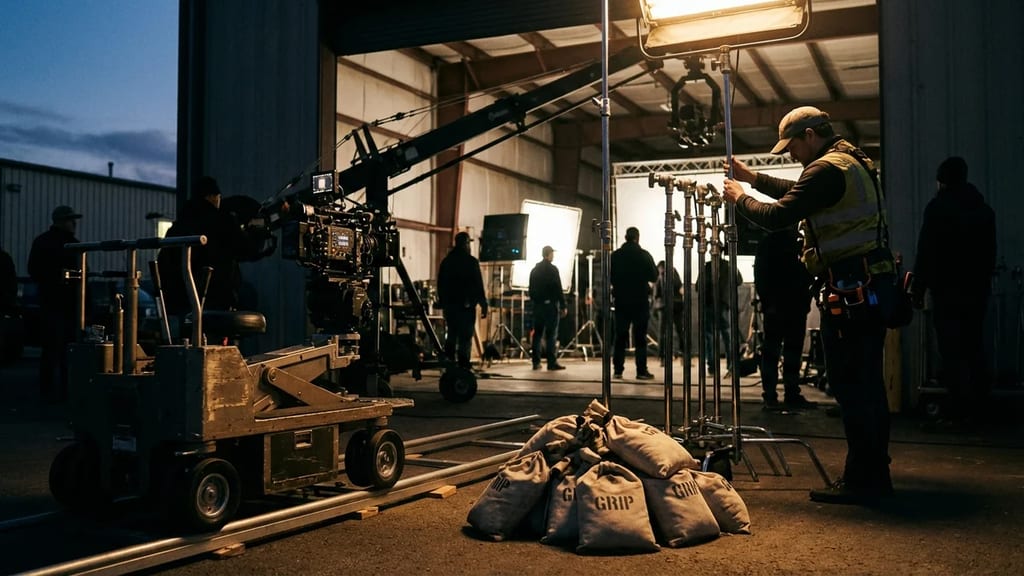
Murnau AI illustration
flow grip roll

Head of the grip department responsible for executing camera movement, managing dollys, cranes, and rigging systems valued at $50,000–$250,000.

Technical Details

The Key Grip manages equipment worth €50,000-€200,000, including dollies (Chapman PeeWee III, Fisher 10), cranes (Technocrane 30/50), Steadicam accessories, and C-stands up to 3.5m high. Their equipment includes sandbags (15-25kg), clamps with a load capacity of up to 500kg, and track systems in lengths of 3-24 meters. Modern Key Grips also operate motion control systems like the Bolt High-Speed Cinebot with speeds up to 4m/s and repeatability of ±0.02mm.

History & Development

The position was established in Hollywood around 1915, as more complex camera movements became standard. In 1927, Fox Film Corporation introduced standardized grip hierarchies for the first time. The turning point came in 1975 with "Jaws," where Key Grip Danny McCauley developed innovative water camera rigs. Since the 1990s, the scope of work has expanded to include precise camera movements for visual effects through CGI integration and remote head technology.

Practical Application in Film

For "Gravity" (2013), Key Grip Gary Hymns, along with the DoP, developed a 20x20m LED cube system that enabled perfectly reproducible lighting conditions. For "1917" (2020), he coordinated kilometer-long track layouts for the seemingly continuous sequences. Typical daily routines include 4-6 camera setups, each with 30-90 minutes of setup time. The Key Grip calculates weight distribution, checks structural integrity, and defines safety zones around moving equipment.

Comparison & Alternatives

Unlike the Gaffer (lighting) or Camera Operator (image composition), the Key Grip focuses on the mechanical aspects of camera movement. The Best Boy Grip acts as their direct deputy and coordinator. In smaller productions, a single Grip often performs both functions. While modern gimbal systems (DJI Ronin 4D) reduce the need for traditional grip equipment, they require specialized technical support from experienced Key Grips.
From the crafts

Perspectives

Cinematographer

Als DoP bin ich täglich auf die präzise Umsetzung meiner Kamerabewegungen angewiesen - der Key Grip übersetzt meine visuellen Ideen in mechanische Lösungen. Seine Expertise entscheidet darüber, ob komplexe Fahrten in einem Take gelingen oder aufwendig wiederholt werden müssen. Bei spontanen Änderungen am Set brauche ich jemanden, der sofort alternative Rigging-Lösungen vorschlägt.

Director

Ich verlasse mich darauf, dass der Key Grip meine Bewegungssprache versteht und die emotionale Wirkung durch präzise Technik unterstützt. Wenn ich eine Kamerafahrt fordere, die die Isolation des Protagonisten verstärken soll, muss er das Equipment so positionieren, dass die Bewegung organisch und unsichtbar wirkt. Seine Vorausplanung ermöglicht mir spontane kreative Entscheidungen ohne technische Kompromisse.

Producer

Ein erfahrener Key Grip spart mir täglich 2-3 Stunden Drehzeit durch effiziente Planung und verhindert kostspielige Equipment-Schäden durch unsachgemäße Handhabung. Seine Personalführung des Grip-Teams direkt beeinflusst mein Tagesbudget von 800-1.500 Euro für Grip-Löhne. Bei Location-Wechseln koordiniert er den Transport von bis zu 4 Tonnen Equipment und minimiert Standzeiten.

More in the lexikon

Related terms

Test your knowledge

Quiz

1. Zu welchem Department gehört „Key Grip"?

2. Wie viele verschiedene Fachperspektiven bietet dieser Eintrag?

Report an error
From the Filmfarm ecosystem

Understand visual language, budget productions, connect crew.

The Lexikon is part of the Filmfarm ecosystem — alongside budgeting (FilmBalance), an industry magazine (FilmCircus) and crew networking (FilmCall, CrewMesh). One shared vocabulary for the whole production.

FilmFarm FilmRadarComing soonFilmPulseComing soonFilmNumbersComing soonFilmCapitalComing soonFilmLabComing soonFilmBalanceComing soonFilmCircusComing soon