Filmlexikon.
Support
Grip
Production · Terms

Grip

Murnau AI illustration
20 c stand 40 c stand c stand arm c stand mini c stand sliding leg c stand grip head head

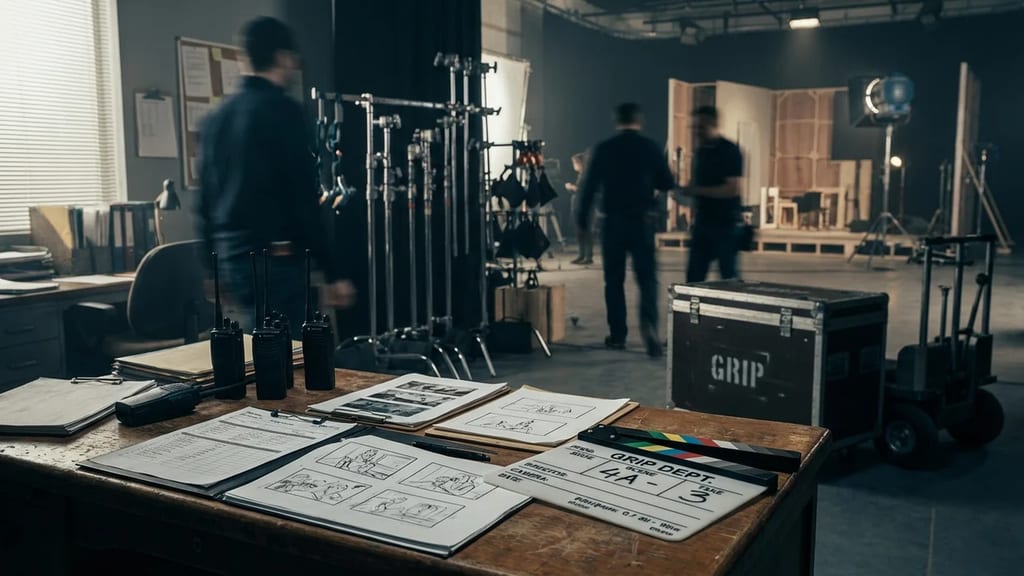
Crew member who designs and executes mechanical camera movements using dollies, cranes, and jibs to achieve smooth, fluid shots.

Technical Details

A grip works with equipment ranging in weight from 0.5 kg (small clamps) to 500 kg (Technocrane). Standard equipment includes C-stands with booms up to 3.5 m in height, dolly tracks in segments from 1.2 m to 6 m in length, and camera cranes with reach of 3 m (Jib) to 30 m (Technocrane 30). Key grips lead teams of 2-8 people, depending on the production size. Best Boys (grip assistants) support with heavy equipment over 50 kg.

History & Development

The position was established in 1925 in Hollywood studios when cameras transitioned from static tripods to mobile dollies. The first documented Key Grip was Ralph Hoge at MGM in 1928. Technical milestones include: introduction of the Western Dolly (1935), Chapman cranes (1950s), Louma remote control (1975), and Motion Control Systems (1980s). Modern grips have been working with computer-controlled systems like the Technodolly and programmable camera movements since the 1990s.

Practical Application in Film

In "Goodfellas" (1990), the grip team led by Larry McConkey realized the famous Copacabana Steadicam sequence through precise coordination with 15 actors. For "Gravity" (2013), grips developed a 3.5 m high LED light dome that enclosed Sandra Bullock and rotated in sync with camera movement. Dolly shots require track precision of ±2 mm, and crane moves are programmed in 0.1° increments. Grips work according to the camera script (Shot List) and timing sheets with second indications.

Comparison & Alternatives

Distinction from the Gaffer: Grips move equipment, Gaffers control lighting. Electricians lay cables; grips mechanically mount lights. Modern alternatives like MōVI gimbals (since 2013) partially replace classic dolly shots but require specialized digital grips. Drones handle crane functions up to 15 m in height; for greater heights, Technocranes with 30+ m booms remain indispensable. Remote heads like the Hot Head enable camera movements without an operator on set.
From the crafts

Perspectives

Cinematographer

Als DoP bin ich auf millimeterpräzise Dolly-Moves angewiesen – wenn mein Key Grip die Chapman Hustler III nicht auf exakt 24 fps Kamerageschwindigkeit synchronisiert, entstehen Ruckler im Bild. Besonders bei Weitwinkel-Aufnahmen unter 35mm werden selbst kleinste Vibrationen im C-Stand sichtbar, deshalb verwende ich nur Grips mit mindestens 5 Jahren Erfahrung.

Director

Ich nutze Grip-Equipment gezielt für emotionale Beats – eine langsame Dolly-Fahrt auf den Protagonisten verstärkt Intimität, während Kran-Moves Distanz schaffen oder Macht visualisieren. Bei "The Shining" hat Kubrick 127 Takes für eine einzige Steadicam-Sequenz gedreht, weil jede Nuance der Kamerabewegung die psychologische Wirkung beeinflusst.

Producer

Ein 5-köpfiges Grip-Department kostet täglich 3.500€, plus 1.200€ Equipment-Miete für Standard-Dolly-Setup. Komplexe Kran-Aufnahmen können den Drehtag um 4 Stunden verlängern – bei 50.000€ Tagesbudget ein kritischer Kostenfaktor. Ich kalkuliere pro Dolly-Move 45 Minuten Setup-Zeit und verlange detaillierte Shot-Listen vom Regisseur für präzise Grip-Planung.

More in the lexikon

Related terms

Test your knowledge

Quiz

1. Was beschreibt „Grip" am besten?

2. Zu welchem Department gehört „Grip"?

3. Wie viele verschiedene Fachperspektiven bietet dieser Eintrag?

Report an error
From the Filmfarm ecosystem

Understand visual language, budget productions, connect crew.

The Lexikon is part of the Filmfarm ecosystem — alongside budgeting (FilmBalance), an industry magazine (FilmCircus) and crew networking (FilmCall, CrewMesh). One shared vocabulary for the whole production.

FilmFarm FilmRadarComing soonFilmPulseComing soonFilmNumbersComing soonFilmCapitalComing soonFilmLabComing soonFilmBalanceComing soonFilmCircusComing soon