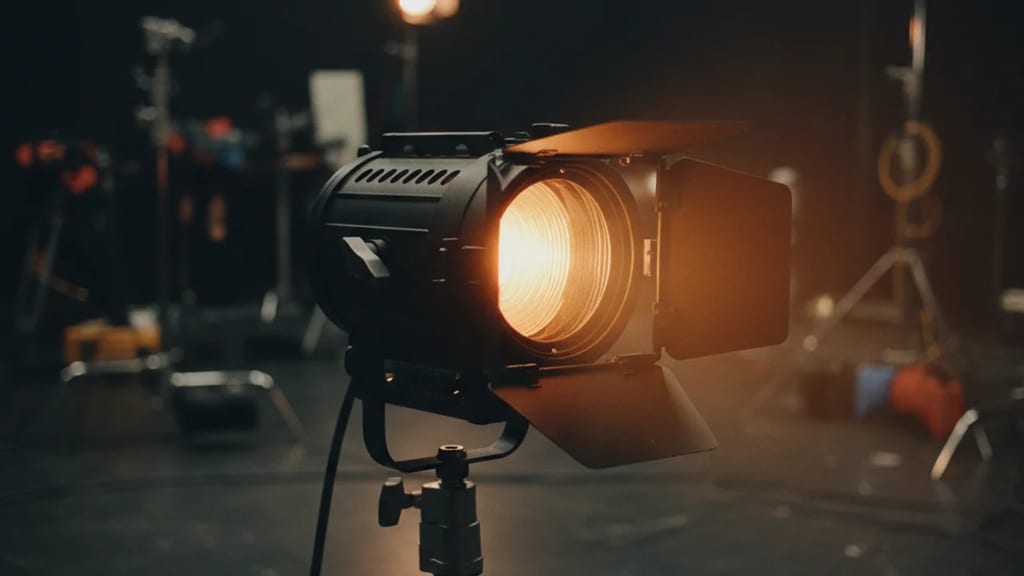
Technical Details
The Junior operates with a 2,000-watt tungsten-halogen lamp (type FEL, 3,200K color temperature) and achieves a luminous flux of approximately 32,000 lumens at full power. The housing typically measures 38 x 30 x 45 cm with a weight of 8-12 kg depending on the manufacturer. Focusing is achieved via a side knob that moves the lamp forward and backward within the reflector. Modern variants feature DMX control and electronic dimming. The beam angle can be continuously adjusted between 12° and 60°, with the light intensity in spot mode at a distance of 10 meters being approximately 2,800 lux.
History & Development
Mole-Richardson developed the first Junior in 1936 as part of their standardized spotlight series for Hollywood studios. The naming convention followed military ranks: Senior (5K), Junior (2K), Baby (1K), and Inkie (200W). Arri adopted the concept in 1952 for the European market with the Arri 650 Plus as a Junior equivalent. In the 1980s, HMI versions like the Arri Junior HMI 575W led to 70% energy savings with the same light output. LED Juniors such as the Arri SkyPanel S30-C revolutionized the category from 2014 onwards with full-spectrum color mixing and flicker-free operation.
Practical Use in Film
Cinematographer Roger Deakins extensively used Juniors for the prison scenes in "The Shawshank Redemption" (1994) to create hard shadows and dramatic side lighting effects. As a key light, the Junior is suitable for close-ups and interviews at a distance of 2-3 meters; as a fill light, it can illuminate larger areas. Its compact design allows for use in confined spaces where a Senior would be too large. Typical workflow: set up on a C-stand with sandbags, use barndoors for light shaping, and CTB filters for daylight correction.
Comparison & Alternatives
The Junior is positioned between the 1K Baby Junior and the 5K Senior, but offers the best ratio of light output to manageability. HMI Juniors like the ARRI M8 deliver daylight-equivalent 5,600K at only 800W consumption. LED panels like the Litepanels Gemini 2x1 are increasingly replacing tungsten Juniors due to variable color temperature (2,700-6,000K) and silent operation. For mobile productions, DoPs now prefer LED Juniors due to lower heat generation and longer lamp life.