Filmlexikon.
Support
IR Cut Filter
Camera · Equipment

IR Cut Filter

Murnau AI illustration
axial cut cross cut cross cutting cut cutter cutting on dialogue cutting on movement cutting rhythm

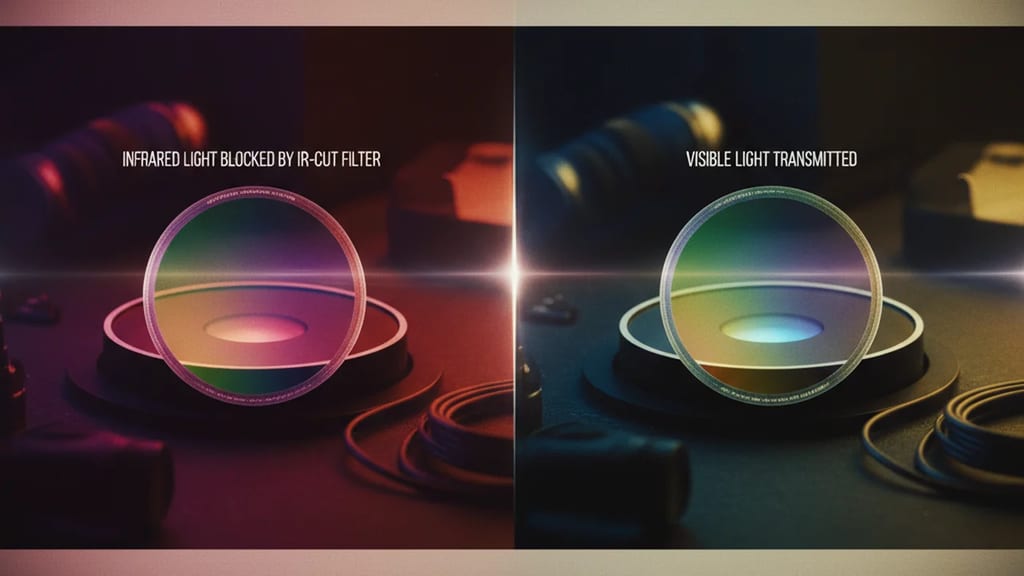
Optical filter blocking infrared light above 750 nm (>95% visible light transmission, <1% IR) to prevent color shift in digital sensors.

Technical Details

Standard IR filters exhibit a transmission of >95% for visible light and <1% for infrared light above 750 nm. The blocking effect is achieved through interferometric cancellation using 20-50 alternating layers of materials with different refractive indices, such as titanium oxide (n=2.4) and silicon oxide (n=1.46). Hot mirror variants reflect IR radiation back, while absorbing filters convert the energy into heat. Motorized IR filters in professional cameras can switch between day and night modes, with the mechanical movement taking 0.2-0.8 seconds.

History & Development

The first IR filters appeared in 1975 with the advent of the first CCD cameras, as these sensors were significantly more sensitive to infrared than film emulsions. Sony introduced the first integrated IR cut filter in the Betacam series in 1981. Red Digital Cinema revolutionized the system in 2007 with the Red One by offering interchangeable OLPF/IR filter combinations (Optical Low Pass Filter). Arri implemented permanently installed IR/UV cut filters in the Alexa series in 2010, with 99.9% blocking above 750 nm.

Practical Use in Film

Without IR filters, characteristic color shifts occur: black textiles appear reddish, skin tones become unnaturally rosy, and vegetation takes on a magenta cast. "Mad Max: Fury Road" (2015) temporarily removed IR filters for its desert sequences to enhance the surreal color grading. Daylight shots with removed IR filters require additional ND filters (Neutral Density), as 30-40% more light reaches the sensor. With LED lighting, the IR filter is essential, as many LEDs exhibit strong IR emissions above 800 nm.

Comparison & Alternatives

UV filters exclusively block ultraviolet radiation below 400 nm, while IR filters limit the upper spectrum. Combined UV/IR filters integrate both functions into a single element. OLPF systems (Optical Low Pass Filter) additionally reduce moiré effects through controlled image blurring. For night vision shots, IR filters are mechanically or electronically deactivated to utilize IR illumination. Software-based IR correction in post-production cannot fully replace physical filters, as already oversaturated color channels are not reconstructible.
From the crafts

Perspectives

Cinematographer

Ich plane IR-Filter-Einsatz bereits beim Location-Scouting, da starke IR-Quellen wie Sonnenlicht oder Halogen-Scheinwerfer die Farbwiedergabe massiv beeinflussen. Bei Beauty-Shots entferne ich bewusst den IR-Filter für den charakteristischen "Film-Look" mit weicheren Hauttönen, muss dann aber die Belichtung um 1,5 Blendenstufen reduzieren. Moderne LED-Panels teste ich grundsätzlich mit Spektrometer, da billige LEDs oft IR-Spitzen bei 850 nm haben.

Director

Ich setze modifizierte IR-Filter gezielt für surreale oder traumartige Sequenzen ein, da die veränderte Farbwiedergabe unterbewusst "Unwirklichkeit" vermittelt. Bei Thriller-Produktionen nutze ich die rötliche Verschiebung durch entfernte IR-Filter für Spannungsaufbau in Innenräumen. Die Technik funktioniert besonders bei Szenen mit viel schwarzer Kleidung oder Vegetation, wo der Magenta-Shift die Atmosphäre verstärkt.

Producer

IR-Filter-Sets kosten 800-2.500 Euro pro Kamera und sind Verschleißteile, die bei sandigen Locations häufig ersetzt werden müssen. Ich kalkuliere für mehrtägige Desert-Shoots grundsätzlich Ersatzfilter ein, da Kratzer die gesamte Aufnahme ruinieren können. Bei Multi-Kamera-Setups achte ich auf identische IR-Filter-Spezifikationen, da bereits 5% Abweichung in der Transmission später teure Color-Correction bedeutet.

More in the lexikon

Related terms

Test your knowledge

Quiz

1. Was beschreibt „IR-Sperrfilter" am besten?

2. Zu welchem Department gehört „IR-Sperrfilter"?

3. Wie viele verschiedene Fachperspektiven bietet dieser Eintrag?

Report an error
From the Filmfarm ecosystem

Understand visual language, budget productions, connect crew.

The Lexikon is part of the Filmfarm ecosystem — alongside budgeting (FilmBalance), an industry magazine (FilmCircus) and crew networking (FilmCall, CrewMesh). One shared vocabulary for the whole production.

FilmFarm FilmRadarComing soonFilmPulseComing soonFilmNumbersComing soonFilmCapitalComing soonFilmLabComing soonFilmBalanceComing soonFilmCircusComing soon