Filmlexikon.
Support
Hot Mirror
Camera · Terms

Hot Mirror

Murnau AI illustration
flow para roll take

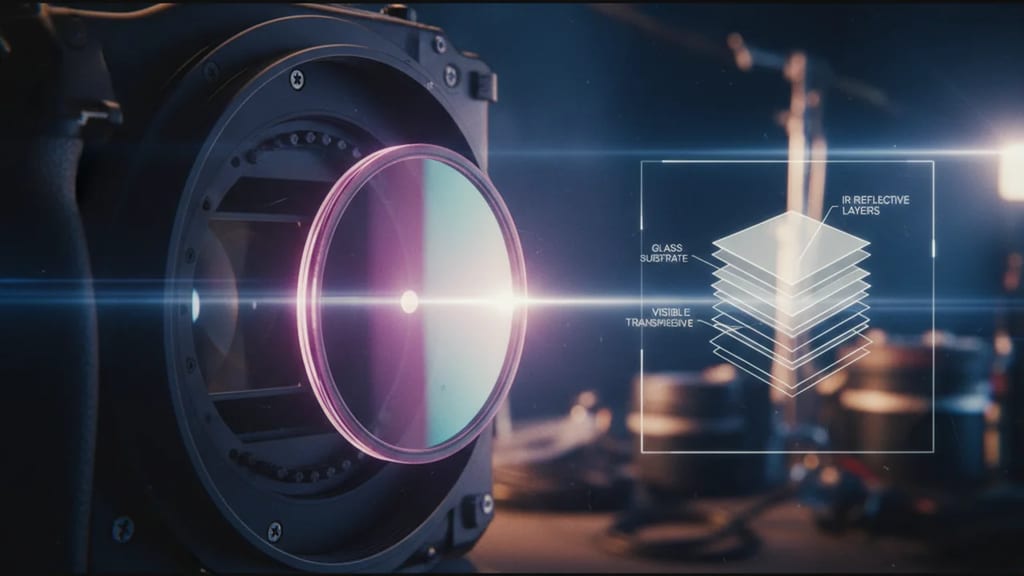
Optical filter with 50 alternating nanometer-layers blocking infrared light above 680–720 nm while transmitting visible light to prevent color shifts on digital sensors.

Technical Details

Hot mirrors utilize up to 50 alternating layers of materials such as titanium dioxide (TiO₂) and silicon dioxide (SiO₂) with thicknesses of 50-200 nanometers. The cutoff wavelength typically lies between 680-720 nm, with the transition band being only 10-20 nm wide. Standard film formats use hot mirrors with a 45° angle of incidence in beam splitter cubes or as flat filters directly in front of the sensor. High-quality versions achieve an optical density of 4.0 in the IR range and exhibit reflection losses below 0.5%.

History & Development

The first hot mirrors emerged in 1950 at Bell Laboratories for military night vision devices. Eastman Kodak adapted the technology in 1963 for professional film cameras to prevent thermal damage to film emulsions. With the introduction of digital sensors in 1999, hot mirrors gained new significance, as CCD and CMOS chips exhibit high IR sensitivity. Modern multispectral coatings since 2010 combine hot mirror properties with UV blocking and anti-reflection coatings.

Practical Application in Film

In "Mad Max: Fury Road" (2015), hot mirrors prevented color shifts caused by intense desert radiation on RED Dragon cameras. Roger Deakins systematically used them in "Blade Runner 2049" (2017) for consistent skin tones under mixed lighting from daylight and artificial light. Hot mirrors eliminate the typical magenta cast that occurs with high IR exposure on digital sensors. In green screen productions, they prevent IR spill from lighting fixtures, which causes keying problems. The filter also reduces thermal noise during longer takes or at high ISO values.

Comparison & Alternatives

In contrast to cold mirrors, which transmit IR and reflect visible light, hot mirrors completely block thermal radiation. UV/IR cut filters combine both functions but often exhibit poorer optical properties. For low-light shooting, hot mirrors can be replaced by switchable IR blocking filters that are deactivated at night. Modern cameras like the ARRI Alexa Mini LF integrate hot mirror coatings directly into the sensor window, making external filters obsolete.

From the crafts

Perspectives

Cinematographer

Ich verwende Hot Mirrors konsequent bei Außenaufnahmen mit digitalen Kameras, da sie Farbtemperatur-Shifts durch IR-Strahlung eliminieren. Besonders bei Hauttönen und in der Color Pipeline spare ich dadurch erhebliche Korrekturzeit. Bei gemischten Lichtquellen verhindert der Filter unvorhersagbare Farbstiche, die erst in der Post sichtbar werden.

Director

Hot Mirrors geben mir die Sicherheit, dass die Farben am Set denen im finalen Bild entsprechen, besonders bei emotionalen Hautton-Sequenzen. Ich kann die Stimmung gezielter über Licht und Farbe steuern, ohne später von IR-bedingten Verfärbungen überrascht zu werden. Bei intensiven Lichtsetups bleibt die visuelle Kontinuität erhalten.

Producer

Der Hot Mirror kostet 150-400€ pro Kamera, spart aber erhebliche Kosten in der Post-Produktion durch reduzierten Color-Correction-Aufwand. Bei Außendrehs verhindert er Nachdreh-Situationen wegen unbrauchbarer Farbwiedergabe. Die Anschaffung amortisiert sich bereits nach zwei Drehtagen durch gesparte Arbeitszeit des Coloristen.

More in the lexikon

Related terms

Test your knowledge

Quiz

1. Zu welchem Department gehört „Hot Mirror"?

2. Wie viele verschiedene Fachperspektiven bietet dieser Eintrag?

Report an error
From the Filmfarm ecosystem

Understand visual language, budget productions, connect crew.

The Lexikon is part of the Filmfarm ecosystem — alongside budgeting (FilmBalance), an industry magazine (FilmCircus) and crew networking (FilmCall, CrewMesh). One shared vocabulary for the whole production.

FilmFarm FilmRadarComing soonFilmPulseComing soonFilmNumbersComing soonFilmCapitalComing soonFilmLabComing soonFilmBalanceComing soonFilmCircusComing soon