Filmlexikon.
Support
Horizontal Flare
Camera · Terms

Horizontal Flare

Murnau AI illustration
flow para roll take

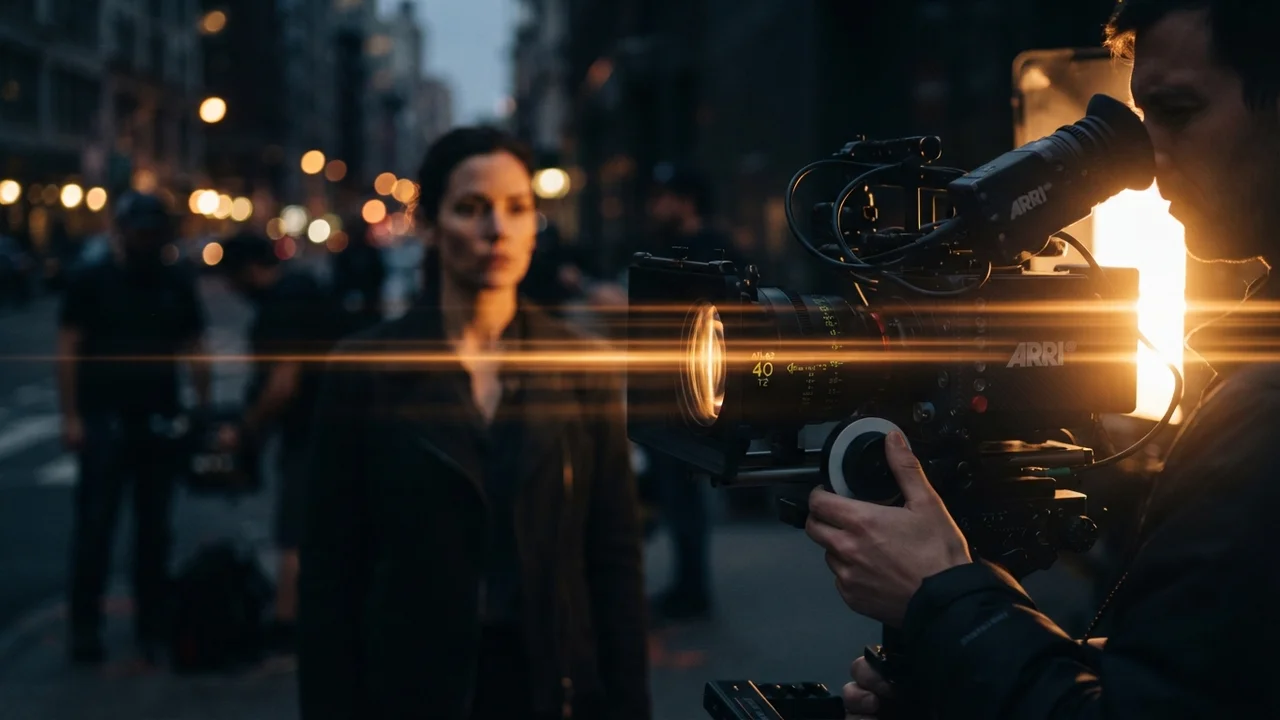
Horizontal lens flare appearing at focal lengths above 85mm when side light hits the front element, creating warm light streaks parallel to the optical axis.

Technical Details

Horizontal flare primarily occurs with focal lengths over 85mm and apertures between f/1.4 and f/2.8 when light sources with an intensity above 3200K strike the front lens laterally. Zoom lenses with more than 12 lens elements are particularly susceptible, as the probability of internal reflections increases exponentially. In digital cameras, the effect is amplified by the reflective properties of CMOS and CCD sensors. Anamorphic lenses, due to their cylindrical lens elements, produce particularly striking horizontal flares with a characteristic bluish tint in daylight.

History & Development

The term became established in 1967 with the introduction of Panavision Primo lenses, which produced new types of flare due to their complex coated elements. Cinematographer Gordon Willis systematically documented horizontal flares during the filming of "The Godfather" (1972) and defined their technical parameters. The digital revolution from 2005 onwards amplified the phenomenon through the higher light sensitivity of CMOS sensors. Modern anti-reflective coatings like Zeiss T* (since 2008) reduce horizontal flares by up to 78% compared to uncoated lenses.

Practical Application in Film

Christopher Nolan consciously utilized horizontal flares in "Interstellar" (2014) with modified IMAX lenses to visualize the vastness of space. Denis Villeneuve specifically employed 1970s Canon K35 lenses in "Blade Runner 2049" (2017), whose uncoated elements create characteristic horizontal flare effects. The technique works optimally in backlight setups with a light-to-shadow ratio of at least 1:8. Undesired horizontal flares can be eliminated using matte boxes with side flags or polarizing filters.

Comparison & Alternatives

Horizontal flare differs from vertical lens flare by its orientation parallel to the image axis and its more uniform light distribution. While anamorphic flares produce characteristic blue lines, horizontal flare typically appears in warm tones between 2800K and 4200K. Digital post-production tools like DaVinci Resolve have offered specialized de-flare algorithms since version 17 that can specifically remove horizontal artifacts. Vintage lenses such as Cooke Speed Panchros produce more organic horizontal flares than modern computer-optimized lenses.

From the crafts

Perspectives

Cinematographer

Ich nutze horizontale Flares gezielt für emotionale Höhepunkte, indem ich vintage Cooke-Objektive bei f/2 einsetze und Prakticals seitlich positioniere. Die Herausforderung liegt darin, den Sweet-Spot zwischen 30-45 Grad Einfallswinkel zu finden, wo der Flare dramatisch wirkt, aber die Bildschärfe nicht beeinträchtigt. Bei digitalen Kameras wie der ALEXA Mini muss ich die Belichtung um 1/3 Blende reduzieren, da horizontale Flares schnell clippen.

Director

Horizontale Flares verstärken die Intimität zwischen Charakteren in Nahaufnahmen, besonders in emotionalen Dialogen bei Sonnenuntergang oder Kerzenschein. Ich setze sie bewusst in Wendepunkten der Handlung ein, da sie unterbewusst Bewegung und Dynamik suggerieren. Die horizontale Ausrichtung führt das Auge des Zuschauers entlang der Bildkomposition und kann Blickrichtungen zwischen Schauspielern verstärken.

Producer

Horizontaler Streulicht durch Vintage-Objektive bedeutet 15-20% längere Drehzeiten, da DoPs mehr Aufnahmen für die perfekte Flare-Intensität benötigen. Ich kalkuliere zusätzlich 2-3 Drehtage für Exteriors bei schwierigen Lichtverhältnissen ein. Die Kosten für geeignete Objektive wie Cooke S4 liegen bei 800-1200 Euro pro Drehtag, aber der visuelle Impact rechtfertigt diese Investition für Premium-Produktionen mit entsprechendem Budget.

More in the lexikon

Related terms

Test your knowledge

Quiz

1. Zu welchem Department gehört „Horizontaler Streulicht"?

2. Wie viele verschiedene Fachperspektiven bietet dieser Eintrag?

Report an error
From the Filmfarm ecosystem

Understand visual language, budget productions, connect crew.

The Lexikon is part of the Filmfarm ecosystem — alongside budgeting (FilmBalance), an industry magazine (FilmCircus) and crew networking (FilmCall, CrewMesh). One shared vocabulary for the whole production.

FilmFarm FilmRadarComing soonFilmPulseComing soonFilmNumbersComing soonFilmCapitalComing soonFilmLabComing soonFilmBalanceComing soonFilmCircusComing soon