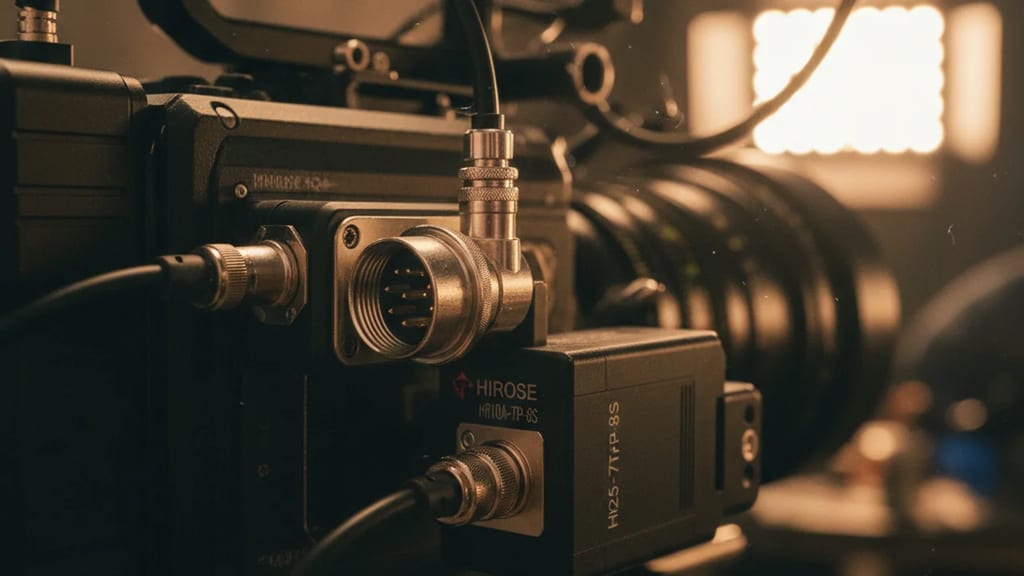
Technical Details
Standard Hirose connectors in film cameras use the HR10A format with a 10.2mm outer diameter and a self-locking bayonet connector. The contacts are made of gold-plated bronze with a contact resistance of a maximum of 20 milliohms at 100mA. Typical configurations are 4-pin for power supply (12V/24V), 6-pin for motor control, and 12-pin for complex camera accessory communication. The connector cycle life is at least 500 connections at ambient temperatures from -55°C to +125°C.
History & Development
In 1973, Arriflex introduced the first Hirose connector in the 16SR, as conventional XLR connectors were too large for compact film cameras. Panavision adopted Hirose standards for the Panaflex series in 1981. From 1995 onwards, the HR10A-7P established itself as the industry standard for electronic camera accessories. RED Digital Cinema used modified Hirose connectors for the RED ONE starting in 2007, while ARRI switched to proprietary LEMO systems with the ALEXA in 2010.
Practical Use in Film
Hirose connectors power follow-focus systems, electronic viewfinders, and wireless receivers directly from the camera battery. In "Mad Max: Fury Road" (2015), 6-pin Hirose connectors enabled remote control of camera pans over distances of 30 meters. Documentary filmmakers appreciate the compact design for handheld shots. The self-locking mechanism prevents accidental disconnection during camera movements, while the gold contacts resist corrosion in humid climates.
Comparison & Alternatives
LEMO connectors offer higher sealing (IP68 versus IP40 for Hirose), but are 40% more expensive and larger. Fischer Connectors dominate outdoor shooting under extreme conditions. D-Tap connectors have largely replaced standard Hirose for simple power supply. Modern cameras like the ARRI ALEXA Mini LF use USB-C and 6-pin LEMO, while older film equipment continues to rely on Hirose compatibility.