Technical Details
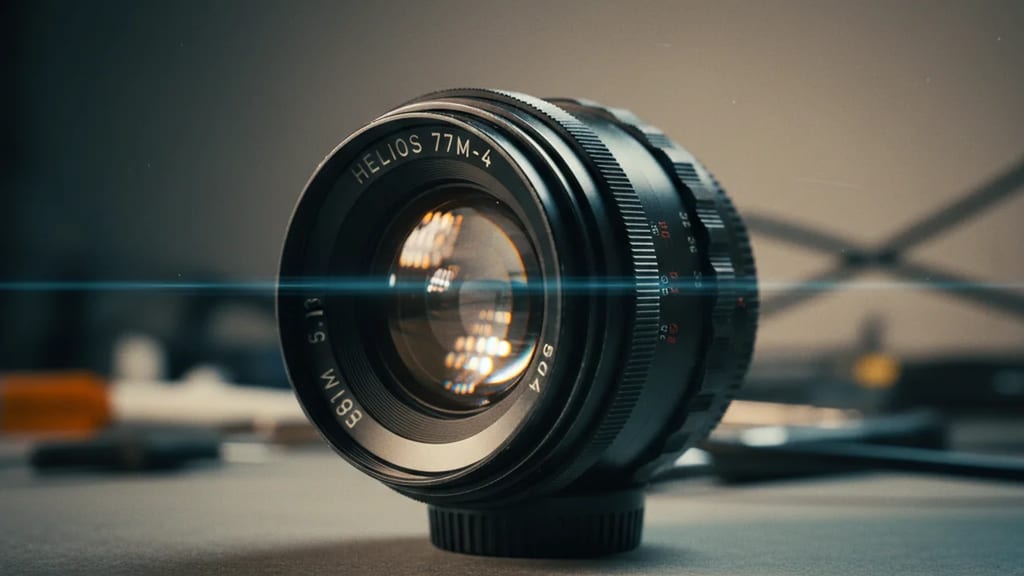
The optical construction comprises six lens elements with single coating, which produces characteristic lens flares in backlight situations. The lens weighs 280 grams with a length of 65mm and features a minimum focusing distance of 0.8 meters. The aperture range extends from f/1.8 to f/16 with a semi-automatic preset diaphragm. The filter thread measures 49mm. The Helios series was produced in various versions, including the 77M-4 specifically for 16mm cameras, as well as versions for 35mm cameras (44M-4, 44M-5).
History & Development
Development began in 1955 at the LOMO factory in Leningrad as part of the Soviet program for in-house production of optical devices. The design was based on confiscated Zeiss documentation from occupied Germany after 1945. Series production started in 1958 and continued until the mid-1980s. Over 500,000 units were produced, primarily for export to socialist countries and as a cost-effective alternative to Western lenses.
Practical Use in Film
At wide apertures, the Helios 77M-4 produces a characteristically soft bokeh with a spiral structure (Swirly Bokeh), which is particularly appreciated in portrait shots. Eastern European film productions of the 1960s and 70s frequently used it for close-ups and dramatic scenes. The lens exhibits moderate chromatic aberration and noticeable vignetting at f/1.8, making it suitable for atmospheric low-key shots. The optical characteristics lend images a vintage-like look with reduced contrast.
Comparison & Alternatives
Compared to the original Zeiss Biotar, the Helios 77M-4 shows lower sharpness performance but similar bokeh characteristics. Modern alternatives like the Meyer-Optik Trioplan 100mm f/2.8 specifically replicate these vintage qualities. For 16mm productions, it competed with the Angenieux 75mm f/2.5 and Zeiss lenses but was significantly more affordable. Today, filmmakers use the Helios 77M-4 via M42 adapters on digital cameras for a deliberately nostalgic visual language.