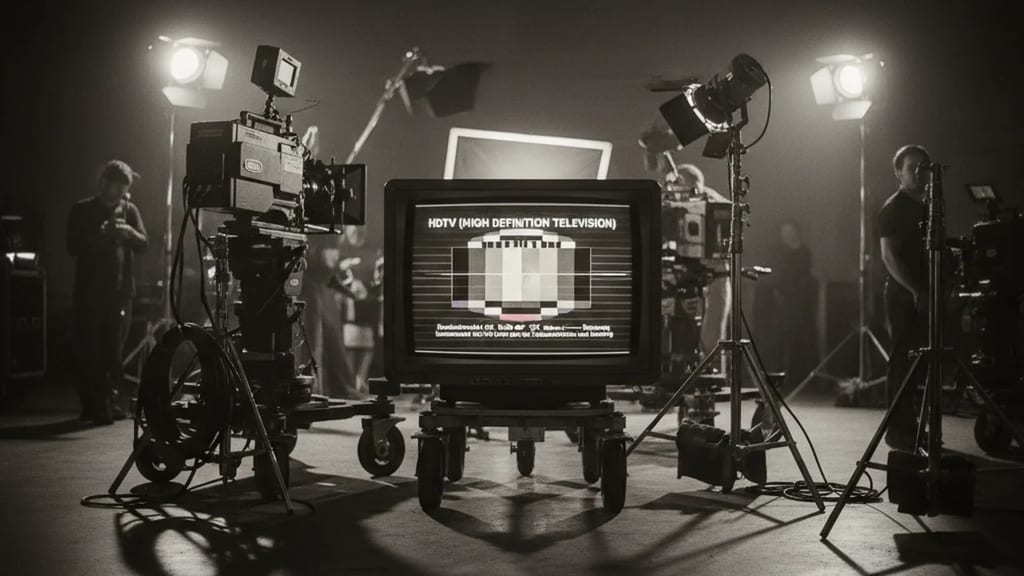
Broadcast standard with 1080 or 720 lines — today's baseline for TV and streaming. Differs from DCI-4K cinema in aspect ratio and color sampling.
Anyone shooting today cannot avoid HDTV — whether they want to or not. The standard is defined by two resolutions: 1,920 × 1,080 pixels (Full HD, usually called 1080p) or 1,280 × 720 pixels (720p). The aspect ratio is 16:9, which has been the broadcasting standard for years. Important: HDTV is not a cinema format. It's television, streaming, screen distribution — and anyone who confuses this quickly runs into technical problems.
On set, the HDTV standard primarily makes a difference in camera choice and frame rate. PAL countries traditionally work with 25 fps, NTSC regions with 29.97 fps (or an integer 30 fps). In practice, this means a European 1080p25 production looks different from an American 1080i60 — not just in frame rate, but also in the perception of motion. Interlacing (the 'i' in 1080i) is an old television crutch; progressive scanning (1080p) has long since prevailed, especially for editing and online distribution. Anyone still working with 1080i will regret it in the post-production workflow — deinterlacing costs quality.
The crucial difference to DCI-4K or other cinema standards lies in sampling and color depth. HDTV typically runs with 4:2:0 chroma subsampling — which is sufficient for TV monitors, but looks thin on a large cinema screen. DCI-4K, on the other hand, calculates with 4:4:4 full-color sampling and higher bitrates. Anyone preparing HDTV material for cinema has to upscale and loses quality in the process. This is not optimal, but it's standard in low-budget production.
Practically, this means for planning: If the final format is HDTV — streaming, TV broadcast, web — then I shoot natively in HD resolution or higher. Never below. A 2K or 4K camera with downsampling to Full HD is cleaner than a native HD camera with upscaling. In editing, I work with proxy sequences in proxy quality (often ProRes Proxy), but always deliver in the required HDTV specs — this is economical and prevents time-consuming conversions.
Related terms
Quiz
1. Zu welchem Department gehört „HDTV"?