Overview
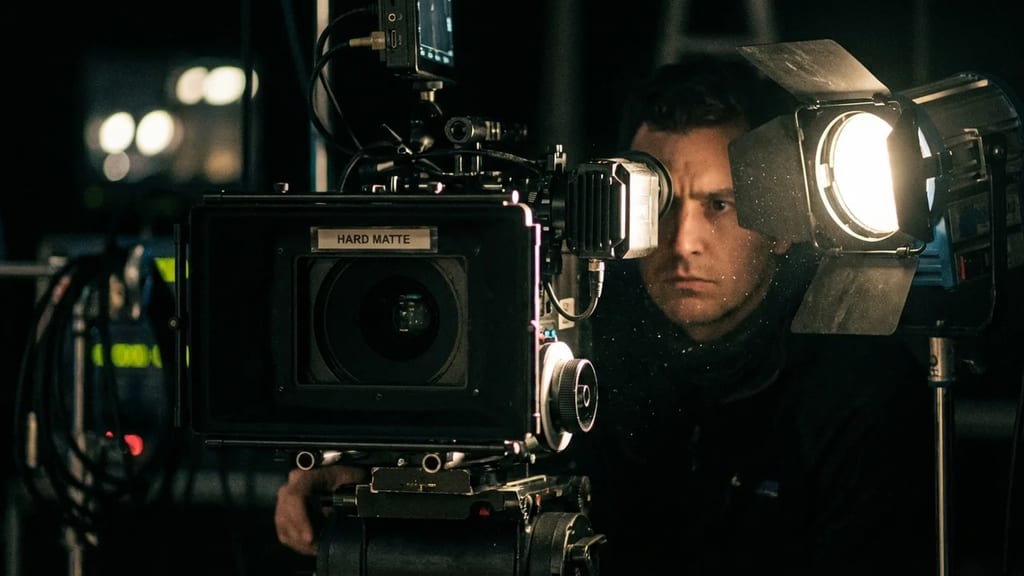
In filmmaking, a Hard Matte (often translated as "hard masking") refers to a process where the desired aspect ratio is physically set within the camera's aperture during recording. A fixed mask blacks out the unwanted areas of the image – typically the top and bottom – ensuring that only the intended frame is exposed. The masked borders appear as permanent black bars and are an inseparable part of the image.
The opposite is a Soft Matte (open masking): Here, the full negative is exposed, and the final aspect ratio is determined later – either by an aperture plate in the projector or by cropping in post-production. If a soft-matte film is shown without this masking (so-called Open Matte), microphones, lights, or set edges that should have been hidden often appear at the top or bottom of the image.
When Masking Applies
Hard masking can be implemented at various stages of the production chain – not necessarily just in the camera:
- In the Camera: A mask in the aperture limits the exposed negative area.
- In the Print Lab: The borders are permanently masked during the creation of the print.
- In the Digital Intermediate (DI): The cropping is permanently "burned" into the image digitally.
The characteristic feature is that the result has a fixed, unchangeable aspect ratio. In practice, hard-matte prints are rarely exposed to the exact target aspect ratio but with some reserve – for example, a 1.85:1 print slightly flatter – to allow for slightly different projector aperture plates.
Typical Aspect Ratios
Hard Matte is usually based on common widescreen cinema formats created by masking the 35mm full frame (as opposed to anamorphic Scope format):
| Format | Aspect Ratio | Distribution |
|---|
| Flat (US Cinema) | 1.85:1 | North America, international |
| Flat (Europe) | 1.66:1 | especially European cinema |
Use on Set and in Post
Hard Matte gives the cinematographer the greatest control: what is masked in the viewfinder cannot be accidentally revealed later. The cinematographer sees the final frame directly and only needs to keep that area clear of boom mics, light stands, and set boundaries. The disadvantage is the lack of flexibility: later reformatting for other distribution channels (TV, home cinema) is hardly possible without headroom and footroom above and below the masked image.
In contrast, Soft Matte exposes more negative area and allows for alternative framing – but at the risk of revealing set elements once the mask is removed (a classic error in "Full-Screen" releases on VHS and DVD).