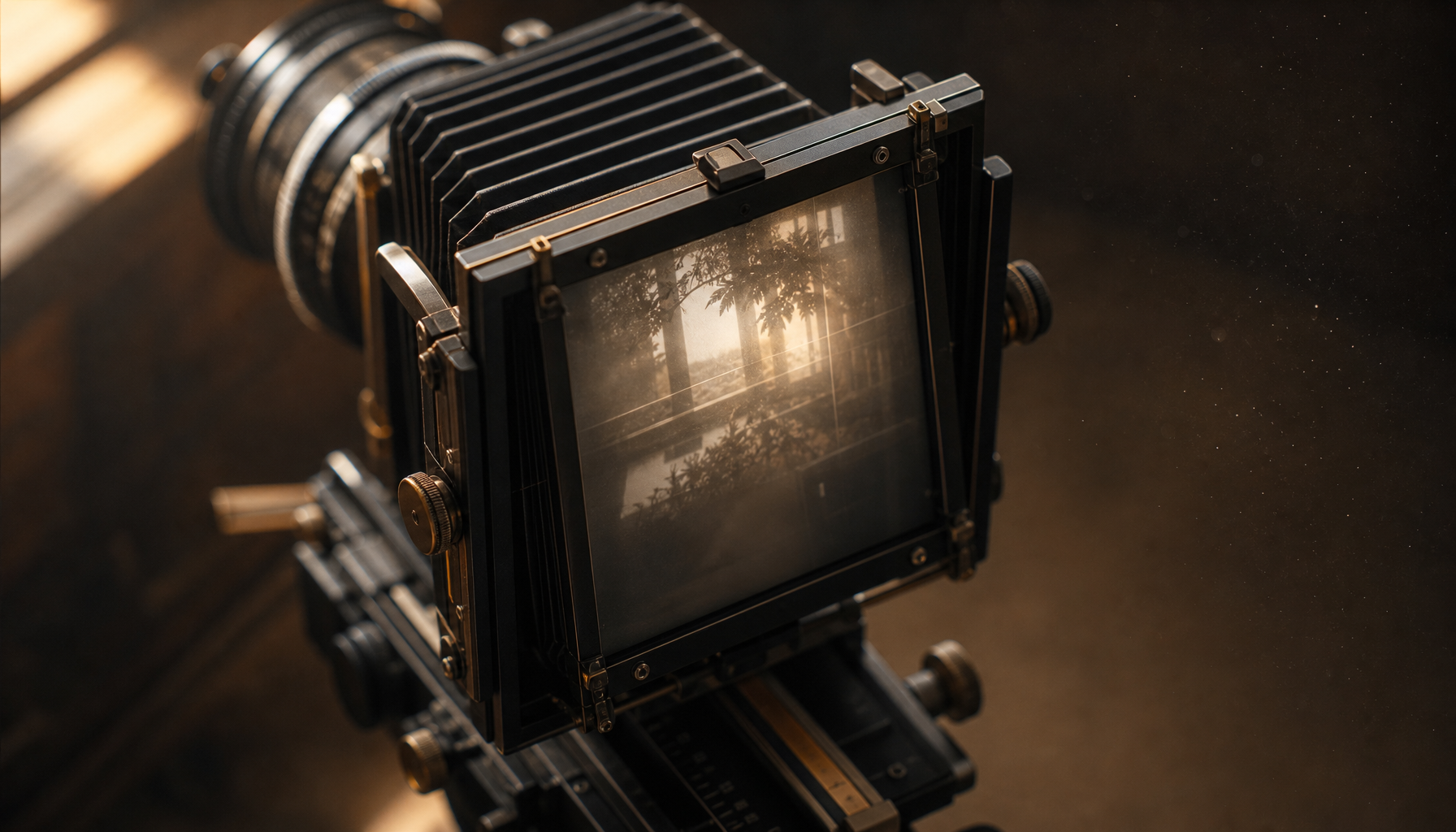
Technique where a digital camera films through the ground glass of a large format camera — the optical properties of the LF lenses are transferred onto the digital medium.
The Ground Glass Camera System combines two camera worlds: a digital video camera (e.g., Sony FX9) films through the ground glass of a large-format analog camera (e.g., Graflex Graphic View 4x5"), on which vintage large-format lenses are mounted. The image is thus created in two stages — first through the optical system of the LF camera, then through the lens of the video camera.
Why It Works
The idea is similar to the principle of filming an IMAX screen with an iPhone: the recording system "inherits" the optical characteristics of the projecting system. An image with the character of large-format lenses emerges on the ground glass — bokeh, depth of field, dimensionality, vignetting. The video camera records this image, including the typical texture of the ground glass itself: a static "grain" that fundamentally differs from film-type, dynamic grain.
The Rig Setup
Light-tightness between the video camera and the ground glass is critical. A custom bellows (similar to a photographic bellows extension) connects the video camera's matte box to the ground glass frame. The greater the distance between the two cameras, the less vignetting — but the larger and more unwieldy the rig. When changing positions, the video camera's focus must be readjusted because minimal alignment deviations of the ground glass create focus shifts.
Lighting Challenge
The system absorbs light at several points: the LF lenses are typically slow (f/4.5–f/9), and the ground glass itself scatters some of the light. On set, this means significantly more light than with conventional shooting, often 4000 ISO on the video camera despite additional artificial lighting. A variable ND on the video camera is essential for exposure adjustments.
What It Can Do That No Filter Can
The ground glass texture is static — it remains constant in the image, regardless of movement or exposure. This fundamentally distinguishes it from film grain, which varies per frame, and from digital grain plugins. Added to this are the optical characteristics of the large-format lenses: field curvature, vignetting, flare character — all of this is created physically, not in post. Light leak artifacts, which occur when ambient light directly hits the ground glass, can be deliberately used as a creative element.
Related terms
Quiz
1. Zu welchem Department gehört „Mattscheiben-Kamerasystem"?