Technical Details
Current Hero models use 1/1.9" CMOS sensors with 27 megapixels and the proprietary GP2 processor. The Hero12 Black achieves video resolutions of 5.3K/60p, 4K/120p, and Full HD/240p with 10-bit color depth. The ultra-wide-angle lens covers a field of view of 156° (SuperView mode), reducible to 95° in Linear mode. HyperSmooth stabilization works with electronic image stabilization and gyroscope data. Waterproof up to 10 meters without an additional housing, expandable to 60 meters with a Dive Housing.
The modular design allows lens changes on Hero models from generation 9 onwards. Battery life is 70-90 minutes for 4K recording, with storage on microSD cards up to 1TB.
History & Development
Nick Woodman founded GoPro in 2002 after a surfing trip; the first Hero camera appeared in 2004 as a pure still camera for $20. In 2006, the Digital Hero followed with a 10-second video function, and in 2009, the HD Hero revolutionized the action camera market with 1080p video. The IPO in 2014 valued GoPro at $2.95 billion.
In 2016, the Hero5 introduced cloud upload and voice control, and in 2018, the Hero7 established HyperSmooth as the industry standard for electronic stabilization. The Hero11 (2022) brought 10-bit video and 8:7 sensor mode, and the Hero12 (2023) introduced HDR video with Bluetooth microphone support.
Practical Use in Film
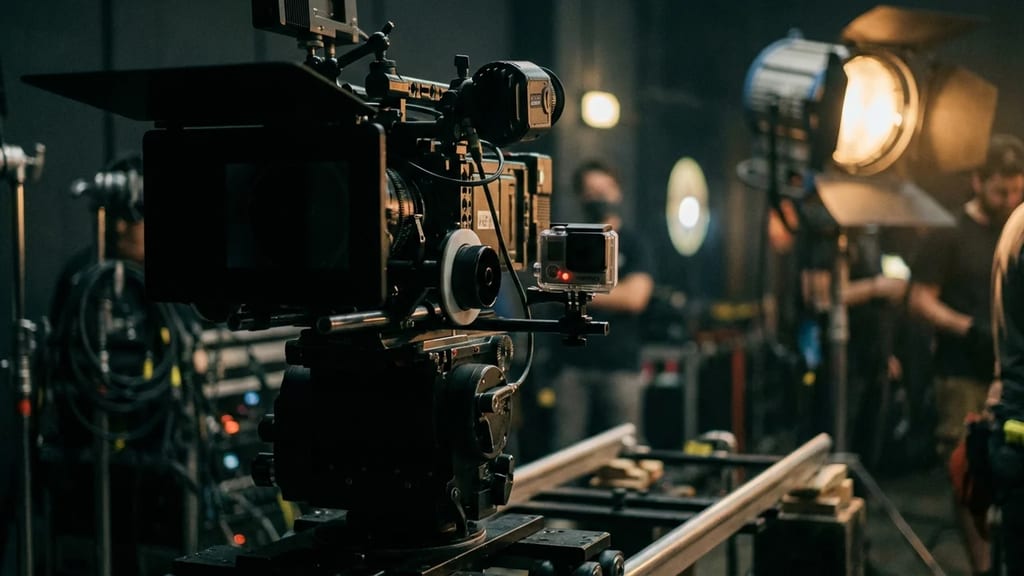
GoPros redefined the found-footage genre: "Hardcore Henry" (2015) was shot entirely with modified GoPro rigs, and "The Revenant" used them for close-up bear shots. Marvel employs them for stunt sequences, and the "Mission: Impossible" films use them on motorcycles and helicopters.
Typical workflows integrate GoPro footage as B-roll into larger productions or as primary cameras for extreme sports documentaries. The wide-angle look requires deliberate framing, as subjects can quickly appear lost. LUT adjustments are used to match the typical GoPro look to main cameras.
Limitations are apparent in low-light conditions (ISO performance ends at 1600) and audio quality without an external microphone.
Comparison & Alternatives
DJI action cameras offer comparable specs with better low-light performance, while Insta360 specializes in 360° recordings. Traditional cinema cameras achieve higher image quality but require more complex protective housings and stabilization rigs.
Smartphone-gimbal combinations are increasingly replacing GoPros for less extreme applications, while professional crash cameras like the Kinefinity TERRA are supplanting them in high-end productions. GoPros remain unrivaled for underwater, motorcycle, and skydiving shots within a budget under €5,000.