Definition & Origin
German Expressionism (1919-1933) is an art movement that radically departs from naturalistic representation. Filmmakers of this era deliberately distorted reality to visually convey psychological and emotional states. Instead of depicting the world as it is, they created images that show how a character feels – through deformed architecture, aggressive shadows, and alienated spaces. This movement emerged directly after World War I in Germany, a time of profound psychological and societal insecurity.
Visual Characteristics & Stylistic Techniques
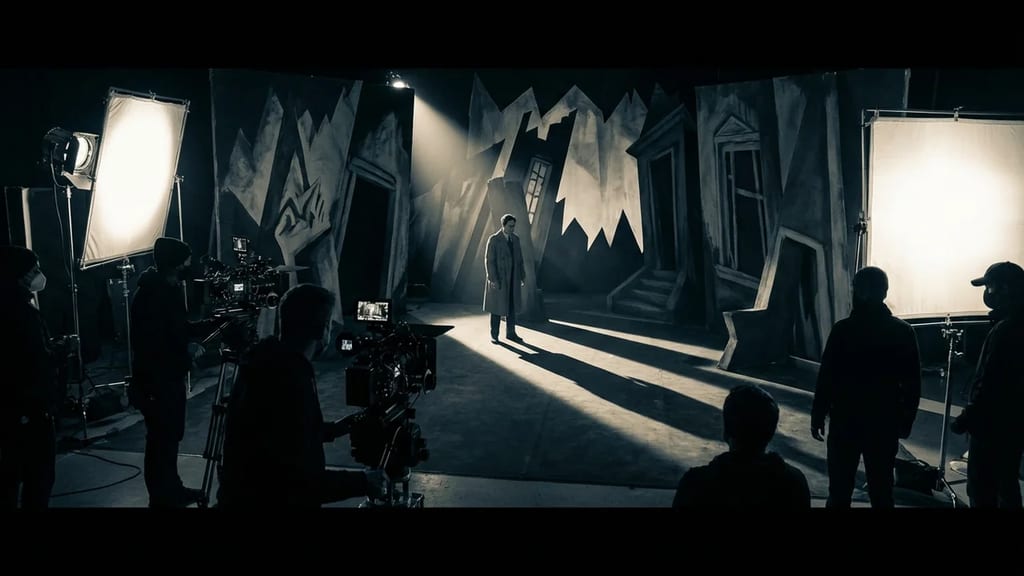
Architecture & Space: Expressionist sets deliberately employ unnatural forms, slanted walls, sharp angles, and geometric distortions. The set designs are not functional but emotional – they create unease through their illogical nature.
Lighting & Shadow: Lighting in Expressionist films is extreme and dramatic. Strong contrasts between light and shadow dominate the image. Shadows are often used as active visual elements, not merely the absence of light. Overexposure and unnatural shading intensify psychological tension.
Camera & Perspective: Camera angles are often distorted – bird's-eye views and low-angle shots intensify the emotional impact. Dynamic camera movements and innovative editing create a sense of disorientation.
Makeup & Costumes: Makeup is often exaggerated, with extreme contours and unnatural colors. Costumes are stylized and not realistic, underscoring the psychological dimension of the characters.
Historical Context
German Expressionism arose from several factors: the cultural trauma after World War I, artistic rebellion against naturalism, and the technical innovation of silent film, which could only express emotional truth through visual means. The Weimar Republic (1919-1933) was a period of extreme social insecurity, inflation, and political instability – these conditions are directly reflected in the Expressionist visual language.
The movement was closely linked to Expressionist painting and literature and had a strong presence at Ufa (Universum Film Aktiengesellschaft), the leading German film studio of the time.
Key Figures & Filmmakers
Robert Wiene (1873-1938) – Director of "The Cabinet of Dr. Caligari" (1920), the movement's milestone. Wiene perfected the integration of Expressionist painting and film narratology.
F.W. Murnau (1888-1931) – "Nosferatu" (1922) and "The Last Laugh" (1924) showcase his mastery of psychological visual language. Murnau's cinematography was technically innovative and emotionally complex.
Georg Wilhelm Pabst (1885-1967) – His films, such as "Pandora's Box" (1929), combine Expressionist techniques with psychological realism.
Cesare Klein – Production Designer of "The Cabinet of Dr. Caligari," whose set designs defined the Expressionist aesthetic.
Albin Grau – Production designer and co-writer of "Nosferatu," who perfected the movement's visual techniques.
Key Films & Masterpieces
The Cabinet of Dr. Caligari (1920) – The archetype of Expressionist cinema. The film depicts a mentally disturbed fortune-teller existing in bizarre, geometrically distorted sets. The distorted backdrops were built as painted canvases and photographed directly on stage – a technique.
Nosferatu: A Symphony of Horror (1922) – Murnau's silent masterpiece uses light and shadow to create psychological horror. The famous scene where Nosferatu's shadow creeps up the stairs is pure visual poetry of Expressionist cinema.
The Last Laugh (1924) – A film about an aging hotel doorman whose loss of dignity is depicted through innovative camera movements and emotional composition. Murnau uses the camera like an expressive brushstroke.
Pandora's Box (1929) – Pabst's masterpiece combines Expressionist techniques with psychological realism, depicting the moral corruption of society.
The Golem (1920) – A supernatural film with Gothic, Expressionist sets, exploring the fear of technology and power.
Technical Aspects & Cinematic Innovation
The silent film format was ideal for Expressionism, as emotional truth had to be conveyed solely through visual means. The films utilize:
- Extreme close-ups for psychological intensity
- Depth of field manipulation for emotional focus
- Rapid editing sequences in psychologically critical moments
- Dissolves and double exposures for dream and thought sequences
- Practical effects such as shadow techniques, overexposure, and optical distortions
Influence & Legacy
German Expressionism had a profound impact on film history:
- Film Noir (USA, 1940s-1950s): The extreme contrasts and psychological lighting of Expressionism were directly incorporated into Film Noir. Many Expressionist filmmakers (like Murnau and Pabst) emigrated to Hollywood, bringing their visual techniques with them.
- Horror Cinema: The psychological visual language of Expressionism defined modern horror films. Movies like "The Shining" (1980) and "Nosferatu the Vampyre" (1979) are direct descendants of Expressionist techniques.
- Visual Storytelling: Expressionism proved that cinema did not have to be naturalistic to be emotionally true. This opened doors for abstract, symbolic, and experimental filmmaking.
- Modern Cinematic Language: Contemporary filmmakers like Tim Burton and Guillermo del Toro directly reference Expressionist aesthetics.
Comparison & Contextualization
vs. Naturalism: While Naturalism depicts the world as it is, Expressionism deliberately distorts to express inner psychological states.
vs. Surrealism: Surrealism (which emerged later in the 1920s) also uses distortion, but for unconscious, traumatic processes. Expressionism remains more firmly rooted in psychological reality.
vs. Soviet Montage: Both are silent film movements, but while Soviet Montage creates meaning through rapid editing (Eisenstein), Expressionism creates meaning through spatial distortion and lighting.
Decline & End of the Movement
With the rise of National Socialism (1933), German Expressionism ended abruptly. The Nazi regime suppressed "degenerate art" and controlled all art forms. Many Expressionist filmmakers emigrated or were persecuted. The last major Expressionist period was 1930-1933; thereafter, ideologically controlled film productions dominated.
Reconstruction & Digital Restoration
Many original Expressionist films have been lost, but modern digital restoration has brought masterpieces like "The Cabinet of Dr. Caligari" and "Nosferatu" back to life. These restorations demonstrate that the Expressionist aesthetic is timeless and continues to move and disturb contemporary audiences.