Filmlexikon.
Support
Gain
Camera · Terms

Gain

Murnau AI illustration
flow para roll take

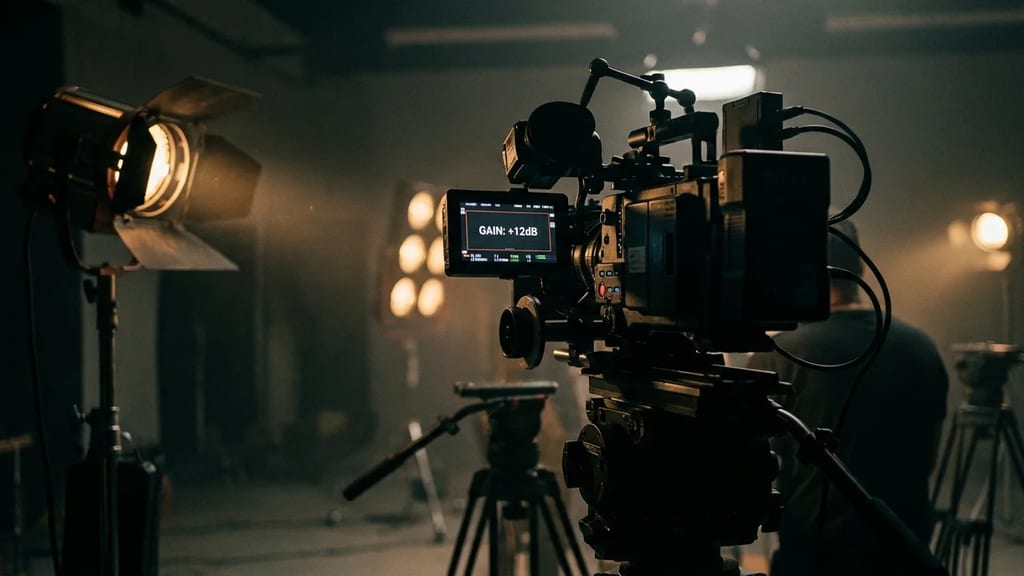
Electronic signal amplification in digital cameras to increase light sensitivity, equivalent to higher ISO values; at extreme levels, increases image noise.

Technical Details

Modern cinema cameras like the ARRI ALEXA 35 typically offer a gain range from -6 dB to +18 dB, corresponding to ISO values from 160 to 6400. The RED V-RAPTOR operates with a native ISO of 800 (0 dB gain) and reaches a maximum of ISO 102,400 (+14 dB). Gain is applied in the analog-to-digital converter before digitization to optimize the signal-to-noise ratio. Dual-native ISO sensors, as found in the Sony FX9, have two native sensitivity levels (ISO 800 and 4000) that can be switched between without loss of quality.

History & Development

Electronic signal amplification evolved from television technology in the 1950s, where Vidicon tubes already enabled variable sensitivities. In 1981, Sony introduced the HDC-300, the first professional video camera with adjustable electronic gain. The breakthrough for cinematography came in 2010 with the ARRI ALEXA, whose dual-gain architecture first enabled cinematic image quality at high ISO values. In 2016, Canon revolutionized low-light performance with the ME20F-SH, which still delivers usable images at ISO 4,000,000.

Practical Use in Film

For "Gladiator" (2000), Ridley Scott was the first to consistently use high gain levels on digital cameras for fight scenes in dim candlelight. Christopher Nolan deliberately avoids gain amplification beyond ISO 800 to maintain his characteristic low-noise image aesthetic. The Netflix series "Ozark" (2017-2022) achieves its dark atmosphere through systematic use of ISO 3200-6400 with available light. In documentaries, high gain allows for discreet shots without additional lighting, as seen in "Free Solo" (2018) on the rock faces of El Capitan.

Comparison & Alternatives

Gain differs from exposure compensation by actual signal amplification rather than post-hoc brightness adjustment. Push-processing in analog film achieves similar results but increases contrast and grain uniformly, whereas digital gain primarily amplifies image noise in the shadows. Modern AI-based noise reduction, such as DaVinci Resolve's Temporal NR, makes high gain values up to ISO 12,800 practically usable. LED panels as an alternative today offer 95+ CRI in a compact form factor, reducing the need for extreme gain amplification.
From the crafts

Perspectives

Cinematographer

Ich arbeite bevorzugt mit dem nativen ISO meiner Kamera, da hier das beste Signal-Rausch-Verhältnis herrscht – bei der ALEXA 35 sind das ISO 800. Wenn ich auf ISO 3200 hochgehe, plane ich bereits in der Postproduktion Rauschunterdrückung ein und belichte leicht über, um das Rauschen in den Schatten zu minimieren. Bei Nachtaufnahmen teste ich vorab, ob zusätzliches LED-Licht oder höherer Gain die bessere Bildqualität liefert.

Director

Hoher Gain ermöglicht mir authentische Lichtführung ohne technische Kompromisse – statt Scheinwerfer aufzubauen, kann ich mit vorhandenem Kerzenlicht oder Straßenlaternen arbeiten. Das digitale Rauschen bei ISO 6400 verleiht Horrorfilmen oder Thrillern eine organische, unruhige Textur, die zur Stimmung beiträgt. Ich entscheide bereits im Drehbuch, welche Szenen von der körnigen Ästhetik hoher ISO-Werte profitieren könnten.

Producer

Kameras mit gutem High-ISO-Performance reduzieren meine Beleuchtungskosten erheblich – weniger Trucks, kleinere Teams, schnellere Setup-Zeiten. Eine ARRI ALEXA 35 kostet zwar 2.000€ mehr pro Drehtag als eine Standard-Kamera, spart aber täglich 4-6 Stunden Beleuchterzeit ein. Bei Locations ohne Stromanschluss oder strengen Denkmalschutzauflagen rechnet sich High-Gain-Equipment durch eingesparte Generator- und Genehmigungskosten.

More in the lexikon

Related terms

Test your knowledge

Quiz

1. Zu welchem Department gehört „Verstärkung"?

2. Wie viele verschiedene Fachperspektiven bietet dieser Eintrag?

Report an error
From the Filmfarm ecosystem

Understand visual language, budget productions, connect crew.

The Lexikon is part of the Filmfarm ecosystem — alongside budgeting (FilmBalance), an industry magazine (FilmCircus) and crew networking (FilmCall, CrewMesh). One shared vocabulary for the whole production.

FilmFarm FilmRadarComing soonFilmPulseComing soonFilmNumbersComing soonFilmCapitalComing soonFilmLabComing soonFilmBalanceComing soonFilmCircusComing soon