Technical Details
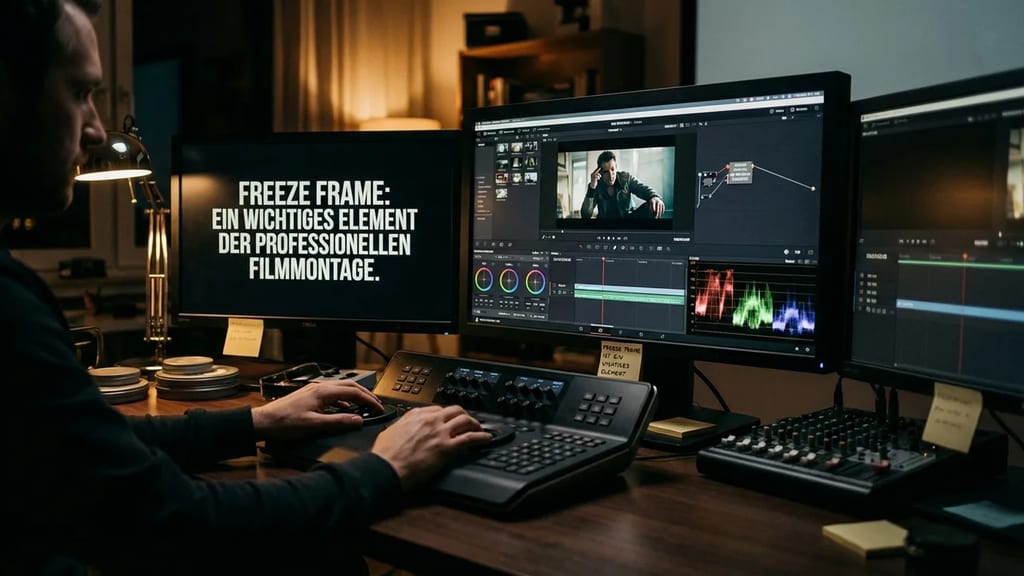
With 24fps material, a selected frame is copied exactly 24 times per second to create the illusion of a frozen moment. In digital post-production, this is achieved through time-stretching algorithms (Time Remapping) at 0% speed. Analog film copies required mechanical duplication of the chosen frame on the printing table.
Three main variants exist: the hard freeze frame (abrupt stop), the soft freeze frame (with fade in/out), and the animated freeze frame, where camera movements or zooms are overlaid on the frozen image. Image quality can be improved through interpolation between adjacent frames.
History & Development
François Truffaut used the first iconic freeze frame in film history in 1959's "The 400 Blows" – Antoine Doinel's gaze into the camera on the beach became a trademark of the Nouvelle Vague. George Stevens already used freeze frames for dramatic emphasis in 1956's "Giant."
The technique reached its peak in the 1970s with films like "Bonnie and Clyde" (1967) and "Butch Cassidy and the Sundance Kid" (1969). Digital editing systems since the 1990s have made freeze frames a standard tool in all post-production.
Practical Use in Film
A classic application of the freeze frame is for character introductions – for example, in "Goodfellas" (1990), where Scorsese introduces each protagonist with a freeze frame. Thelma Schoonmaker, Scorsese's editor, uses a duration of 2-4 seconds for optimal effect.
In the horror genre, freeze frames enhance shock moments, while comedies use them for punchlines. The workflow includes frame selection, quality control for enlargements, and color correction of the static image. Disadvantages appear with fast movements, where freeze frames can look blurry or smeared.
Comparison & Alternatives
A freeze frame differs from slow motion by a complete stop of movement, while extreme slow motion (1000fps+) achieves similar dramatic effects. Still photography in film, on the other hand, uses actual photographs instead of frozen film frames.
Modern motion graphics expand freeze frames with 2.5D techniques, where image layers are separated and animated spatially. Time Slice Photography with up to 120 synchronized cameras replaces classic freeze frames with 360-degree frozen moments, popularized by "The Matrix" (1999).