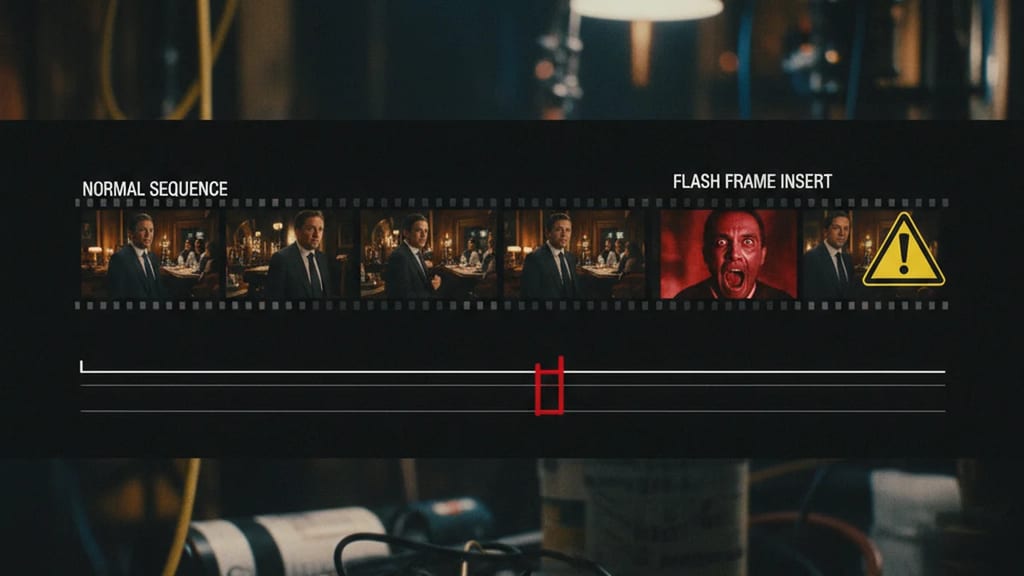
Technical Details
Flash frames are typically created with exposure values of 100% white (RGB 255,255,255) or extreme overexposure (+3 to +5 stops). In digital post-production, this corresponds to luminance values of 100-109 IRE (Institute of Radio Engineers). The optimal duration is 1-2 frames at 24fps, as 3+ frames become consciously perceptible. Variations include pure white flashes, colored flashes (often red for violence scenes), or heavily overexposed stills from the action.
History & Development
The first documented use was in 1966 in Kenneth Anger's "Scorpio Rising," where flash frames enhanced crash sequences. Director Nicolas Roeg perfected the technique in 1973 in "Don't Look Now" with 1-frame flashes during a love scene. William Friedkin popularized flash frames in 1973 in "The Exorcist" with 13 hidden subliminal frames of Pazuzu's face. The technique reached its peak in the 1990s through directors like David Fincher ("Fight Club," 1999) and Darren Aronofsky ("Requiem for a Dream," 2000).
Practical Use in Film
In "Fight Club," Fincher inserted Tyler Durden's face as single flash frames in four scenes before the character officially appears. Aronofsky used sequences of flash frames in "Requiem for a Dream" in combination with hip-hop montage (Snorricam, extreme close-ups) for drug-induced delirium sequences. "The Ring" (2002) used flash frames of the videotape images at 0.5-second intervals. The workflow requires precise frame-by-frame editing and synchronization with sound design, as flash frames are often combined with audio spikes.
Comparison & Alternatives
Flash frames differ from subliminal messages in their visibility – they are perceived unconsciously, not completely hidden. Jump cuts create narrative leaps, while flash frames have a psychological effect. Strobing effects use longer, rhythmic light sequences. Modern alternatives include digital glitch effects, lens flares, or HDR overexposure. Flash frames are suitable for horror, thrillers, and experimental films, less so for romantic comedies or documentaries.