Filmlexikon.
Support
Flash Forward
Theory · Terms

Flash Forward

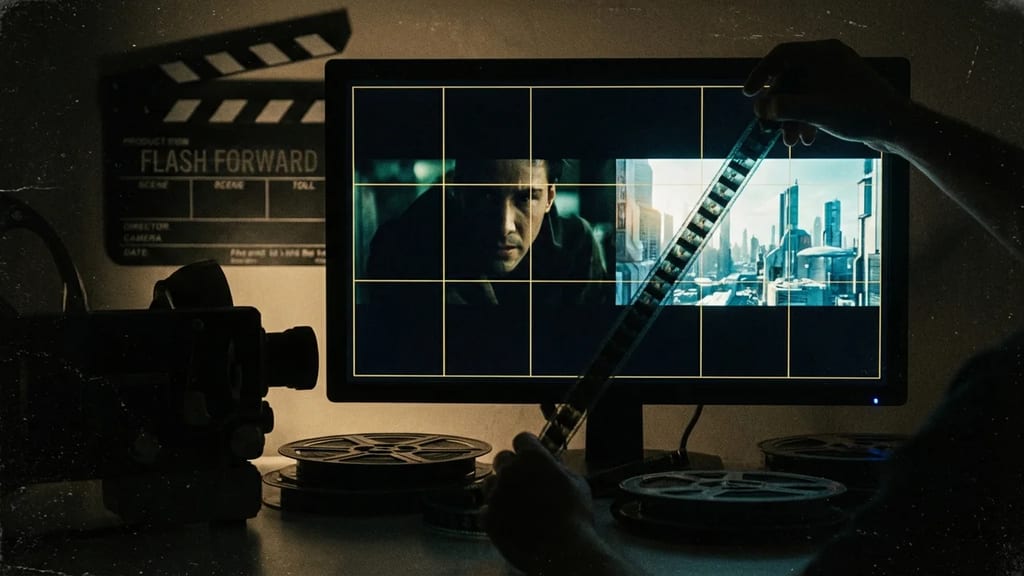
Murnau AI illustration
flow roll conflict

Narrative jump forward in time that anticipates future events, creating tension through prophetic preview or showing immediate consequences of action.

Technical Details

Flash forwards are realized in post-production through specific editing patterns: L-cuts with 0.5-2 seconds of audio lead-in, match-cuts via identical image composition, or smash-cuts for abrupt temporal leaps. Color correction is often performed with saturation values reduced by 15-30% or increased contrast values (+0.3 to +0.7 gamma) for visual differentiation. Three main variants dominate: the Prophetic Flash Forward (hinting at future events), the Revelatory Flash Forward (revealing the outcome of the plot), and the Circular Flash Forward (returning to the starting point).

History & Development

Alain Resnais systematically employed flash forwards for the first time in 1961 in "Last Year at Marienbad," followed by Nicolas Roeg's "Performance" (1970) with 23 flash forwards in a 105-minute runtime. The technique achieved commercial acceptance in 1994 with Tarantino's "Pulp Fiction" and became a standard tool of mainstream storytelling through the TV series "Lost" (2004-2010). Digital editing systems like Avid since 1989 enabled precise frame-accurate placement without costly negative cuts.

Practical Application in Film

"The Usual Suspects" (1995) uses 7 flash forwards for the gradual revelation of Keyser Söze's identity, while "Arrival" (2016) exposes 14 apparent flashbacks as flash forwards. The workflow requires meticulous script supervision: each flash forward shot needs exact continuity documentation for the later full scene. Advantage: increased narrative tension and non-linear dramaturgy. Disadvantage: doubling of shooting times for affected scenes and complex post-production.

Comparison & Alternatives

Flash forwards differ from flashbacks in their prognostic rather than retrospective function and from dream sequences in their factual plot relevance. Parallel editing (cross-cutting) shows simultaneous events, while flash forwards depict temporally displaced ones. Modern alternatives include split-screen techniques or VR-180 recordings for immersive future visions. Flash forwards are suitable for mystery and thriller genres, parallel editing for action sequences.

From the crafts

Perspectives

Cinematographer

Ich muss Flash Forward-Aufnahmen identisch zur späteren Vollszene ausleuchten - gleiche Kelvin-Temperatur, identische Lichtverhältnisse. Besonders kritisch bei Available Light-Situationen: Ein 2700K-Tungsten-Setup lässt sich drei Wochen später nicht exakt reproduzieren.

Director

Ich setze Flash Forwards gezielt zur emotionalen Manipulation ein - der Zuschauer erhält Information, die Protagonisten fehlt. In "Breaking Bad" zeigen die Teaser der 5. Staffel Walts Zukunft ohne Kontext und erzeugen 16 Episoden lang narrative Spannung.

Producer

Flash Forwards verdoppeln faktisch die Drehzeit betroffener Szenen - Location-Miete, Cast-Verfügbarkeit, Equipment zweimal ansetzen. Bei "Westworld" kosteten die komplexen Zeitebenen zusätzliche 3,2 Millionen Dollar pro Staffel durch Reshoots und erweiterte Postproduktion.

More in the lexikon

Related terms

Test your knowledge

Quiz

1. Zu welchem Department gehört „Vorausblende"?

2. Wie viele verschiedene Fachperspektiven bietet dieser Eintrag?

Report an error
From the Filmfarm ecosystem

Understand visual language, budget productions, connect crew.

The Lexikon is part of the Filmfarm ecosystem — alongside budgeting (FilmBalance), an industry magazine (FilmCircus) and crew networking (FilmCall, CrewMesh). One shared vocabulary for the whole production.

FilmFarm FilmRadarComing soonFilmPulseComing soonFilmNumbersComing soonFilmCapitalComing soonFilmLabComing soonFilmBalanceComing soonFilmCircusComing soon