Filmlexikon.
Support
First Assembly
Editing · Terms

First Assembly

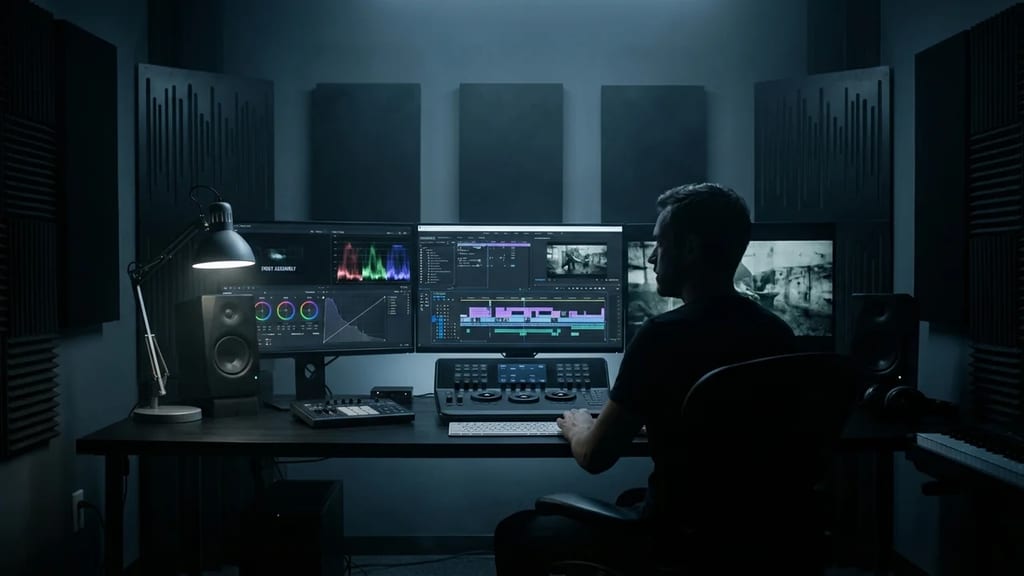
Murnau AI illustration
assembly flow roll

First Assembly: initial editor's cut, typically 180–300% of intended runtime, with minimal refinement, used to evaluate narrative structure and pacing before detailed editing.

Technical Details

A first assembly typically has a runtime of 180-300% of the planned final version – for a 90-minute feature film, 3-4 hours are typical. Edits are made without fine-tuning edit points, so shots often remain 2-5 seconds longer than in the final version. Modern digital editing systems like Avid Media Composer or Adobe Premiere automatically mark first assembly sequences with special bin markers and metadata for version control.

History & Development

The concept developed in 1927 with the introduction of the Moviola editing table at Universal Studios, which enabled systematic workflows in the editing room for the first time. Hal Ashby coined the modern first assembly workflow in 1965 with "The Cincinnati Kid" by cataloging and versioning all takes digitally for the first time. Since 1995, the process has been entirely digital, reducing the creation time from 6-8 weeks to 2-3 weeks.

Practical Use in Film

Christopher Nolan's first assembly of "Dunkirk" (2017) lasted 4.5 hours with a final version of 106 minutes. Martin Scorsese traditionally works with three parallel first assemblies from different editors, which are then compared. The first assembly serves as a basis for discussion for producers and financiers, as the narrative structure becomes fully visible for the first time. Test screenings are based exclusively on revised versions, never on the pure first assembly.

Comparison & Alternatives

The first assembly differs from the rough cut by the absence of any rhythmic work and fine cuts. Unlike the director's cut, it does not yet contain creative decisions regarding timing and drama. String-outs, on the other hand, only show individual scenes without context. Modern preview assemblies already integrate temp music and basic sound mixing, while the classic first assembly remains completely silent or only uses original sound.
From the crafts

Perspectives

Cinematographer

Beim First Assembly erkenne ich erstmals, ob meine Bildgestaltung die gewünschte narrative Wirkung erzielt – besonders bei Kamerabewegungen und Achsenverhältnissen zwischen verschiedenen Einstellungsgrößen. Die noch ungefeinten Schnitte zeigen schonungslos auf, wo ich zu wenig Coverage gedreht habe oder wo bestimmte Einstellungen visuell nicht funktionieren.

Director

Der First Assembly ist mein erster Realitätscheck – hier sehe ich ungefiltert, ob die Geschichte funktioniert oder wo dramaturgische Löcher klaffen. Oft erkenne ich erst jetzt, dass bestimmte Szenen überflüssig sind oder dass mir entscheidende Übergangsmomente fehlen, die ich in Reshoots nachdrehen muss.

Producer

Mit dem First Assembly kann ich erstmals konkrete Laufzeiten kalkulieren und dem Verleih realistische Zahlen liefern. Diese Phase kostet typischerweise 15.000-25.000 Euro bei einem Mittelbudgetfilm, aber hier entscheidet sich, ob teure Reshoots oder zusätzliche VFX-Arbeit nötig werden – Kostenfaktoren von potenziell 200.000-500.000 Euro.

More in the lexikon

Related terms

Test your knowledge

Quiz

1. Zu welchem Department gehört „Erster Zusammenschnitt"?

2. Wie viele verschiedene Fachperspektiven bietet dieser Eintrag?

Report an error
From the Filmfarm ecosystem

Understand visual language, budget productions, connect crew.

The Lexikon is part of the Filmfarm ecosystem — alongside budgeting (FilmBalance), an industry magazine (FilmCircus) and crew networking (FilmCall, CrewMesh). One shared vocabulary for the whole production.

FilmFarm FilmRadarComing soonFilmPulseComing soonFilmNumbersComing soonFilmCapitalComing soonFilmLabComing soonFilmBalanceComing soonFilmCircusComing soon