Technical Details
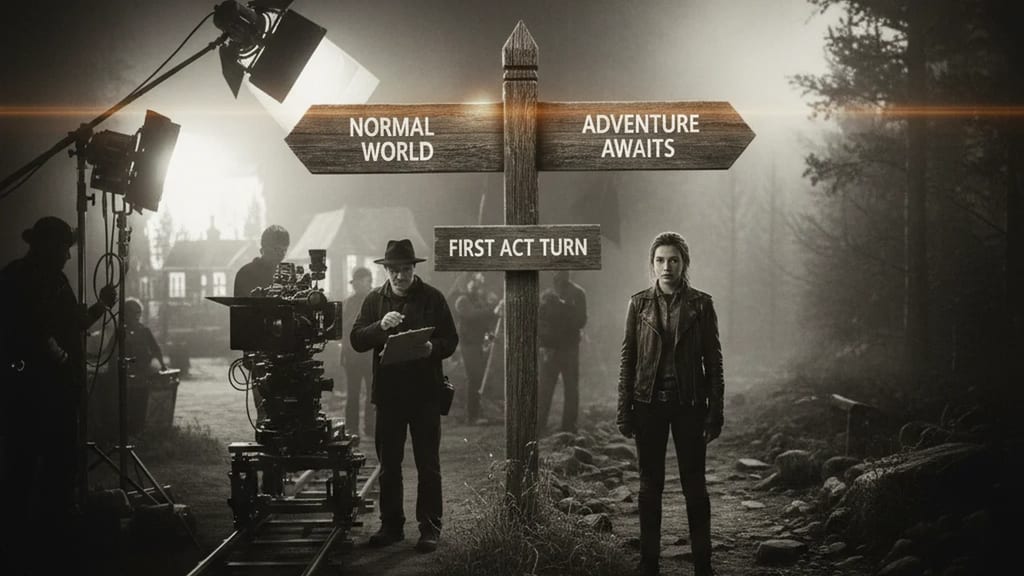
In the classic three-act structure, the First Act Turn is precisely positioned at the end of the first act, which comprises 20-25% of the total runtime. For a 120-minute film, this falls between pages 17-30 of the screenplay (based on the rule of thumb: one page equals one minute of screen time). The turn manifests as a "Point of No Return" – a dramatic moment containing at least one of the following components: loss of the protagonist's previous life situation, confrontation with the antagonist, or discovery of new information that fundamentally shakes the protagonist's worldview.
History & Development
Syd Field codified the concept in 1979 in "Screenplay: The Foundations of Screenwriting," thereby precisely defining timing parameters for Hollywood screenplays for the first time. Robert McKee refined the psychological aspects of the turn in 1997 in "Story," while Christopher Vogler established the mythological dimension as the "Call to Adventure" in 1992 through "The Writer's Journey." Blake Snyder, in 2005's "Save the Cat!," specified the timing to exactly minute 25 in a 110-minute film, leading to the now-dominant "Beat Sheet" methodology.
Practical Application in Film
In "Jaws" (1975), the First Act Turn occurs at minute 23 when Mayor Vaughn forces Brody to keep the beaches open despite the shark threat. "Star Wars" (1977) positions it at minute 27 with the murder of Luke's aunt and uncle by Imperial stormtroopers. "Die Hard" (1988) sets the turn precisely at minute 22 when Hans Gruber takes over Nakatomi Plaza, forcing McClane into confrontation. Auteur filmmakers like the Coen Brothers consciously shift these timing conventions: "No Country for Old Men" (2007) places multiple micro-turns between minutes 15-35.
Comparison & Alternatives
The First Act Turn differs from the "Inciting Incident" (minutes 10-17) due to its irreversibility and from the "Midpoint" (minutes 55-65) due to its expository function. European narrative traditions often favor the five-act structure with correspondingly shifted turns at minutes 20 and 40. Serial formats adapt the concept for 45-60 minute episodes with turns at minutes 8-12. Modern streaming productions experiment with more compressed structures: Netflix algorithms favor turns as early as minutes 5-8 to maximize viewer retention.