Definition
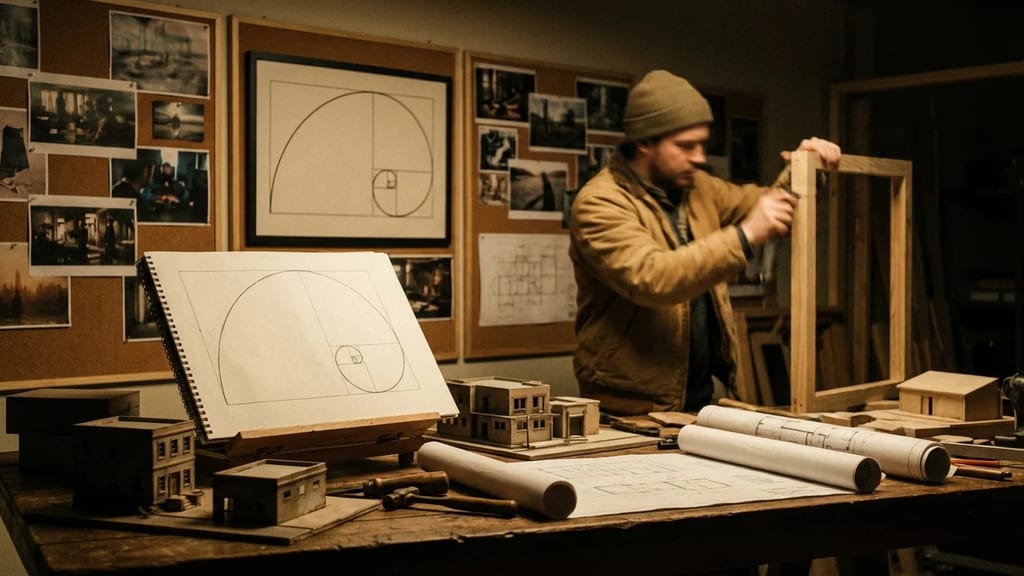
The Fibonacci spiral is a geometric composition method based on the mathematical Fibonacci sequence (1, 1, 2, 3, 5, 8, 13, 21...) and visually implements the Golden Ratio of 1:1.618. The spiral is created by arranging squares according to Fibonacci numbers and drawing quarter circles within each square. Named after the Italian mathematician Leonardo Fibonacci (1170-1240), it is frequently found in natural structures such as snail shells or sunflowers.
Technical Details
The spiral construction begins with a 1x1 square, followed by another 1x1 square, then 2x2, 3x3, 5x5, 8x8, and so on. The radius of curvature corresponds to the respective Fibonacci number. In the 2.35:1 film format (Cinemascope), the spiral divides the image into two complementary areas with a ratio of 8:13; in 16:9, the division occurs at approximately 5:8. Modern camera monitoring software like SmallHD's 702 Touch or Atomos Sumo offer Fibonacci overlays as composition aids. The spiral can be applied clockwise or counterclockwise, depending on the desired visual flow.
History & Development
The first documented use of the Fibonacci spiral in film occurred in 1968 by cinematographer Sven Nykvist in Ingmar Bergman's "Hour of the Wolf." Stanley Kubrick systematically utilized mathematical composition methods from the 1970s onwards, particularly evident in "Barry Lyndon" (1975). Digital post-production enabled more precise implementation of spiral composition from the 1990s. Software like DaVinci Resolve integrated Fibonacci guides as a standard feature in 2012. Today, filmmakers such as Denis Villeneuve and Christopher Nolan routinely employ this technique for visually complex sequences.
Practical Application in Film
Denis Villeneuve's "Arrival" (2016) structures the alien ship shots according to Fibonacci principles, with Louise Banks consistently positioned at the spiral's center. Christopher Nolan's "Interstellar" (2014) uses the spiral for the wormhole sequences to suggest natural curvature. Terrence Malick's "The Tree of Life" (2011) organizes 70% of its nature shots using Fibonacci composition. The method is particularly suitable for establishing shots, landscape photography, and emotional close-ups, less so for fast-paced action sequences or multi-person dialogues.
Comparison & Alternatives
The Rule of Thirds divides the frame into equal 3x3 segments, whereas the Fibonacci spiral creates more dynamic, asymmetrical proportions. The Golden Ratio line works with 1:1.618 ratios without a spiral form. Modern eye-tracking based composition statistically analyzes viewer gaze behavior rather than mathematically. Fibonacci is suitable for contemplative, artistic films, while the Rule of Thirds is preferred for commercial productions with a fast editing rhythm. For handheld shots or documentary approaches, precise mathematical composition is often impractical.