Overview
Facial Capture (also Face Capture) refers to the recording of an actor's facial expressions and their transfer to a digital character. Subtle movements such as blinks, lip movements, eyebrow raises, and cheek tension are captured. Facial Capture is a sub-discipline of Performance Capture; if facial capture is combined with body motion capture, it is referred to as full Performance Capture.
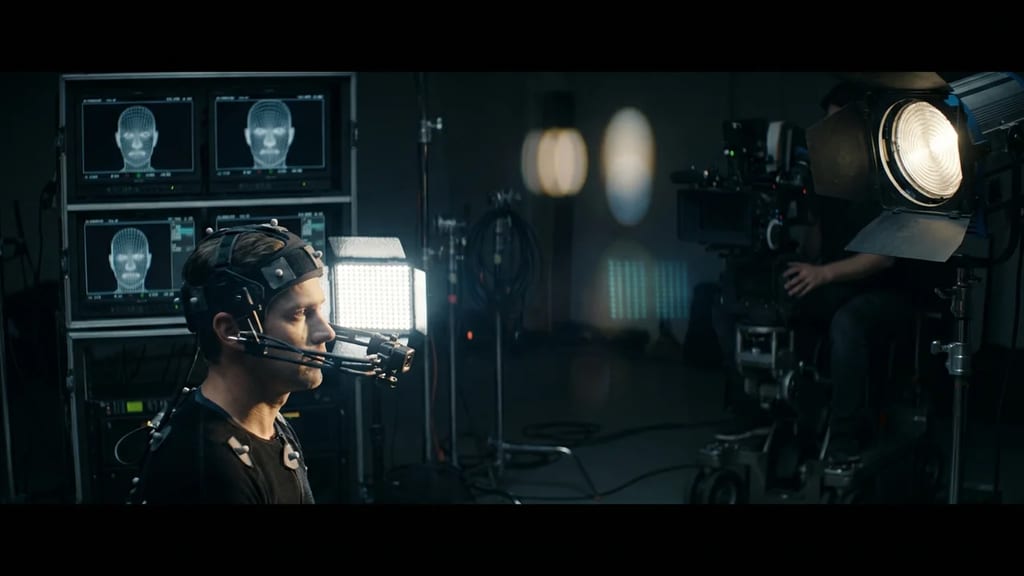
Unlike pure body motion capture, which relies on optical marker systems in space, facial capture today is mostly done via a camera attached to the performer's head. This allows the actor to move freely while their face is continuously recorded. The recordings are then transferred to the digital character's facial rig in a step called "solving" (retargeting).
Methods
In practice, two fundamental approaches are distinguished:
| Method | Principle | Characteristics |
|---|
| Marker-based | Painted or adhered dots/markers on the face are tracked by cameras. | High resolution of individual tracking points; disruptive for the performer; can force more exaggerated acting. |
| Markerless | Natural facial features (nostrils, lip corners, eyes, wrinkles) are tracked via image analysis without markers. | Less restrictive for the performer; computationally intensive; benefits greatly from high resolution and frame rate. |
Head-Mounted Cameras (HMC) played a central role in the proliferation of markerless methods: first widely used in the pre-production of James Cameron's "Avatar" (2009).
Head-Mounted Camera (HMC)
The HMC is a helmet- or rig-like device whose arm holds one or more cameras pointed at the face. Depending on the model, this typically involves between one and four cameras; the design and manufacturer vary greatly. Because the camera moves with the head, it provides a constant, frame-filling image of the face – regardless of where the performer moves within the capture volume.
On-Set Usage
Facial Capture is used when an actor's facial expressions are intended to drive a fully or partially digital character – for example, for photorealistic CG characters, creatures, or avatars in feature films, series, and video games. The performer wears the HMC (often in addition to a motion capture suit for the body), performs the scene, and the facial data is subsequently transferred to the digital face in the VFX pipeline. Machine learning is increasingly used to automate the solve from real facial expressions to the character rig.