Filmlexikon.
Support
Edge Lighting
Lighting · Terms

Edge Lighting

Murnau AI illustration
color temperature flow roll take

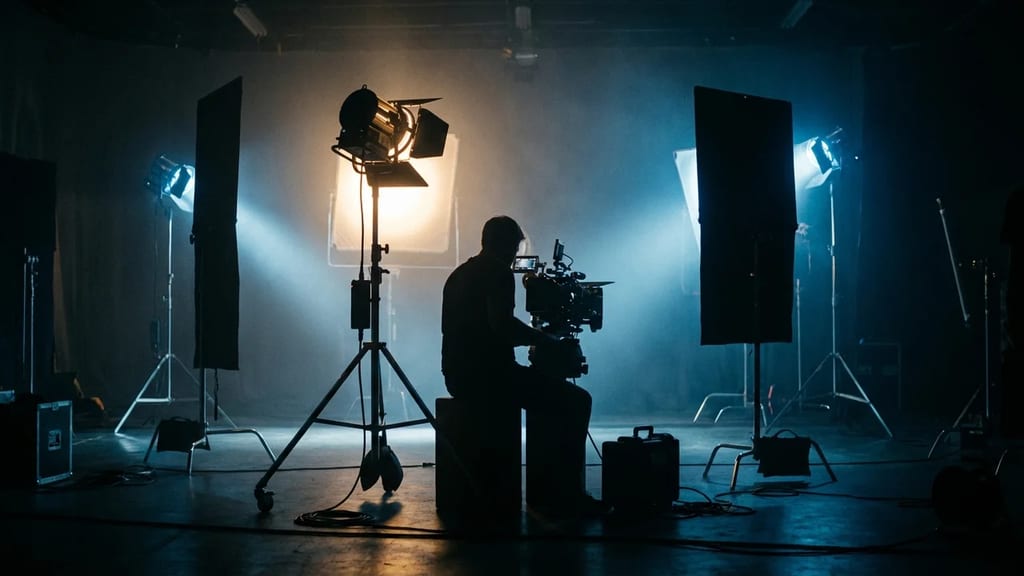
Backlighting or sidelighting technique that separates subjects from the background by illuminating their edges, creating spatial depth and visual separation.

Technical Details

Edge lighting is typically achieved using Fresnel lights from 650W to 2000W or LED panels with 200-400W output. The standard color temperature is 5600K (daylight) or 3200K (tungsten), with modern LED systems offering stepless adjustments between 2700K-6500K. Barn doors, snoots, or honeycomb grids limit light spread to a 10-40° beam angle. For human subjects, the light is positioned 1-2 meters behind the subject at a height of 2-3 meters. Special variants include "hair light" (directed specifically at the hair) and "shoulder light" (emphasizing the shoulder area).

History & Development

Cecil B. DeMille and cinematographer Alvin Wyckoff developed early edge lighting techniques in 1915 for "The Cheat" to separate the protagonist Fannie Ward from the background. In the 1940s, Gregg Toland perfected the technique for "Citizen Kane" (1941) using 10kW carbon arc lamps. Hollywood studios in the 1950s established the three-point lighting system with mandatory edge lighting. Modern LED technology since 2010 enables remote-controlled edge lighting setups with DMX protocol and real-time adjustment of lighting parameters.

Practical Use in Film

Roger Deakins systematically used edge lighting in "Blade Runner 2049" (2017) for character isolation in dark industrial settings. Emmanuel Lubezki employed natural edge lighting from a low sun in "The Revenant" (2015), enhanced by 4x4 meter reflectors. The workflow requires precise light measurement with a spot meter and continuous monitoring via monitor scopes. Edge lighting reduces post-production work for green screen shots by 20-30% by creating clean subject edges. The technique becomes problematic with rapid camera movements or windy outdoor shoots.

Comparison & Alternatives

Edge lighting differs from background lighting by directly illuminating the subject rather than the set. Unlike fill light, it increases contrast instead of reducing it. Modern alternatives include programmable LED tubes like Astera Titan or Quasar Q-LED, which enable remote-controlled edge lighting simulation. For low-budget productions, 200W LED panels with diffusion gels replace costly Fresnel setups. Digital Intermediate (DI) can create edge lighting simulation in post-production but does not achieve the natural plasticity of real lighting.

From the crafts

Perspectives

Cinematographer

Ich setze Kantenlicht gezielt ein, wenn die Motivtrennung vom Hintergrund kritisch wird – besonders bei dunklen Kostümen vor dunklen Kulissen benötige ich mindestens eine Blendenstufe Überbelichtung am Rand. LED-Panels mit Barn Doors geben mir die Flexibilität, auch bei engen Drehorten präzise Lichtkanten zu setzen, ohne dass Überstrahlungen ins Objektiv fallen.

Director

Kantenlicht ist mein Werkzeug für emotionale Gewichtung – wenn Charaktere in entscheidenden Momenten vom Hintergrund "freigestellt" werden sollen, verstärkt die leuchtende Kontur ihre narrative Präsenz im Bild. Bei Thriller-Szenen nutze ich bewusst einseitiges Kantenlicht, um Figuren zwischen Licht und Schatten zu positionieren und innere Konflikte visuell zu unterstreichen.

Producer

Kantenlicht-Setups verlängern die Einrichtungszeit pro Einstellung um 15-20 Minuten, rechtfertigen sich aber durch reduzierte VFX-Kosten bei Green-Screen-Arbeiten. Ich kalkuliere für Kantenlicht-Heavy-Szenen zusätzliche Gaffer-Stunden und mobile LED-Systeme, die schneller repositionierbar sind als klassische Tungsten-Scheinwerfer – das spart letztendlich Drehtage.

More in the lexikon

Related terms

Test your knowledge

Quiz

1. Zu welchem Department gehört „Kantenlicht"?

2. Wie viele verschiedene Fachperspektiven bietet dieser Eintrag?

Report an error
From the Filmfarm ecosystem

Understand visual language, budget productions, connect crew.

The Lexikon is part of the Filmfarm ecosystem — alongside budgeting (FilmBalance), an industry magazine (FilmCircus) and crew networking (FilmCall, CrewMesh). One shared vocabulary for the whole production.

FilmFarm FilmRadarComing soonFilmPulseComing soonFilmNumbersComing soonFilmCapitalComing soonFilmLabComing soonFilmBalanceComing soonFilmCircusComing soon