Technical Details
Cinematographic Duvetyne typically has a basis weight of 300-500 g/m² and is made of 100% cotton with a brushed finish on both sides. Black Duvetyne achieves reflection values below 5%, while grey Duvetyne is around 8-12%. Standard dimensions are 3x3m, 6x6m, and 12x12m sheets, as well as fabric by the meter in 150cm or 300cm widths. Special variants include flame-retardant treated Duvetyne (B1 certification), self-adhesive versions for permanent installation, and white Duvetyne as a diffuse reflector. The material thickness is usually 1.2-1.8mm.
History & Development
The use of Duvetyne in film production began around 1925 at Paramount Studios when cinematographer Karl Struss used the material to control spill light in portrait shots. In the 1930s, Matthews Studio Equipment developed the first standardized Duvetyne sheets with grommets for attachment to C-stands. The introduction of flame-retardant treatments occurred in 1952 following several studio fires. Modern Duvetyne systems have integrated hook-and-loop fasteners and modular mounting systems since the 1990s for faster setup and breakdown.
Practical Use in Film
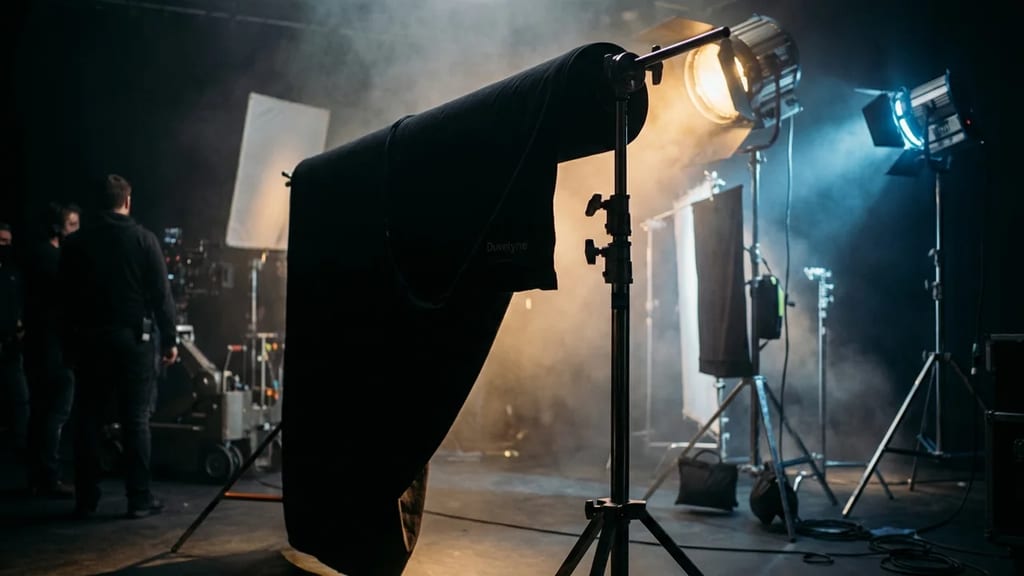
Duvetyne serves as a flag for targeted shading of image areas, as a cutter for hard light limitation, and as a backdrop for eliminating background reflections. In "Blade Runner 2049," cinematographer Roger Deakins used large-scale Duvetyne installations to control LED wall lighting. In greenscreen productions, black Duvetyne prevents color fringing from diffuse green reflections. The fabric can be mounted onto grip equipment in seconds and allows for precise light shaping without electrical dimmers. Disadvantages: weight for large formats and limited washability.
Comparison & Alternatives
Compared to rigid flags, Duvetyne offers flexibility and weight advantages but does not achieve their precise shadow edges. Modern LED panels with built-in barndoors partially replace traditional Duvetyne setups but cost many times more. Diffusion paper (diffusion) and ND filters (neutral density) reduce light intensity, while Duvetyne primarily shapes and shades. Duvetyne, its American counterpart, exhibits identical optical properties with slightly different weaving techniques. For budget productions, wool blankets are used, which, however, only achieve 70-80% light absorption.