Definition & Origin
Dogme 95 was an artistic manifesto and film revolution founded in 1995 by Danish filmmakers Lars von Trier and Thomas Vinterberg. The paradox of Dogme 95 was that maximum restriction created maximum artistic freedom. By establishing rules that banned artificial lighting, music, makeup, and special effects, the Dogmatists forced filmmakers to concentrate on what is real – acting, dialogue, genuine locations, real people. This was a reaction against the overproduced, artificial cinema of the 1990s – European art films and Hollywood blockbusters.
The Dogme manifesto was formulated like a radical political document, with "Vows of Chastity" that filmmakers could sign. Films that followed all Dogme rules received the Dogme certificate.
The Dogme Rules (Vows of Chastity)
The ten Dogme rules were radical and rigorous:
- Only natural lighting – Artificial light is forbidden. Films must be shot with natural light from windows, street lamps, etc.
- Sound must be synchronized to the image – No separate soundtracks, no music, no sound effects that are not diegetic.
- The camera must be handheld – Tripods, zoom, dolly, and other technical effects are forbidden. The camera must document reality, not control it.
- Color is permitted, but no filters – The film must show natural colors. No color grading, no artificial color manipulation.
- No aspect ratio changes – The image format must remain constant. No wide-screen effects.
- Special effects are forbidden – No CGI, no optical effects, no trick photography.
- The story may not take place more than 30 years in the past or future – Stories must be contemporary, not historical.
- The story must take place in the real world – No invented worlds, no science fiction or fantasy. Reality is the setting.
- Images must be in Academy format (1.37:1) – Later modified to standard format.
- The director must not be credited – Films were signed with the Dogme certificate, not as individual creations.
Visual Characteristics & Stylistic Techniques
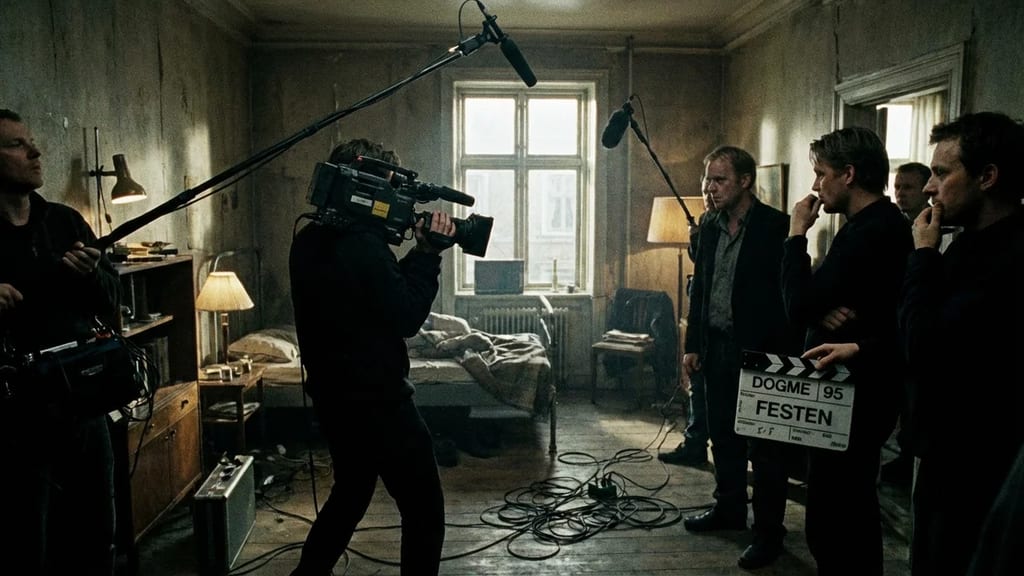
Handheld Camera: The handheld aesthetic creates proximity and authenticity. The camera follows characters documentarily, not controlling them.
Natural Light: Without artificial lighting, images are often dark, grainy, and unbalanced. This creates documentary truth rather than cinematic illusion.
Digital Video: Dogme films often used DV cameras instead of 35mm film. The graininess and lower resolution of early digital video was a visual statement against overproduced, polished cinema.
Acting Focus: Without technical effects, acting is central. Emotions must be genuine – no visual tricks to manipulate feeling.
Diegetic Sound: All sounds must come from the action. No score, no music except music being played in the scene. This creates a realistic audio universe.
Spatial Authenticity: Locations are often real and unglamorous – real houses, real streets, real interiors.
Historical Context
Dogme 95 emerged in the mid-1990s as a reaction against several phenomena:
- Overproduction: Hollywood blockbusters became increasingly expensive, larger, and artificial. Simultaneously, European art films became increasingly mannered and self-indulgent.
- Digital Revolution: The DV camera became available, affordable, and usable in the mid-1990s. This enabled new filmmaking with minimal resources.
- Postmodern Exhaustion: After decades of citation techniques and self-referentiality, many artists felt exhausted by postmodernism. Dogme was a return to artistic truth and authenticity.
- Danish Cinema: Denmark had a strong film culture with schools like the Det Danske Filmskole that promoted experimental approaches.
Key Figures & Filmmakers
Lars von Trier (1956-) – Co-founder of Dogme 95 and director of "Breaking the Waves" (1996) and "Dancer in the Dark" (2000). His films combine Dogme rules with narrative and visual innovation – despite restrictions, emotionally and technically subtle works emerged.
Thomas Vinterberg (1969-) – Co-founder of Dogme 95 and director of "Festen" (The Celebration, 1998), a neorealist family drama. Vinterberg's films demonstrate that authenticity and emotionality are intensified through Dogme restrictions.
Søren Kragh-Jacobsen (1947-) – An early Dogme filmmaker whose "Mifune" (1999) demonstrated that love stories also work under Dogme conditions.
Kristian Levring (1957-) – An experimental Dogme filmmaker whose work later ironically questioned his initial conviction.
Key Films & Masterworks
Festen/The Celebration (1998, Thomas Vinterberg) – A Dogme-certified film about a family gathering where a son reveals his father's incestuous abuse. Shot handheld, with natural light (often dark, grainy), without score. The authenticity is overwhelming – without visual manipulation, the acting must carry genuine emotional weight.
Breaking the Waves (1996, Lars von Trier) – A film about a religious woman in Scotland who engages in a "suffering sacrifice" for her disabled husband. The film is not technically Dogme (von Trier had not yet founded Dogme) but would be immediately Dogme-inspired afterward. The handheld camera, natural lighting, and emotional authenticity define von Trier's application of Dogme principles.
Dancer in the Dark (2000, Lars von Trier) – A film about a blind woman in America who wants to protect her family. The film combines documentary neorealism (for non-dance sequences) with elaborate musical numbers, deconstructing the Dogme principle. Von Trier used Dogme restrictions to achieve greater emotional effectiveness.
Idioterne/Idiots (1998, Lars von Trier) – A film about a group of young people who act "retarded" as a form of existential liberation. Shot in Dogme style with handheld camera and natural light. The controversy over the depiction of disability reflects Dogme's unvarnished authenticity.
Mifune (1999, Søren Kragh-Jacobsen) – A Dogme-certified film about a man and woman who meet in Denmark. A simple, intimate drama, shot with handheld camera and natural light. The simplicity is striking.
Technical Aspects & Cinematic Innovation
The Dogme rules deliberately aimed at minimalism:
- DV cameras instead of 35mm, allowing minimal equipment
- Natural lighting enforced, requiring long shooting times (especially in Danish winters)
- Handheld operation required physical endurance from cinematographers
- Single-system sound (sound on camera), no separate sound recording
- Minimal crew – Dogme films were shot with small teams, which intensified creativity
Influence & Legacy
Dogme 95 had paradoxical effects:
- Authenticity Movement: Dogme inspired a global movement toward more authentic cinema without technical artifice. Filmmakers worldwide adopted Dogme principles.
- Digital Cinema Legitimation: Dogme 95 legitimized digital video as an artistic medium. This was important for the transition to digital cinematography.
- Minimalism in Hollywood: Even Hollywood directors like Michael Haneke use Dogme-inspired techniques – handheld camera, minimal music, natural lighting.
- Critique of Artificiality: Dogme 95 radically questioned what "film art" means. This opened discourse about authenticity versus artificiality.
Comparison & Contextualization
vs. New Hollywood: While New Hollywood combined artistic ambition with visual innovation, Dogme 95 took the opposite position – artistic ambition through renunciation of visual innovation.
vs. Nouvelle Vague: Both are artistic rebellions against established systems, but the Nouvelle Vague sought formal freedom, while Dogme sought formal restriction.
vs. Italian Neorealism: Both share emphasis on authenticity and real locations, but Neorealism was politically motivated while Dogme was aesthetic and philosophical.
Controversy & Criticism
Dogme 95 was not without controversy:
- Artificial Authenticity: Critics argued that Dogme rules themselves create artificiality – the restrictions are artificial and may prevent rather than promote authenticity.
- Practical Problems: The rules were difficult to follow. Many "Dogme-certified" films broke rules (von Trier later admitted breaking Dogme rules).
- Elitism: The Dogme movement was criticized as elitist – only filmmakers with resources could undertake Dogme productions.
End of the Movement & Legacy
Dogme 95 as a formal movement ended in the early 2000s. Many initial filmmakers who committed to Dogme did not maintain the rules for long. But the philosophy and principles remain influential.
Contemporary films following Dogme principles continue to emerge – films with handheld camera, minimal music, natural lighting. Dogme 95 remains an important reference for filmmakers seeking authenticity and artistic truthfulness.